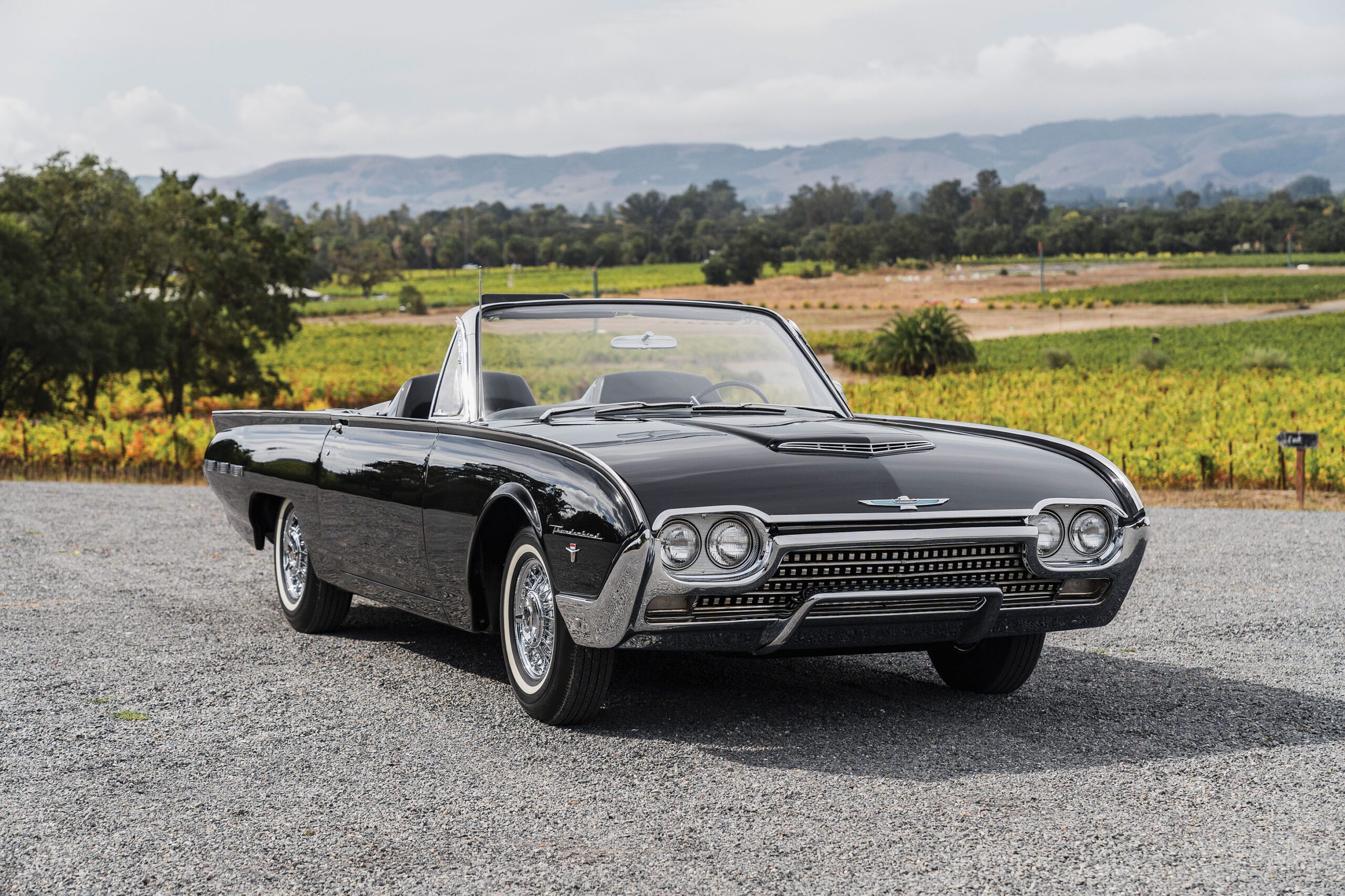
This car, Lot 133, sold for $48,160, including buyer’s premium, at Broad Arrow Auctions’ Las Vegas, NV, sale, on October 31, 2025.
At the start of the 1960s, Ford was beginning to reorient itself to the demands of the domestic performance-car market — this, while the Automotive Manufacturers Association’s 1957 ban on direct motorsports participation was still in effect. While the Thunderbird had transitioned from sporty car to personal luxury car, the 1961–63 “Bullet Bird” (or “Rocket Bird” in some circles) played into this hand. That pointed prow had a look of speed, further enhanced with the introduction of the Sports Roadster package in 1962. While the styling was more eye candy than substance, real performance was available under the hood.
Fast from the factory
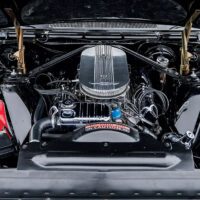
While several Fords and Mercurys could be sold in the late-1950s through mid-’60s with triple 2-barrel carburetors, they were only installed at the factory on M-code Thunderbirds. And not just the Sports Roadsters — they were optional on any 1962–63 ’Bird. All other FoMoCo “tri-power” setups were either shipped in the car’s trunk (the standard 4-barrel induction was left in place), or sold over the parts counter at a dealership. Other M-code differences from a regular 300-hp 390-ci V8 included the better-flowing, higher-compression 406-ci-style cylinder heads and the heavy-duty oil pump from the 390 Police Interceptor engine.
Interestingly, the M-code package was exclusive to the T-bird, although full-size Fords and Mercurys had two flavors of 406-ci V8 in 1962 through mid-’63 (even if the top-shelf 405-hp tune had its three deuces packed in the trunk). The final year for triple 2-barrels for any domestic Ford product was 1963, which was also the end of any multi-carbureted option for the T-bird. Engineers found that the new 1963 427-ci FE-block engines offered more performance with less hassle.
Premium pricing
Originally considered an option package, the initial 558 Sports Roadsters built for 1962 had regular T-bird convertible body-type and -style codes of 85 (the second and third digits in the VIN) and a body-style code of 76A on the trim tag — including on the one Elvis Presley bought new. By December 11, 1961, Ford gave the Sports Roadster the body-type code 89 for the serial number and a 76B body-style code. That there are more Sports Roadsters today than there were when new is more fact than joke. Especially for anyone considering a pre-December 1961-built example, consulting someone knowledgeable in these cars for a pre-purchase inspection is highly recommended.
MSRP for a base Sports Roadster was $5,439 — Cadillac convertible money on a car that may have looked good but lacked optional air conditioning, power windows or even the Magic-Aire heater/defroster. Some $372.20 of the Sports Roadster package’s $651 cost was designated for the included Kelsey-Hayes wire wheels, which were available at that price as a stand-alone option on any T-bird. In 1962, wire wheels wouldn’t yet seal tubeless tires adequately, so they were factory fitted with tubes and “ventilated” tires to prevent overheating. Even with tubes, the wheels developed an immediate reputation of being slow leakers (also an issue on 1962–64 Chevy Corvairs with knockoff wire wheels).
Ford built 1,427 Sports Roadsters for 1962, but only 455 in 1963 (including 37 M-codes). Looking at the numbers, it was little wonder that Ford quietly discontinued production shortly before the end of the 1963 model year. It was becoming a sales flop, mostly due to the high cost of entry. Like the final 2002–05 “Retrobird” T-birds, the bloom fell off the rose shortly after the initial hype went away.
The bird has flown
During the pandemic market bubble, both 1961–63 convertibles and Sports Roadsters saw higher sale prices, with the latter significantly outpacing the former. The apex was reached when I witnessed the sale of a ’63 M-code Sports Roadster, in the always-hard-to-shift Rangoon Red over red interior combo, at Mecum’s 2023 Monterey auction for $151k (SCM# 6959943). In the years since, values have plummeted, dropping even further than the overall collector car market.
Our subject car was offered on Bring a Trailer in September 2023, with a $45,253 high bid that didn’t meet the reserve. Here in Las Vegas, it was consigned without reserve, hence guaranteed to sell. A relatively austere example with only two stand-alone options aside from the M-code engine, it lacks A/C or power windows. Both are highly desirable on a Sports Roadster. It is also a more-common 1962 model-year car, but we can still see the air escaping the market bubble even faster than an original Kelsey-Hayes wire wheel.
With the $48k sales price in Vegas offset by consignment and transportation expenses, that offer on BaT might not look all that bad in retrospect — essentially a draw. Granted, back then, one could assume there was possibly more money on the table. For someone looking at flipping this car, potential gains will be minimal. But if the buyer always wanted a Sports Roadster and isn’t fixated on future values, this example represents a decent buy even just for a basic Sports Roadster. Its M-code spec is just the cherry on top of the 390-ci block.