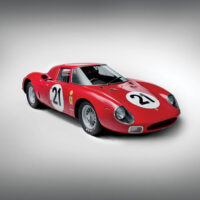
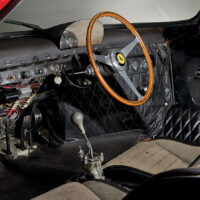
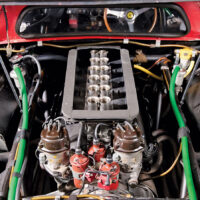
This car, Lot 262, sold for $36,351,936 (€34,880,000), including buyer’s premium, at RM Sotheby’s Paris, FRA, auction, on February 5, 2025.
Walking to my university classes in Terre Haute, IN, I passed a deteriorating downtown storefront that had once hosted a thriving theater. Peeking through the dirty windows was a ragtag collection of antique and vintage automobiles. Aptly named The Early Wheels Museum, the collection belonged to Tony Hulman, owner of the Indianapolis Motor Speedway. Among the cars, several USAC race cars caught my attention, but it was a red Ferrari 250 LM that would draw me back again and again. At the time, I would never have imagined I would encounter this car one again, several decades on.
Years later, I recognized the car during a visit to the IMS Museum and learned it was the 1965 Le Mans winner, chassis 5893. Then in 2023, the museum displayed in at The Amelia concours. I was a judge there, teamed with Luigi Chinetti Jr., and I pointed out the LM to him. I proudly recited my Terre Haute story, which Luigi topped with his reply, “I drove it to a 7th-place finish at the 24 Hours of Daytona.”
Rarer than a GTO
RM Sotheby’s presents a compelling story of 5893’s importance using the history of Luigi Chinetti Sr., NART, the 250 LM’s racing career and the car’s provenance. The 250 LM did not have as broad of an influence on Ferrari’s history as the 250 GTO, but looking at the high points, the LM is a formidable contender for GOAT.
Just 32 examples of the 250 LM were built compared to 36 250 GTOs. The 250 LM featured several firsts for a supposed GT Ferrari, such as a mid-mounted engine, rear-mounted transmission and inboard disc brakes. Despite being called a 250, only the first example was powered by the famed 3-liter V12. Subsequent examples featured a 3.3-liter 275 engine. Borrowing a phrase from fellow SCM scribe Thor Thorson, the 250 LM is a weapons-grade race car: lighter, faster and more exotic than a GTO.
Chassis 5893’s 1965 Le Mans victory is especially impressive when you review the competition. Ferraris at the race consisted of a 275 P2, 330 P2, 365 P2, four other 250 LMs and another four Ferraris. Ford was represented by five Cobra Daytona coupes and six GT40s. Porsche was represented by several 904s. The victory of 1965 would be the last time a Ferrari would win at Le Mans for 58 years.
Road vs. race
Looking through a list of the most valuable automobiles to sell at auction, 40 of the top 50 are race cars, including all of the top nine. The few road cars that populate the list are one-offs and small production sports cars. It may seem counterintuitive that race cars dominate the list, as their usefulness as race cars is long gone. The attributes that make a race car valuable actually have little to do with driving.
Race cars are singular — as in, no two are alike. They are rare, often built in quantities of fewer than 10. All valuable race cars look good, but they are also historical treasures. It is the history that makes them valuable. Make and model are primary to a race car’s value, but a car’s unique history determines the sale price. Where they raced and how they finished sets the stage for the model’s importance, while individual cars are judged on more subjective attributes. Holding the same steering wheel Stirling Moss held can be more important to buyers than whether the car was wrecked during a race.
Originality is important to collectors, but not as much to racers. Replaced engines, transmissions and other components are commonplace in the heat of racing. Repaints and color changes never got a second thought, so please don’t ask.
Most owners of vintage race cars will never drive a mile in anger, but eligibility also factors into value. Getting into the Mille Miglia, Monaco Historic Grand Prix or the Rolex Monterey Motorsports Reunion matters. The right car gets you into top concours events such as Pebble Beach, Villa d’Este and Hampton Court. An invitation to participate in the prestigious 250 GTO only tour is sometimes credited with adding millions to the value of that model.
Victory for the buyer
Chassis 5893 lives in rarefied air. Only 13 Ferraris can lay claim to the ultimate Ferrari victory: a Le Mans win. Masten Gregory and Jochen Rindt are well-known drivers who add to 5893’s prestige. Despite two accidents, the car is in fine condition and retains its original major components. The pre-sale estimate was “in excess of” roughly $26m, about $10m shy of the sale price, a world auction record for the model. Additionally, according to RM Sotheby’s, it became the sixth-most-expensive car to sell at auction and the fourth-most-expensive Ferrari, behind three 250 GTOs.
The dusty red Ferrari that I first saw in Terre Haute sparked a fire that has burned in me for decades. It is a special moment to be able to write about it. I am afraid the current vintage-Ferrari market is tepid at best. This sale is one of the few bright spots of the past few years, but it won’t spark a run. The buyer of 5893 was the winner on this one, but only because they got a special car.