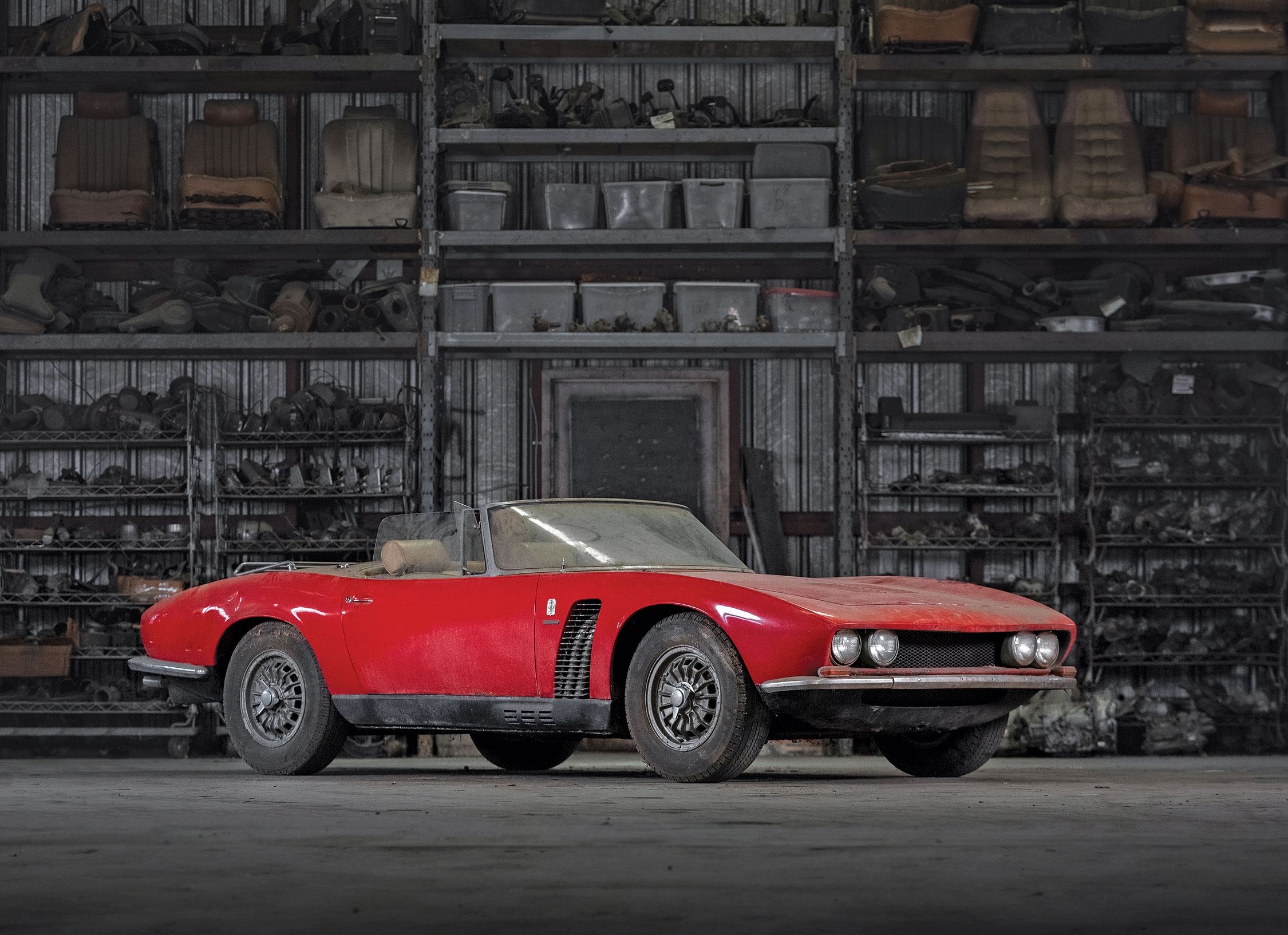
This car, Lot 283, sold for $1,875,000, including buyer’s premium, at RM Sotheby’s Los Angeles, CA, auction, on October 26, 2024.
Iso is often forgotten in the pantheon of great Italian automakers even though it was the creator of the Isetta, the quirky microcar famously licensed by BMW. Iso was also a major producer of motorcycles in Italy, but the family-owned automaker is best known for its Rivolta 2+2 coupe (named for Iso’s owners, the Rivolta family) and for the Grifo fastback coupe. Just to put the jokes about an Italian sports car named “Grief” to bed, grifo is actually Italian for “gryphon,” the legendary eagle/lion hybrid animal.
A true thoroughbred
Both the Rivolta and the Grifo have impressive pedigrees. They were designed by Giorgetto Giugiaro at Bertone and engineered by Giotto Bizzarrini shortly after he left Ferrari. Indeed, Bizzarrini stated that the racing version of the Grifo was a successor to his masterwork, the Ferrari 250 GTO. “I started with the idea of Ferrari’s 250 GTO,” he said, “and wanted to improve on it.”
As with the racing Grifo, Iso used a Chevrolet 327-ci V8, as used in contemporary Corvettes, paired with either 4-speed manual transmissions or ZF 5-speeds. These powertrains were used in both the Rivolta and Grifo models, and unusually for the era, this meant that Iso could offer cars with an automatic transmission although they built only a handful.
The Rivolta debuted in 1962, with the Grifo coming a couple of years later. Iso intended to produce just 50 examples, and two prototypes were produced in 1963–64 as the A3/L (L for Lusso, or Luxury). This was to distinguish the road cars from the A3/C (C for Corse), the racing version that Bizzarrini really wanted to build. The two prototypes included a coupe that went into production and a convertible that did not.
Hard-knock life
That’s where the story of this car begins. Our subject car is the one-of-one convertible Iso Grifo A3/L Spider prototype. As was common in the era, these prototypes were sold after being used by Iso as test mules. By 1973 the Spider was in the hands of television producer and collector Greg Garrison before winding up in Klein’s collection in 1980.
At various times, the car is believed to have worn different colors — perhaps in color testing by Bertone, which produced the Grifo bodies. It was seen in both red and green in-period. It is also believed that the interior was redone from its original black to tan, by Bertone. Those are comparatively minor issues to sort out in the restoration. The biggest problem is this car suffered a front-end collision at some point before Klein’s ownership and was inauthentically reconstructed.
The original Grifo had two grilles separated by a septum, and dual headlights on each side. In 1970, Iso used an open single grille and semi-pop-up headlights for Series 2 cars. The crash repair was not particularly well-executed, likely both because the recipient car was a prototype and because every Grifo body was hand-formed and thus unique.
Finally, the Spider has suffered from about 40 years of neglect under Klein’s ownership. The auction photos are merciless. There’s visible rust, dust, and the engine bay looks like it has been home to rats. The luggage rack on the back is borrowed from some other car.
All the money
If you wanted the only Iso Grifo Spider prototype in the world, this is the car, and it probably won’t be cheaper the next time it comes up for auction. Its companion Grifo A3/L prototype coupe sold at Gooding & Company’s 2018 Scottsdale auction for $1,760,000 (SCM# 6857869), wearing a 1980s restoration that had delivered a collection of awards from Pebble Beach, Concorso Italiano and Meadow Brook. That’s the benchmark, but in its current condition, the Grifo Spider is probably the better part of a million dollars removed from that level of concours competition.
At the auction, it was the age-old story of two bidders, alike in dignity, and both with pockets deep enough to hit heavy. Both wanted the car and were prepared to bid high to get it. In the end, the Grifo Spider shot well past its estimate. In its current condition, this car was incredibly well sold indeed. Keep an eye out at Pebble Beach in a few years to see this one as Giugiaro originally intended. Unlike for this Grifo’s buyer, it’ll only cost you an admission ticket. ♦