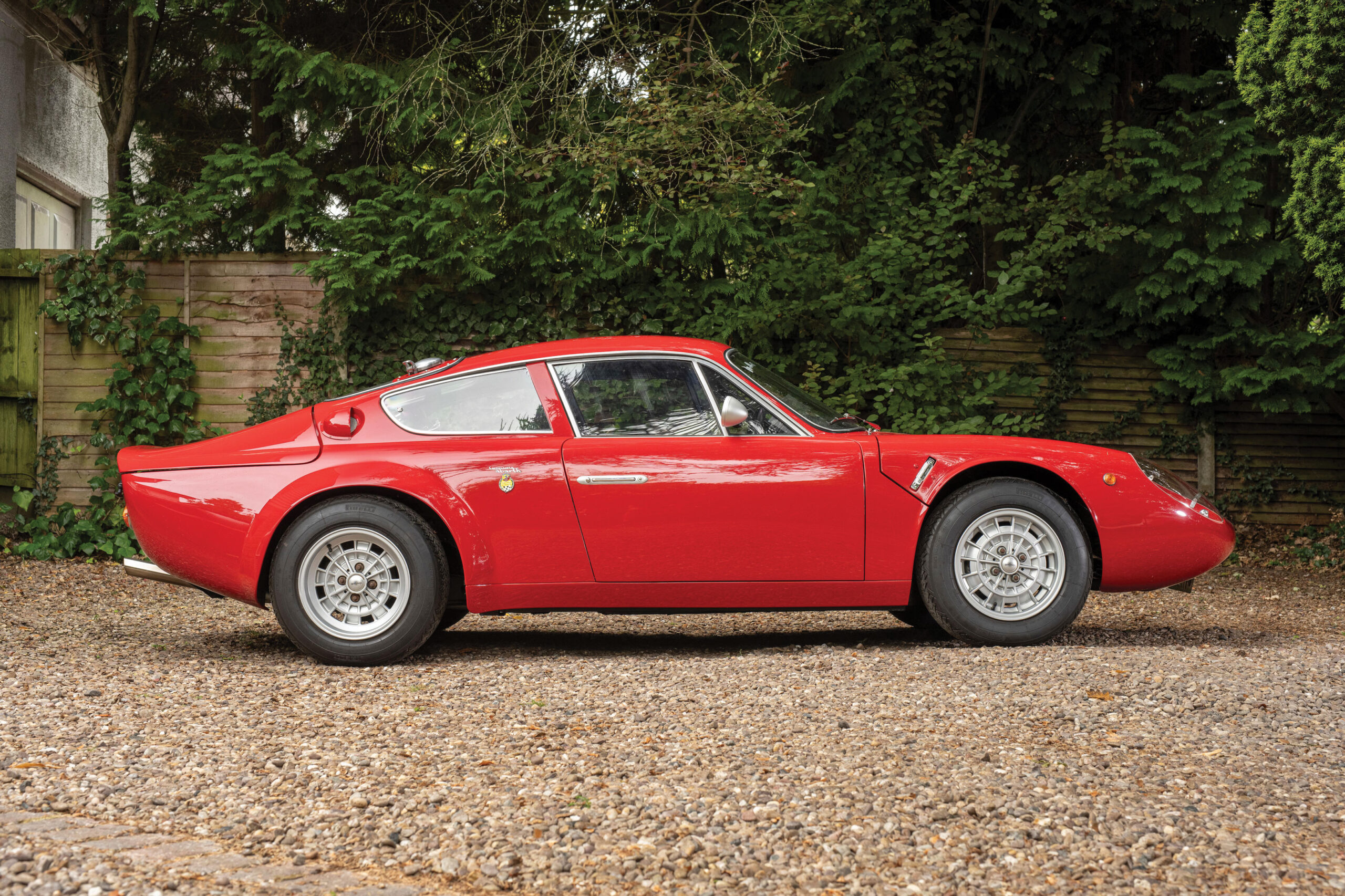
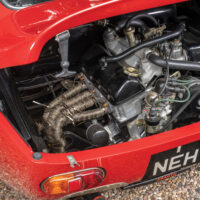
This car, Lot 109, sold for $154,770 (£117,500), including buyer’s premium, at Bonhams Cars’ Chichester, U.K,. auction, on September 7, 2024.
The Abarth-Simca owes its existence to a confluence of events grounded in Simca chief Enrico Pigozzi’s long-term friendship with the Agnelli family, who ruled Fiat. The friendship was not only personal; Fiat founded Simca in 1934. Business ties ran deep. When Pigozzi wanted to introduce a new 4-door sedan, he acquired a throwaway Fiat design to use as a template, known as “Project 122” on Fiat’s factory floor. Developed by Simca’s chief of design, Mario Revelli de Beaumont, with the help of Felice Boano at Fiat, the Simca 1000 debuted at the Paris Motor Show in 1961.
Meanwhile, Turin-based Abarth had been advancing its product line from tuning equipment to complete race cars powered by small-displacement engines. After 1952, platforms were most often provided by Fiat, while the bodies were outsourced to coachbuilders from Allemano to Zagato. Abarth amassed a solid record with hundreds of victories on tracks worldwide, attracting Pigozzi’s notice. Laboring under slack sales and aiming for the youth market, Simca needed an injection of excitement. A collaboration between Abarth and Simca to build a performance car commenced in 1962.
Giant killer
The relationship began with the delivery of a Simca 1000 floorpan to Abarth, complete with transmission, steering and suspension but no body or engine. The chassis was shortened, and a new lightweight and aerodynamic aluminum body was styled in-house, cutting weight to 1,388 pounds — a 200-pound savings over the sedan. The engine was Abarth’s 1,288-cc, DOHC 4-cylinder, decked with two Weber carburetors; output was 125 hp. The Simca 4-speed gearbox was modified by Abarth. Immediately, the car began winning races.
In 1963, Abarth-Simca launched both the 1600 GT and 2000 GT, with an evolved design based on the 1300. When the FIA announced that the 1,600-cc class would be dissolved at year’s end, Abarth’s 1600 GT program was terminated, with few ever having been produced. Abarth Simcas would win 177 times in 1964, famously besting a Ferrari 250 GTO for a win at the Trophy of the Mountains in San Remo. Other period competitors included Porsche’s new 904 GTS and Alfa Romeo’s TZ.
During production, aerodynamic solutions evolved from the early round-tail design to the addition of the “ducktail” upswept rear, then the long-nose design with front-hinged clamshell lid. As with many Abarth cars, individual cosmetic differences are somewhat common. From the factory, Abarth supplied custom performance parts to privateers, further differentiating each scarce Abarth from another. Though both 1300 and 2000 GT homologation demanded 100 copies each, it’s highly unlikely production numbers ever reached those levels.
Abarth-Simca cars were wickedly expensive — about twice the cost of a Corvette — which limited sales. Simca’s fading fortunes led to a takeover by Chrysler in 1965, spelling the end of the Abarth-Simca collaboration. The 30 unused cars shipped to Radbourne Racing in 1968 lost their best bits, taken by Abarth for service of its other cars.
Cheap for a reason
Our subject car was originally a 2000 GT, built for a dry-sump, twin-plug, 1,946-cc DOHC 4-cylinder with dual Weber DCOE carburetors. It received the optional cantankerous 6-speed manual gearbox, the two extra gears added by Abarth. Output was 177 hp, enough for over 160 mph.
Now fitted with a Simca 1200S “Poissy” OHV 4-cylinder engine bearing dual Solex carburetors, its 84-hp output will not match that of the race-bred 2000 GT, though the more-mundane mechanicals should be easier to service. Our subject wears reproduction Campagnolo wheels, 5.5 inches wide at the front and seven at the rear. Mild wear is evident in the cabin and engine bay, but the exterior cosmetics are respectable.
Against a backdrop of severe rarity and assuming at least #2 condition, the drivers of value here are the body, the engine and an individual car’s race history. The replacement engine in this example is a definite demerit on the value scorecard. Abarths were often meant to be raced or at least run hard, and many of these bespoke engines didn’t survive. That means a genuine Abarth engine of the correct type can double the value of a given car. Our subject car has no race history, but we know around 30 out of the entire run didn’t — those were the cars given over to Radbourne. The body is the later style, considered the pinnacle of the Abarth-Simca GT’s development. Previously offered for online sale in July 2024 by Collecting Cars, it failed to meet reserve at an undisclosed high bid.
These cars do not appear at auction with any regularity. We last saw one sell at RM Sotheby’s November 2021 Le Castellet sale, a ducktail 1963 Abarth-Simca 1300 GT with an original engine and documented period race history that made $310k (SCM# 6948577). More recently, in March at an Aguttes sale in Paris, a 1963 round-tail 1300GT, delivered by the factory without an engine to its first owner, and with uncertain race history, sold for $144k.
In light of these sales, our subject car, with a relatively fresh restoration balanced against its non-original mechanical components, was well bought at $155k. The price allows room to source a more-suitable engine — reproduction or, with any luck, a rare-as-hens-teeth original — which will add value to the car at the next sale. ♦