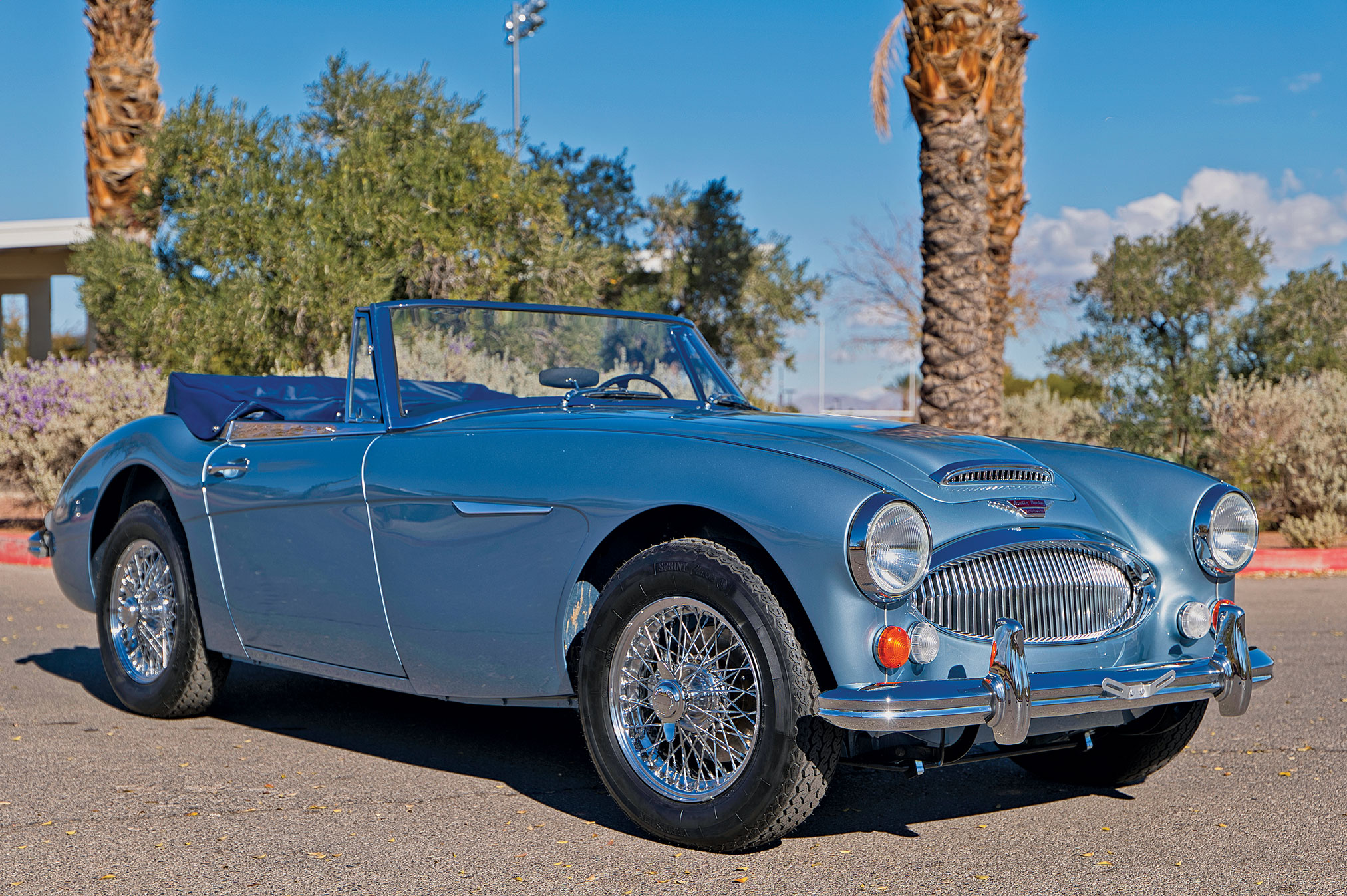
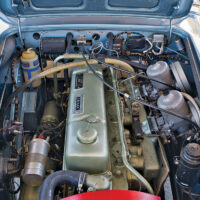
This car, Lot 51, sold for $70,000, including buyer’s premium, at Worldwide Auctioneers’ Tempe, AZ, auction, on January 26, 2024.
The Austin-Healey 3000 Mark III started life in late 1963 as a new anachronism. Consider that roll-up windows and a wrap-around windshield had just been added to the Healey line in 1962 with the BJ7 Mark II transition model that preceded the BJ8. First gear still had no synchro, and it was supplied with bias-ply tires. Produced for just over four years in the mid-1960s, the BJ8 was a fine example of the state of the art, circa 1945. Nothing about it was cutting edge, innovative, or even up to date for the time it was produced. And yet it possesses a unique and endearing persona that endures even today.
The last angry car
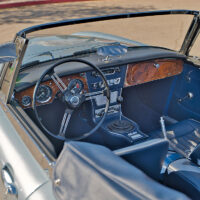
The Austin-Healey nameplate was only 10 years old when the BJ8 (referring to its British Motor Corporation series designation) entered production, but it was dramatically different from the cars originally bearing the name. The first Austin-Healeys were four-bangers with folding windscreens, detachable side windows and a bare-bones interior fitting for a competition car. Just over a decade later they had morphed into a more-family-friendly convertible with 2+2 seating, reasonable weather protection and even a walnut burl dashboard — yes, real wood. And yet there was still something of the original character abiding within.
A British Motor Corporation advertising campaign for the new model recognized that essential character when they labeled it “The Last Angry Car.” First gear whined, the engine roared from a deep throat, and its unassisted steering provided a brief workout for those unfortunate enough to find a need for parallel parking.
Like other British cars, the BJ8s were not assigned a “model year.” Changes to the model were made mid-production as running changes with no attempt to define a 1964 model, a 1965 model and so forth. The Healey cognoscenti (or perhaps more aptly, “trainspotters”) recognize the first 1,390 BJ8 models as “Phase I,” which was never an official name, followed by the Phase II that gained needed additional ground clearance via an updated rear chassis. After that, minor changes to the taillights and the front sidelights were the only noticeable modifications.
By the time the BJ8 was announced in early 1964, its obsolescence was already in sight and plans for its replacement soon began. However, by the mid-1960s, BMC was struggling with labor strikes and a shortage of investment funds, both of which combined to place the brand in peril. By 1967, U.S. safety and emissions regulations set to go into effect the following year — and inadequate resources to meet them — would seal Austin-Healey’s fate. Over four-plus years in production, 17,712 BJ8s left the Abingdon factory.
Bling, 1960s-style
Our subject car is a quintessential BJ8. The “Healey Blue” color was associated with Austin-Healeys since the first model entered production in 1953, and it continued to be a popular choice through the end of the range. Healey Blue is arguably the defining color for the marque, its subtle metallic content nicely highlighting the curvaceous bodywork.
The retractable top, tonneau cover and interior in Ambla vinyl, all in blue, combine to complement the paintwork. Add to that the considerable chrome on these late Big Healeys and the result is the most stylish of the range, with an upscale presence. The bling was built in.
While this example currently wears blackwall radials, the whitewall tires originally supplied on this car only would have added to the effect. A shame then that whitewalls have largely fallen out of favor in the intervening decades.
The production record lists 60-spoke painted wire wheels, heater, adjustable steering column, laminated windscreen, Roadspeed tires (those would be Dunlops) and overdrive. It is unusual to find an example sent to North America that did not have all of those items. Think of them as the “standard” options, designed to extract the higher price that resulted.
Bought on the downslope
You can’t buy a project car and pay for a professional restoration for one of these cars at the sales price of this one. Doing most of it yourself and paying yourself nothing for your labor could make it just possible, but in general, Healeys have continued to dwell in the category of being more expensive to restore than the final product will earn. At one point within memory these last-of-the-line Healeys were selling for more than E-type Jaguars, but those days have now shrunk in the rear-view mirror.
Hammering at $62,500, for a final sales price of $70,000 including premium, this sale is in the lower end range of market-correct, with prices having slowly trended downward in recent years. As such, I will call the sale fair both ways. ♦
(Introductory description courtesy of Worldwide Auctioneers.)