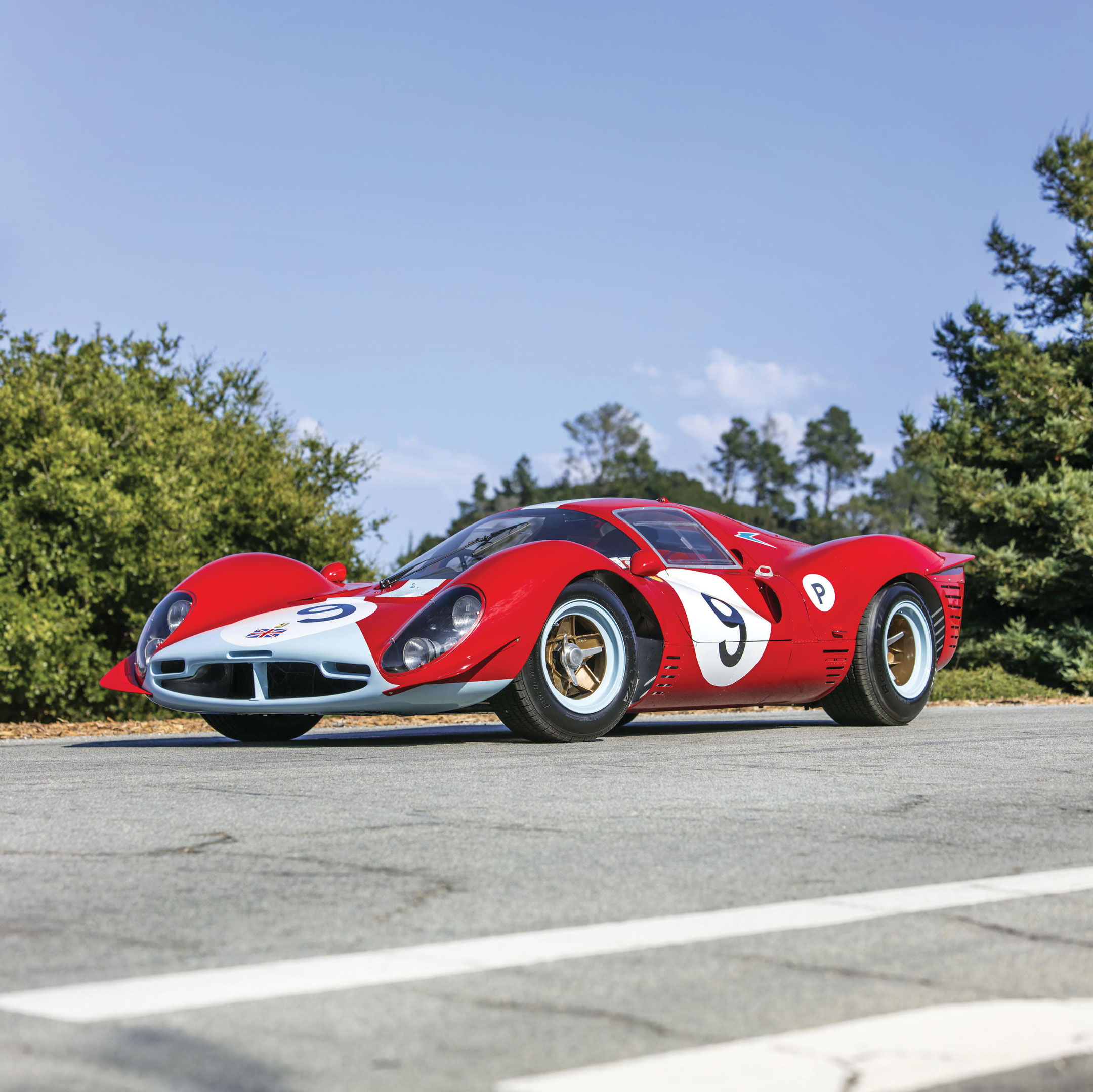
This car, Lot 67P, sold for $30,255,000, including buyer’s premium, at Bonhams Cars’ Carmel, CA auction on August 18, 2023.
“Write what you know.” It’s an adage usually offered as advice to would-be scribes. Sometimes this is easier to do — and this is one of those times. I had the honor of taking care of this car for about six years and oversaw its sale to the consignor in 2005, so I do have some personal insights.
The first is that it is an absolutely fabulous car, breathtakingly beautiful and fast, but not without its difficulties and shortcomings. It has been observed that a Ferrari GTO makes a mediocre driver look great, while a mid-engine Ferrari makes a great driver look mediocre. I never raced our subject car, but I did drive it on the track in laps that let me feel its potential as a racer. Trust me when I say that you would never want to drive it on the street.
Generation gap
I have long argued that the best way to understand sports-racing Ferraris over the years is to think of them as generations. The first consisted of the early cars, 2- to 4.5-liter V12s with simple frames and live axles. The second generation saw better tubular frames and transaxles with De Dion rear suspension and mostly 4-cylinder engines, such as Mondials and Monzas. The third generation went back to regular transmissions and live axles, but with far better frame and suspension design, gorgeous bodies and 3-liter V12s. These are the ultimate collectibles: SWBs, Testa Rossas and GTOs.
The fourth generation is the mid-engine sports racers, basically the 250 LM through the P4. Our subject car fits here. (The fifth generation, effectively 2-seater Formula One cars, doesn’t concern us today.) Each generation has broad similarities and with occasional outliers fits into a general value envelope.
Enzo Ferrari didn’t much like mid-engine cars, but he was a realist about winning, so he followed the trend. This started with F1 in 1960. For sports racers, he held out until 1963, when he introduced the 250P to run in the new prototype class beside the GTOs in GT class. Both were successful, with the advantage that they ran the same races but in different classes, so they all could win. Ferrari completely dominated that year, but serious competition was on the horizon. Henry Ford, having been rebuffed in his attempts to buy Ferrari, swore he was going to beat them on the track. Starting in 1964, the war was on.
Ford v Ferrari
The primary battles were in the GT class between Cobras and GTOs. The new Ford GT40 arrived in time for Le Mans but wasn’t even close to ready for prime time, so Ferrari continued to win with its evolving 275P and 330P models, mostly just with bigger engines and more tire in the 250P platform. The following year, 1965, saw the introduction of the 250 LM, which was really just a 275P with a roof and (unrealized) pretensions about being a production car. The GT40 was getting better but still not a full challenger.
A lot changed going into 1966. The FIA altered the Manufacturers’ Championship, the feature show, from ostensibly production GT cars to Group 6 Prototypes with no minimum production and no displacement limit. Ford introduced the 7-liter GT40 Mk II, and Ferrari countered with the 330 P3. The battle was on.
Ford used a monocoque chassis while Ferrari stayed with an evolution of the earlier tubular chassis but with more power and a ton more tire. The new body design was far curvier and sexier, as well as aerodynamically better. It was Ford’s year, of course, but Ferrari was a strong second, beaten fair and square but not humiliated.
The rules were going to change again for 1968, so neither manufacturer did much for 1967. Ford introduced the Mk IV while Ferrari converted its three 330 P3s to P4 configuration (with a three-valve head and Lucas injection) and built two 412Ps for privateer use (with a two-valve head and Webers). That was the end of the era.
Fickle Ferraris
This leaves our subject 412P in rare company. Only five cars share this body. Each is slightly different; they are emphatically not interchangeable. The P4s were factory team cars while the 412Ps were private. All have good history.
Yet extremely high-end collectibility is a fickle mistress, and being the last and fastest doesn’t always mean most valuable, so let’s look at some of the other factors. A huge component of collector cars is social, particularly at the top. Where and with whom can you go play and be a welcome peer? Having the appropriate car to participate in a rarified world provides an important part of a car’s market value. You are not just buying a car — it is a lifestyle signifier.
These factors do not work in favor of Ferrari’s mid-engine sports racers. There is no P-Car club or user group. They are beautiful, impressive, fast and important cars, but unless you are a serious track rat, they are not much fun. They are hot, claustrophobic, noisy, uncomfortable under about 100 mph, and fragile in street use. You can high-center one on a 2×4 and break an irreplaceable wheel in a minor pothole. They are fabulous at the track and the crowds genuflect, but if you care about winning you will have your tail handed to you by GT40s and Lolas using engines that can be replaced overnight. All of this limits value.
I said earlier that each generation of Ferraris shares a general value range. The mid-engine sports racers run from about $17m for an “ordinary” 250 LM (32 built) to roughly $30m for the 412P. There are plenty of outliers with higher values due to their provenance, but for the rest, this is the range.
The auction process for this car was somewhat strange. It began with a high, fixed opening amount. There was only one bid that achieved the predicted $30m goal (including premium), then the car was hammered sold. But the final result was pretty much what everybody expected, without much drama. In the end, this is a wonderful car, fairly bought. ♦
(Introductory description courtesy of Bonhams Cars.)