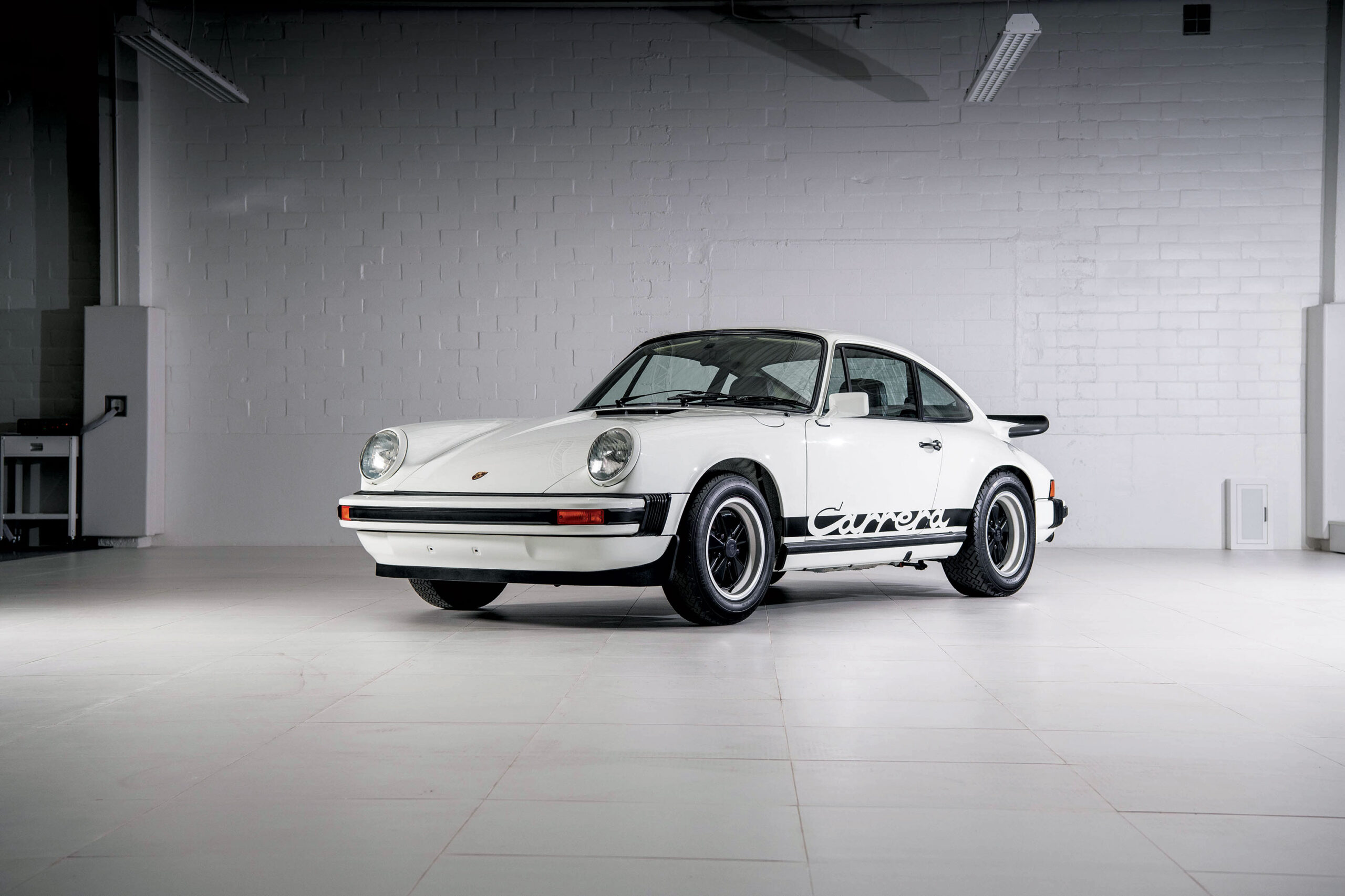
This car, Lot 2112, sold for $368,000, including buyer’s premium, at RM Sotheby’s auction in Houston, TX, on December 2, 2023.
The 1973 Porsche 911 Carrera RS was a success for Porsche, selling three times the number of cars initially forecasted. Porsche built 1,525 of them in three series, excluding the 55 RSRs that share the same serial-number range. The RS became many drivers’ all-time favorite Porsche.
The 1974 model year saw the RS divided into three models. Because of new emissions standards in North America, buyers here got a 2.7-liter engine with CIS (Continuous Injection System, aka Bosch K-Jetronic) fuel injection for 1974–77. The new 1974 G-body 911 had federally mandated collapsible bumpers and a resultant shortened front hood. Porsche also chose this new model to partially redesign the interior.
The top-of-the-line model was labeled “Carrera,” starting a dilution of that name which heretofore had always applied to special high-performance and race cars. The regression was complete with the 1977–83 SC and the 1984–89 Carrera 3.2-liter.
Europe got both the CIS cars and, with less-stringent emissions laws, a continuation MFI (Mechanical Fuel Injection) model with the identical 1973 RS 2.7-liter engine, the Type 911/83. The car also had most of the suspension, brake and chassis features of the 1973 RS. We Yanks have always called it the “Euro Carrera” to differentiate it from the tamer U.S. model.
Much more exciting (but also not sold in the U.S.) was the 1974 Carrera RS 3.0-liter built in just 54 examples, a homologation car for the 51 RSRs. This RS was a real fire-breathing race car for the street. It ran Group 3 races, tours and rallies all over the world.
A European immigrant
It was illegal to import Euro Carreras until special EPA/DOT exemptions arrived in the 1980s. Then, both the 1973 RS (with light DOT modifications) and the Euro Carrera were U.S.-legal. Performance differences between the 1973 RS and the Euro Carrera were virtually nonexistent, but the latter had substantially lower value. Thus arose the moniker “poor man’s RS.” In October 1986, the Connecticut Valley Region of PCA hosted Derek Bell as Chief Instructor at a Driver Education/Time Trial weekend at Lime Rock. There were 23 1973 RSs there, including your author’s, and one Euro Carrera. Obviously, the latter had not caught on yet.
That’s a shame because the Euro Carrera is an excellent car and good value. The 1974 body modifications did not add much weight. The factory claimed 2,400 pounds versus 2,370 for the 1973 RS Touring and 2,116 for the RS Lightweight. With the same 210 hp as the 1973 RS, it performed almost identically to a Touring: both about 5.5 seconds to 60 mph and about 150 mph top speed. The 1973 RS narrowly won the quarter-mile sprint at 14.1 seconds vs. 14.5 for the Euro Carrera.
According to Ryan Snodgrass, who sorted all the build records, Porsche made 2,264 Euro Carreras in 1974–76, including 1,633 coupes and 631 Targas. If you are interested in these cars, you will benefit mightily from his book Carrera 2.7 published by Parabolica Press.
Still a budget RS
Limited numbers of Euro Carreras have come to market in recent years. Reviewing all public sales, we can find about 40 cars have been offered since 2015. Most earlier transactions ranged between $150,000 and $250,000, although RM Sotheby’s had two sales in 2015 of $308,00 and $390,000, certainly aided by both cars being painted in attractive greens. At Monterey in August 2023, RM Sotheby’s sold a 15,000-km example in Grand Prix White for $434,000 — the all-time record price at public auction (SCM# 6961202).
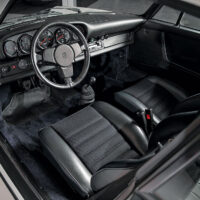
The White Collection Euro Carrera was not a low-mileage example, but it was very original. It had a well-documented history with its first owner, who sold the car to Vinod Ramani (owner of the White Collection) in 2014. The car was a 1975 model that benefited from a standard and attractive blue-black two-tone interior. Paint-meter readings indicated originality, and the engine and gearbox numbers matched those on the build sheet. Options included a sunroof, rear wiper, tinted glass, Koni shock absorbers and a Blaupunkt Lubeck radio/cassette player. The car had its original German title and registration, a Porsche Certificate of Authenticity, a complete owner’s manual kit with service book, a correct toolkit and assorted spares. It was in excellent cosmetic condition but would soon need service; the only running time since 2014 was with the car in static position.
The car was hammered at $330k, for a final sale price including buyer’s premium of $368k. Prices realized on many of the White Collection cars benefited from a positive “halo effect” of the story behind the collection and RM Sotheby’s expert marketing. In this case, however, the resultant price was fair to both buyer and seller. ♦
(Introductory description courtesy of RM Sotheby’s.)