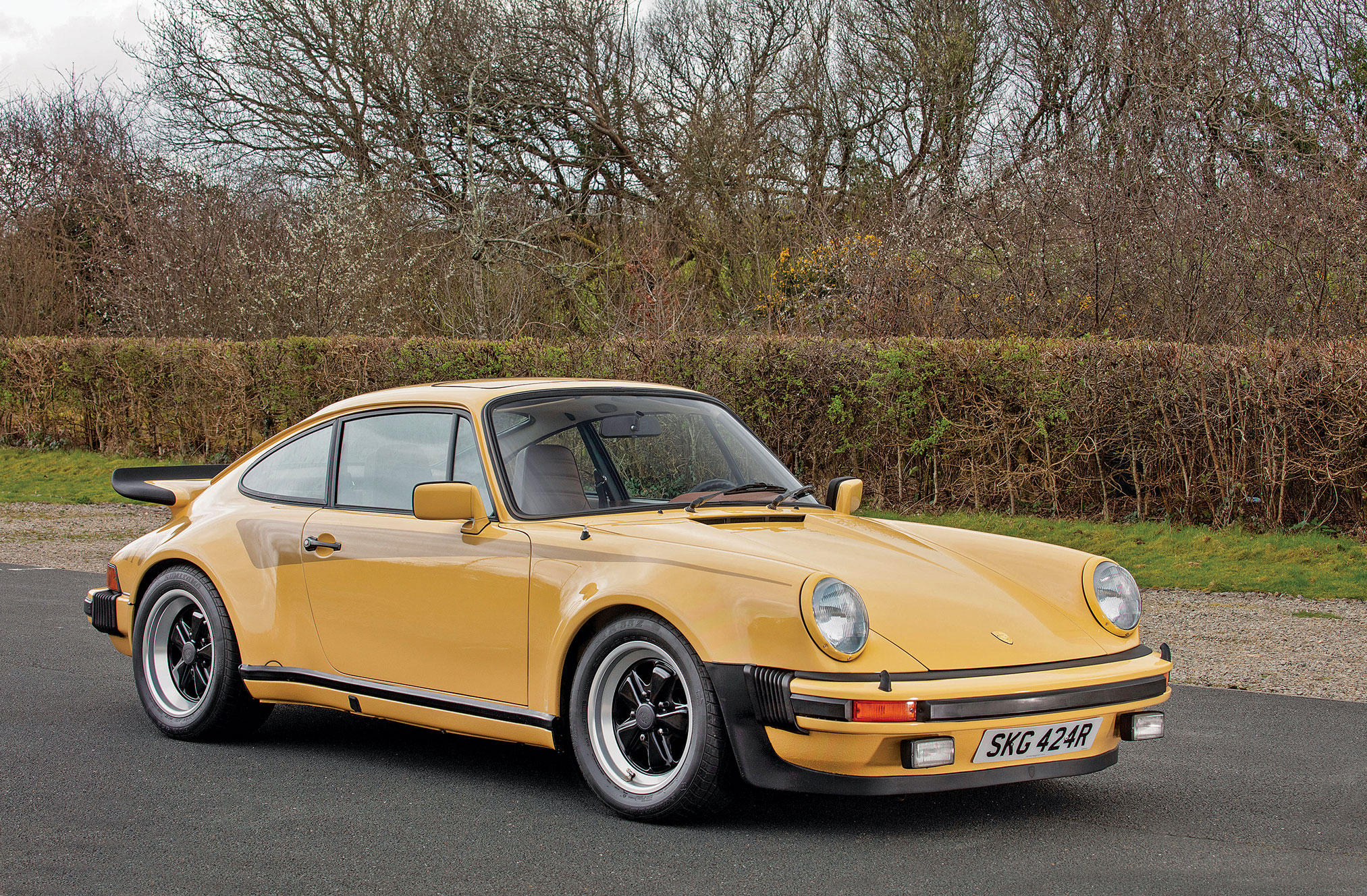
This car, Lot 145, sold for $110,418 (£88,550), including buyer’s premium, at Bonhams Cars’ Chichester, U.K., auction, on April 14, 2024.
Everyone loved the Porsche 930 the moment it was introduced — road testers, the public, and youngsters with car posters on their bedroom walls. But loving it and buying it were two different propositions. Not only was the new Turbo expensive, some considered the car dangerous to drive. This love/fear dichotomy dogged the Turbo for a while, until superior engineering, magazine road testers and market familiarity overcame all objections.
Turbo time travel
Turbocharging and its cousin, supercharging, go back over a century. Supercharging employed a blower driven by the crankshaft, while turbochargers were driven by exhaust gases in a more-complex system. Early vehicles that benefited from such added power were race cars, luxury cars, airplanes and heavy equipment.
In the early 1960s, GM added turbochargers to its Corvair Monza and the Oldsmobile Jetfire. Ten years later, in 1970, a former Ferrari-BMW-Porsche engineer, Michael May, developed and sold over 4,000 turbo kits for the German Ford Capri V6, raising horsepower from 108 to 180. BMW followed suit, selling almost 1,700 2002 Turbos, which are highly prized today. BMW soon canceled the model due to high manufacturing costs and adverse emissions requirements.
Porsche had supercharging history with the 1930s Auto Union Grand Prix race cars. But it wasn’t until 1969 that it built a 2.0-liter turbocharged prototype. In 1970, it purchased a Capri turbo kit. Neither project impressed the company. Then, after successfully turbocharging the 917/10 and 917/30 race cars, Porsche built a turbocharged 2.7-liter-powered 911 for CEO Ernst Fuhrmann. Porsche’s perceptions changed, and the 930 project was born.
It was introduced with a mockup at the October 1973 Frankfurt show, and then again fully developed at the Paris show a year later. Thereafter, the words “Porsche” and “Turbo” became synonymous.
Fully loaded
After first considering the 930 to be the next Carrera RS, Porsche mandated that it go in the opposite direction — to be a luxury tourer. It looked fearsome with a deep front air dam, wide muscular flares and the “whale tail” spoiler on the rear deck. But it came standard with air conditioning, power windows, a premium radio and full leather, plus a sunroof on the majority of Turbos.
The car listed at 2,785 pounds, but the press test car came in at 3,155 pounds. That was a luxo-barge compared to a 911 at 2,475 bare and 2,845 loaded. Surprisingly, only 70 pounds of the excess weight was attributable to the turbocharged engine.
Weight be damned, the 930 was a rocket ship. It did 0–60 mph in 4.9 seconds, the quarter-mile in 13.5 seconds, and top speed was 156 mph. The same specs for a 911S were 7.5 seconds, 15.8 seconds, and 138 mph.
Speed costs
The 930 initially was propelled by a 2,993-cc engine developed off the RSR unit, adding a KKK turbocharger and with no intercooler (yet). It delivered 260 horsepower in Europe and 234 in the U.S. with emissions gear. The highest-powered 911 had been the 1973 Carrera RS at 210 hp. The 1975–76 911S had 158 horsepower. The straight-line king clearly was the Turbo. On tight tracks, however, 911s ran close and Carrera RSs could run away from 930s. Turbos prevailed on longer tracks, such as Road America.
Unfortunately for most of us, the Turbo was 80% more expensive than a standard 911. In part due to being fully equipped, its MSRP was $25,880 compared with $13,845 for a base 911S. That was a sobering step up.
That high price held the 930 Turbo back. Introduced in Europe with the 1975 model, the car sold 284 units. Those are highly sought-after today, with 1976s trailing behind. With the North American market added for 1976, sales rose to 1,174 units, followed by years of 1,422, 1,257, and finally, 2,052 in 1979. That was to be the last year of the Turbo in North America, and a buying craze ensued. Turbos did come back in 1986 — a story for another day.
Media acclaim
In 1975–76, the new Turbo Carrera was fully discussed in sports-car magazines. Road & Track highlighted that under 3,000 rpm, where the boost came on, the car was a low-compression laggard. But from 3,000 to redline at 6,950 rpm, the Turbo was a beast. Said R&T, “Above 3,000, look out… Some awesome unseen force is… thrusting the [Turbo] forward at an incredible rate… Then it shifts into the next gear and… the same heavy g-loads and fireworks start all over again.”
The magazine was also complimentary of the Turbo’s underpinnings. “With its wider track (2.4-inch increase up front and a whopping 4.8-inch increase at the rear compared to the [flared] 1975 Carrera, and race-car suspension, the Turbo was far and away the easiest Porsche to drive near the limit that we have ever tested.” On the Stewart Air Base skid pad, the Turbo pulled 0.852 g, about the same as a 1973 RS and stellar for a heavyweight.
R&T concluded, “Porsche engineers have not only proved that turbocharging and low emissions are totally compatible but have silenced the critics who say racing does not improve the breed. True, such clever engineering doesn’t come cheaply, but Porsche has never before offered a [car] with the luxury, performance and technical sophistication of the Turbo.”
Wrong side of the road?
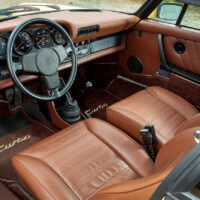
Despite the U.K. auction venue, our subject car is a left-hand-drive U.S. model with CoA confirming matching numbers for the engine and gearbox. It was accident-free but repainted and clean overall, with some weak spots, such as door jambs. This 930 had a desirable sunroof and Turbo side script (1975–76 only). The car had 39,268 miles on its six-digit odometer, presumably accurate. The gearbox was rebuilt and Bonhams Cars had the results of a leak-down test available.
Past five-year sales of 1977 930s in the mileage and condition range of our subject car vary from $110,000 to $210,000. This example sold for $110k, which seems a bit low for an attractive low-mileage original 930, even with a repaint. Some people do not like Sand Beige, but it looks its best on a Turbo with the period decals. We vote this one a good buy. ♦
(Introductory description courtesy of Bonhams Cars.)