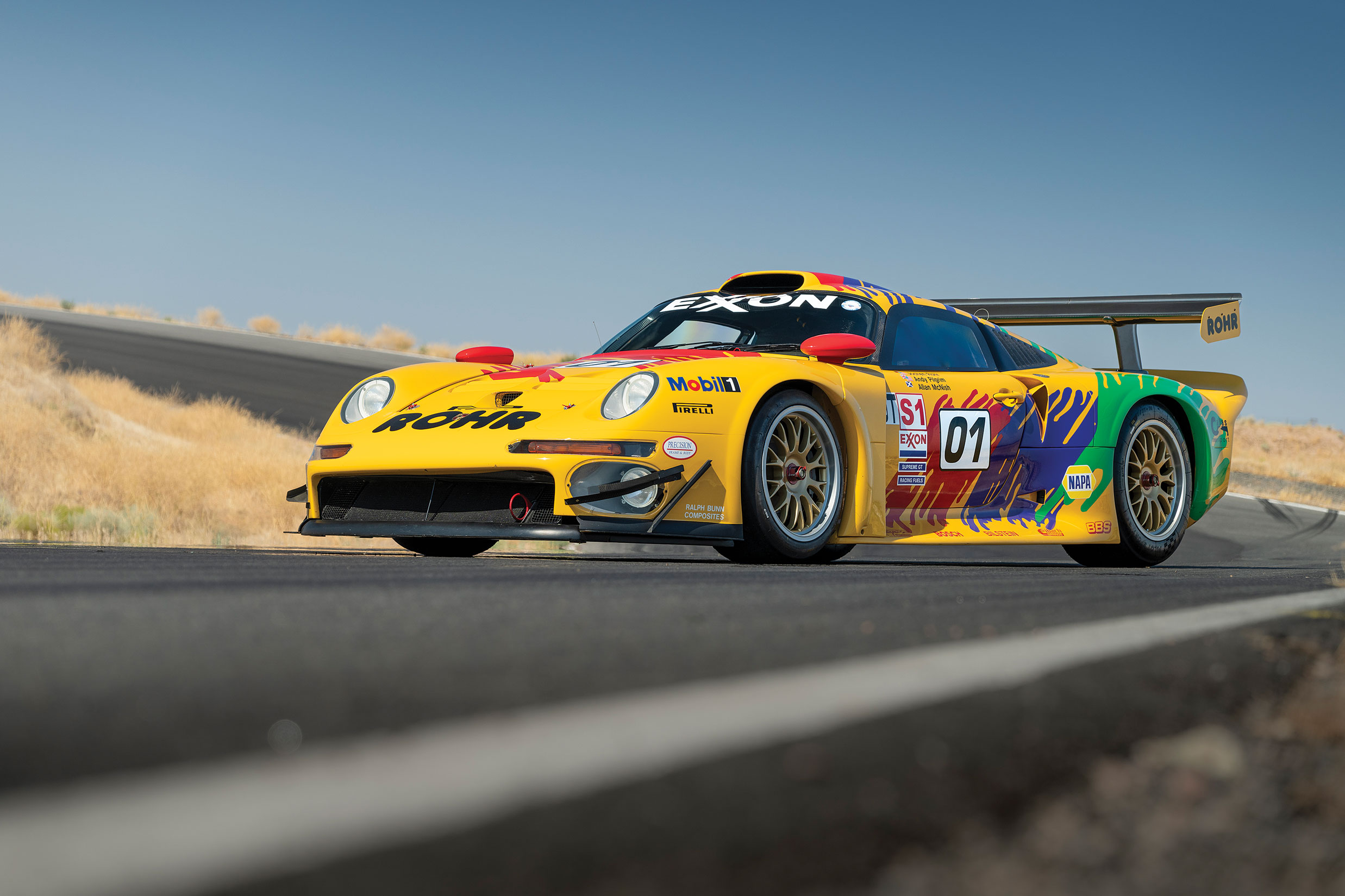
This car, Lot 275, sold for $7,045,000, including buyer’s premium, at Broad Arrow Auctions’ Monterey, CA, sale, on August 15, 2024.
In the early 1990s, the FIA dropped prototype racing, largely because Porsche’s 956s/962s had been winning almost everything since 1982. Into that breach stepped Jürgen Barth, Patrick Peter, and Stéphane Ratel, who together in 1994 launched the BPR Global Series for modified production cars. Rules were loose and cars poured in. The series was a success, so now manufacturers wanted in, especially Barth and Porsche.
Barth had the idea to upgrade the Porsche 911 (993) GT2 Evo with bigger turbos and more to make a GT1 car. But racing that two-box body against the wedge-shaped McLaren F1s and Ferrari F40s didn’t work. At Le Mans, Porsche’s GT2/GT1 was 10 seconds faster than a normal GT2 but 10 seconds slower than competitors.
A fresh start
After a dominant 1995 season including a Le Mans 24 Hours victory by the McLaren F1, Porsche understood it had to go in a new direction. A development budget was approved in July 1995, soon after Le Mans. Norbert Singer and Horst Reitter pinned the parameters, and 993 designer Tony Hatter did the bodywork. A mid-engine layout was specified for balance and to allow an upward-sloping rear floor for venturi-effect aerodynamics. Wind-tunnel testing took 33 days. CEO Wendelin Wiedeking mandated that the car be identifiable as a 911.
For the power unit, Singer adapted the 3,164-cc 1994 Dauer 962 powerplant — four valves per cylinder, twin turbocharged, fully water cooled, and intercooled. Heads and valvetrain were 959-based, with K27.2 turbos set at one bar of pressure. As Type M96/80, this unit initially developed 557 horsepower, later 592.
Initially, the front end was all 993-series 911, including the metal tub and suspension (modified to a double-wishbone design), to take advantage of existing crash-test data and make the GT1 a “production-based” racer. That front mated to a steel roll cage and a steel-tube rear frame. The new rear suspension was five-link double wishbones, lateral pushrod shocks and 15-inch brakes with eight-piston calipers front and four-piston rear. The carbon-fiber body had 2.5 inches of ground clearance, with a wheelbase 11 inches longer and eight inches wider than a street 911. Weight was roughly 2,320 pounds. By mid-1996, prototypes were being tested at Estoril, Paul Ricard and Porsche’s own Weissach proving grounds.
To the track
In 1996, Porsche focused on Le Mans, where factory-entered GT1s finished 1-2 in the LMGT1 class, placing 2-3 overall with drivers Stuck/Wollek/Boutsen and Dalmas/Wendlinger/Goodyear, respectively. GT1s went on to win the last three BPR Global GT races of the year.
For 1997, a modified “GT1 Evolution” was introduced with more-slippery bodywork. It was about 2.5 inches wider in front and two inches in the rear, with a steel monocoque out back and 996-style “fried egg” headlamps. The aero changes aided top speed, and at Le Mans ’97, factory entries held the lead for most of the first half of the race. Unfortunately, both later retired, though privateer GT1 Evos placed 3-4 in class, 5th and 8th overall.
Street racers
Porsche finally built the 20 required homologation Strassenversions (road cars) and sold them for about $888,000 each. The cost seemed outrageous then but was reportedly a money loser for Porsche. These cars were slightly detuned — with softer suspensions and leather interiors with two seats — weighing in at 2,536 pounds. They had Motronic engine management, steel brakes, dual-mass flywheels, were raised 2.5 inches and reverted to a five-dial instrument cluster, plus a water-temperature gauge.
With 536–544 hp on hand, magazine testers drove Strasses to 62 mph in 3.9 seconds, the quarter-mile in 11.6 seconds and on to a top speed of 191 mph. For reference, at Le Mans the Evos hit 205 mph on the Mulsanne Straight.
The ultimate GT1
For 1998, Singer’s crew was allowed to redesign the “GT1/98” as long as one street car was homologated. Porsche wanted to strip out at least 200 pounds, and eventually got the cars down to 2,075 pounds. The entire monocoque was now carbon fiber, and the gas tank moved from the front to midships on a 12-inch-longer wheelbase. Aerodynamics were smoothed. The suspension was reworked and updated. The gearbox became a sequential unit with a triple-disc clutch. The engine was a tad larger at 3,198 cc, yielding 550 hp with the FIA-mandated turbo restrictors.
The 1998 racing season was dominated by the Mercedes CLK GTRs that won every race except Le Mans. There, GT1/98s placed 1-2 overall, driven by McNish-Ortelli-Aiello and Muller-Alzen-Wollek, respectively, after top competitors suffered mechanical issues.
Big win, big price
That sole victory made the GT1s famous. Porsche’s supercar now had race cred, publicity and posters galore. Since then, prices of Strassenversions and Rennversions have appreciated — slowly at first, then rapidly in 2016–19. An Evolution Rennversion converted to street spec was sold by RM Sotheby’s at its 2016 Monaco sale for $3.2m (SCM# 6799766). Strasse 005 sold in March 2017 at Gooding & Co. Amelia Island for $5.7m (after selling at Bonhams in May 2003 for $756k). Since 2017, two private Strasse sales logged in at approximately $10m and $12.5m. A 1997 Evo Rennversion is for sale at Lee Maxted-Page’s store in London, asking £10m ($13.1m), its serial number one digit before our subject car, with body-production number one digit after.
Our subject GT1 was delivered to Germany’s Roock Racing in February 1997, running five times without distinction, including a DNF after only eight laps at Le Mans ’97. Roock sold the car to Jochen Rohr in the U.S., who repainted it Speed Yellow with artistic red/blue/green “florals” added by his daughter. Already running a 993 GT2 Evo in IMSA, Rohr switched to the GT1 and won the last four races in the 1997 season with Alan McNish and Andy Pilgrim driving. Between their two cars, the Rohr team won the IMSA GTS-1 class championship.
For 1998–99, Joel Reiser and Tony Callas ran six races in the car, then sold it to Schumacher Racing in 2001. The latter team entered four IMSA races and earned one podium, a 2nd-place at Lime Rock. Following its retirement from racing, the car went into the collection of the late Matt Drendel in Hickory, NC, then in 2012 to a longtime car collector and vintage racer in Newport Beach. He showed and raced it, including at a Porsche Club annual concours in Salt Lake City and at Rennsport V and VI at Laguna Seca.
At the time of the auction, this GT1 had been gifted to his two children, who consigned it to Broad Arrow — after a couple of tries at a private sale. Pre-auction, Broad Arrow estimated a sale at $8,500,000 to $10,500,000. In Monterey, it hammered at $6.4m for an all-in of $7,045,000. That was well short of the low estimate and the $8.5m asked in earlier private-sales negotiations. The buyer did very well.
We have heard rumors from Europe that the car will be converted to a Strasse, perhaps at the factory (which did one earlier), repainted in its original silver, and that it will be back on the market in 2025 or 2026 for much more money. As a wag once said, “It takes money to make money.” ♦