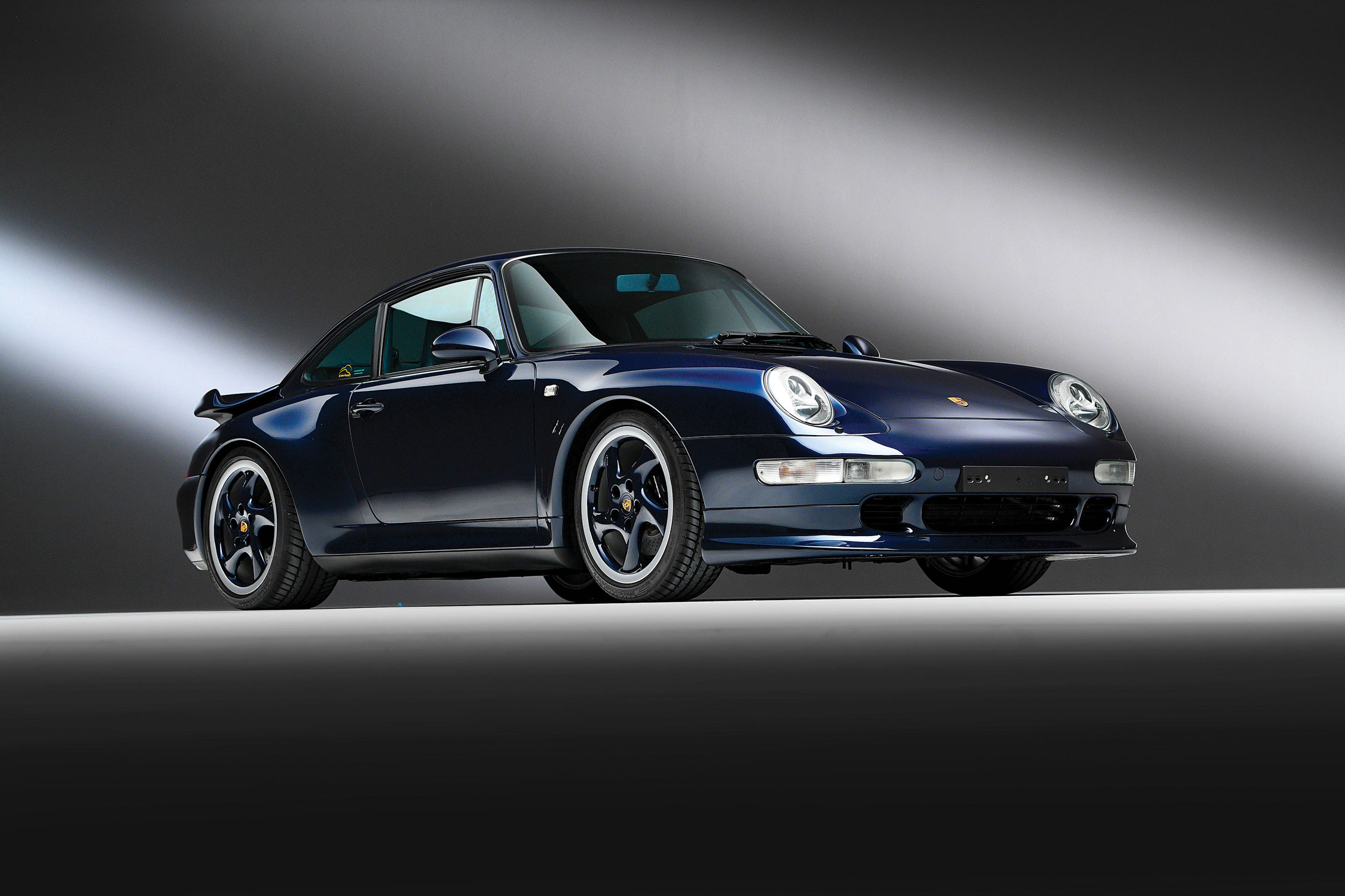
This car, Lot 158, sold for $809,019 (£614,200), including buyer’s premium, at Bonhams Cars’ Chichester, U.K., auction, on September 7, 2024.
The confluence of four factors made for this strong result. First, the 993-series Porsche 911 Turbos are in demand. Second, this car was in a market-preferred color (Ocean Blue), and had covered just 6,838 miles (11,029 km). Third and finally, it was documented as the “last 993 delivered.”
End of air-cooled
Among Turbos, the 993 variant has a strong niche following. It was the first Porsche street car (other than the low-production supercar 959) with twin turbochargers — one for each cylinder bank, and this time, non-sequential. Your turbo rush came all at once. And it ended the run of air-cooled Turbos initiated by the venerable 930 in 1975.
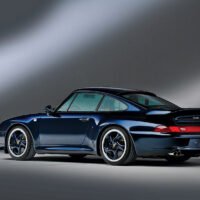
The sculpted bodywork of the 993 was an instant hit. It represented the first major change in appearance since the G-body’s introduction in 1974, although the preceding 964 made a stab at it. The Turbo went two degrees better with bigger wheelarch flares and a well-integrated fixed rear wing. That look wears well even today; “Top Gear” recently declared the 993 Turbo the most beautiful Porsche ever.
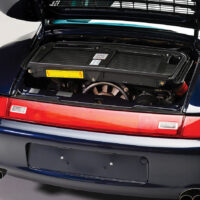
The rear suspension saw a multi-link design replace the trailing-arm setup of previous 911s, on top of which came power-taming all-wheel drive for the first time in a Turbo. The “Gen 2” 3.6-liter engine with a Bosch M5.2 Motronic ECU had 402 horsepower and 398 lb-ft of torque, so “taming” was a good idea. The engine’s compression ratio was 8.0:1, with 11.6 pounds of boost available. The smaller low-inertia turbos with improved management lowered turbo lag time by 50%. The AWD center diff and driveshaft added 110 pounds, but the car was only 66 pounds heavier than the RWD 1993 964 Turbo 3.6 at 3,305 pounds. The new car needed just 3.7 seconds for the 0–60 mph run and had a top speed of 180 mph.
Road & Track summed it up well: “Thanks to the relatively small proportion of the power fed to the front wheels, [you can accelerate through corners] without provoking cumbersome understeer. The car just accelerates hard, drifting beautifully in an almost perfectly neutral attitude with full control.”
Today, it’s notable to driving enthusiasts that 993 Turbos have no driver’s aids — well, other than AWD — and it’s the old-school idiom of “smaller is fine, lighter weight is better” — for a Turbo, anyway. Then in 1998, Porsche added the Turbo S, with 450 hp and sexy air inlets in the top of the rear fenders. Total 993 Turbo production was 6,680 out of over 77,000 total 993s.
Delayed delivery
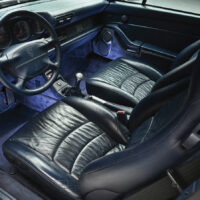
Porsche built our subject Turbo for a German writer, Claus Vanderborg. It was optioned with a power kit to deliver 450 horsepower (equivalent to the Turbo S), a 92-liter gas tank, a strut bar, dual-pipe exhausts, second oil cooler, plus Ocean Blue-painted wheels and brake calipers. Vanderborg had Porsche send the car to its Sonderwunsch (“Special Wishes”) Department for customization. It emerged six months later with full Night Blue leather interior including all switches, controls and instruments.
The car went to Sonderwunsch on March 27, 1998 — the same day that Ferry Porsche died. Vanderborg had his car dedicated to Ferry’s memory with a brass plaque attached to the dashboard. The phrase, “The Last Waltz” was placed in the rear window and on both doorsills. The car was officially delivered on September 5, 1998, with a factory letter saying it was the last 993 delivered to any customer.
Lots of lasts
Jerry Seinfeld famously purchased the very last 993 built, a Miami Blue C4S coupe that was officially manufactured on March 31, 1998. And to confuse the matter just a little, Seinfeld had also purchased the last 993 delivered to North America. It was a 1998 Carrera S coupe in Panthero Metallic (black) paint with $41,000 in options including full leather interior, Technology wheels, Motor Sound, power “sport” seats, and — oops — a Tiptronic gearbox. It carried a brass plaque in the trunk identifying it as the last 993 for North American delivery.
Thusly, the collector world ended up with Seinfeld’s last 993 built, this last 993 (Turbo) delivered, and the last 993 delivered to North America. What does any first or last appellation add to collectibility? I’m not that smart, but I believe the correct answer might be: a lot for Seinfeld’s Miami Blue C4S, something for the last Turbo, and the market has said not much for the last North American-delivered 993.
That car, the Panthero Metallic C2S with 6,268 miles, hit the public market in 2024 after being sold by Seinfeld in 2007 and resold in 2021. It was a no-sale at high bid of $178,000 on Bring a Trailer in May 2024 and then sold for $245,000 on PCarMarket in June. The sale included some paperwork with Seinfeld’s name on it.
Top-dollar Turbos
Here, our “last delivered” 993 Turbo sold for $809k. While it has the equivalent of an S engine, it is missing the rear-fender air inlets — and the scarcity of being an S. And if you think $809k is high, the car was previously for sale at a British dealer, asking £1,500,000, or almost $2,000,000. Obviously, it did not sell.
For reference, so far in 2024, Broad Arrow Auctions Monterey sold a black Turbo S with 2,000 miles for $665,000; RM Sotheby’s Monterey sold a white Turbo S with 4,000 miles for $654,000; PCarMarket sold a red Turbo in August with 9,000 miles for $290,000; and Bring a Trailer sold a Polar Silver Turbo in April with 3,000 miles for $395,000. The all-time record was set in 2023 at RM Sotheby’s Monterey, where Todd Blue sold the 1,850-mile, Cobalt Blue, ex-Otis Chandler Turbo S for $896,000 (SCM# 6961209). This excludes the “Project Gold” Turbo, a one-off Porsche built in 2018 that RM Sotheby’s sold that year for $3.4m, which can’t really be compared to a period-built production car.
My instincts say that this “Last Waltz” 993 Turbo sold strongly. Only history will tell us if this car’s value is headed up or down. I’d take the under on that bet, but the market has spoken — and it’s seldom wrong. ♦