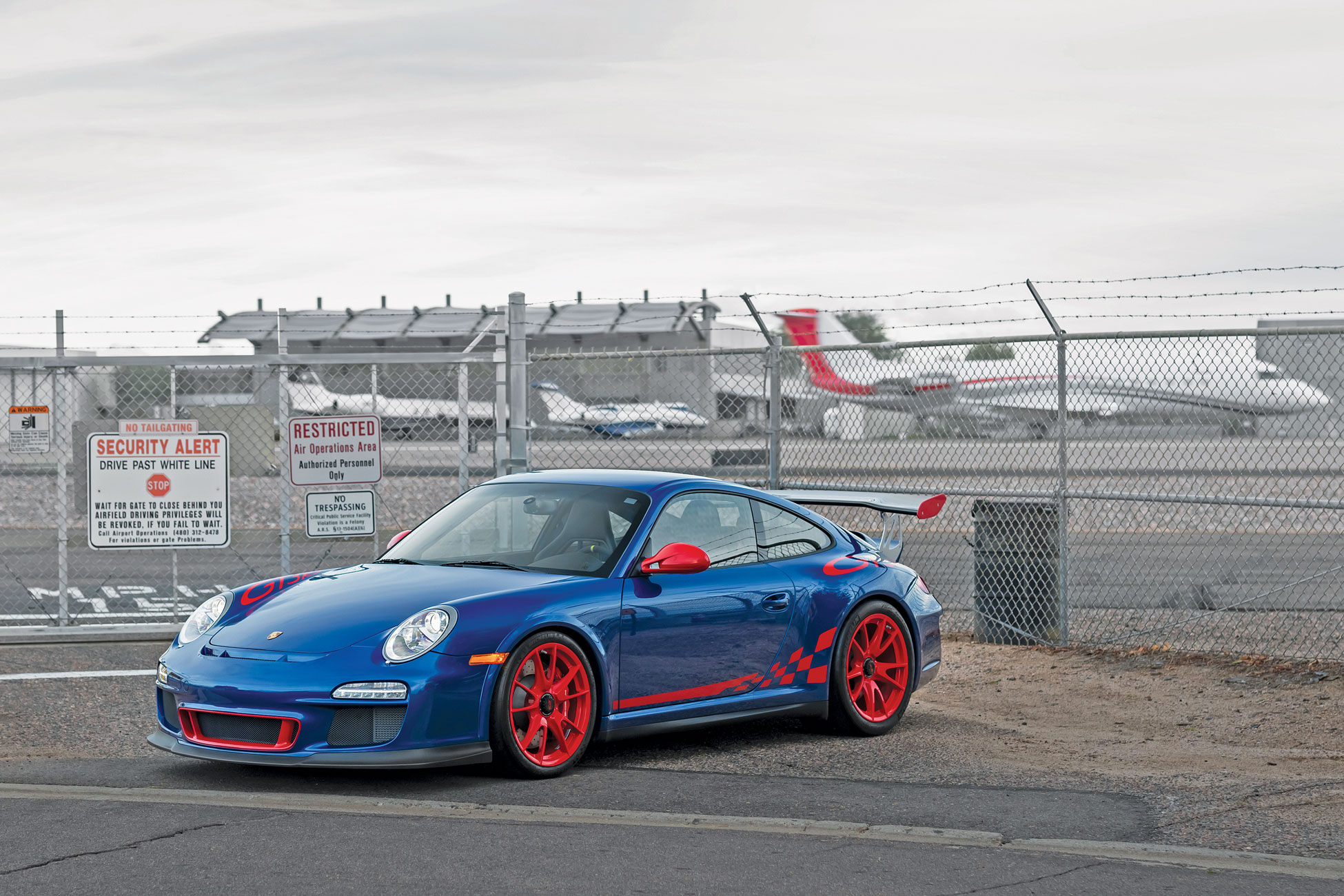
This car, Lot 155, sold for $406,500, including buyer’s premium, at RM Sotheby’s Scottsdale, AZ, auction on January 28, 2023.
Porsche moved haltingly into normally aspirated super-performance 911s for the street. They were rare until Andreas Preuninger and his merry band took over planning Porsche’s GT cars in 2003. Afterward, quite a few desirable models blossomed.
An iconic start
We reviewed the history of RSs in our profile of the 964 Carrera RS (“German Profile,” March 2023). To recap, FIA rules forced Porsche to build the 1973 Carrera RS 2.7 to homologate its first Group 4 RSR. The marketing department said they couldn’t sell the required 500 units, but the RS was a huge hit despite not being legal in the U.S. Porsche built 1,525 of them in three production runs, with a 210-horsepower 2.7-liter engine and a 2,100-pound curb weight. It was the first street Porsche to approach 1.0g on the skid pad.
The formula for selling special high-performance 911s had been established, but Porsche continued to move slowly. The 1974 RS 3.0-liter (52 units made) “homologation car” was a pure race car for the street, as was the 1984 SC/RS, with just 21 units.
Enthusiasts lobbied for another high-performance street car. Porsche started down that road with the finance-hampered late-1980s 3.2-liter Carrera Club Sport — a car for which management would not let marketing use the “RS” appellation. It was not “special enough.”
That ended with 1992’s 964 Carrera RS, with 3.6 liters and 260 hp. Pent-up demand was high. Porsche sold 2,179 of them without North America participating. Relatively quickly, Porsche built the 55-unit 1993 RS 3.8-liter homologation car for the 964 RSR, then the 300-hp 993 RS 3.8. It was a 1996 model, built 1,014 strong, again with no North American deliveries.
The 2004 996 GT3 RS was Andreas Preuninger’s first RS. It was another homologation special, available only in Carrara (not a typo) White with either blue or red trim. Porsche built around 682 of them, again with none coming to North America. (In 2013 I successfully petitioned DoT for “Show or Display” status, after which 15–20 came in — later ones with extraordinarily high EPA conversion costs.) The ’04 GT3 RS is a great driving car with an expertly tuned suspension and 385 hp, taking 4.3 seconds to reach 60 mph and on to a top speed of 190 mph.
RS finds U.S.
For 2007–08, Porsche introduced the 997.1 GT3 RS, which finally came to North America. It was an excellent car, making 415 hp from 3.6 liters, while running from 0 to 60 mph in 4.0 seconds, hitting the quarter mile in 12.4 seconds at 116 mph, and reaching a top speed of 193 mph. In the U.S., MSRP was $123,000, with a typical delivered price of around $140,000 after options. Porsche produced 1,169, of which 452 came to our shores. Prices have been rising.
The 997.2-series 911 also had a GT3 RS, built in 2010–11 with a 3.8-liter engine, 450 hp, and upgraded suspension and aerodynamics. The performance numbers ticked up a bit. Porsche built 1,500, and 612 came to North America. They are highly regarded and have appreciated strongly in the last three years.
The 2011 997.2 GT3 RS 4.0-liter was the big dog in the RS hunt, with 500 hp. It was even lighter and more finely tuned. Just 600 were made, 157 arriving in North American garages. These are the rarest and best-performing of all GT3 RSs and, along with the 3.8-liter, also the last of the manual-shift GT3 RS models.
Raising the bar
The 993-996-997 RSs were built in quantities under 1,500. I have previously written about that being a historic demarcation line for collectible exotic sports cars, but that number could rise going forward as the roster of collectors grows. For contrast, Porsche built 4,520 of the 2016 991.1 GT3 RSs and 4,750 of the 2019, 991.2 variant.
While the 991 RS was easier to drive faster, it demanded less driver involvement, with a PDK automatic gearbox, rear-wheel steering and advanced computer-activated suspension controls. It was also heavier, longer and wider. Those facts focused both collectors and drivers back on the earlier models, and prices have risen in turn.
Winner, winner, schnitzel dinner
Our subject 2011 997.2 GT3 RS was in the rarest of the factory colors, Aqua Blue Metallic. (North American paint counts were roughly 58 Aqua Blue, 223 white, 285 gray and 46 paint-to-sample, for 612 cars in total. Only 11 of these were ordered with graphics delete.) It had $10,000 of options — full leather, red instrument faces, and Sport Chrono. However, it was missing the optional but desirable PCCB carbon-fiber brakes and front axle lift, the latter being almost a necessity. Its price as delivered was $147,490.
Mileage is ultra-low at 374, which means that it probably will remain mostly parked. I do hope the new owner has the opportunity to drive it — it would be a shame to miss the on-road excellence of a 997.2 GT3 RS. There is probably some room to enjoy the car without suffering any loss of value, so long as the odometer reading stays at three digits.
A similar RS in Aqua Blue with red trim sold for $368k at Gooding & Company’s Monterey sale last August, but that one showed 7,000 miles (SCM# 6954838). Shortly before that, cars with under 10,000 miles had averaged about $250k and cars with 20,000-plus miles averaged about $225k. Clearly, the market is rising. ♦
(Introductory description courtesy of RM Sotheby’s.)