Robert has pursued parallel career paths for more than 50 years, first as a car designer, then as a writer specializing in design. The first car made to his sketches — a one-off known as the Parkinson Jaguar Special, which is still vintage-racing — was done when he was 15 years old. At 19, he was a General Motors designer, working chiefly on Corvettes, and he had been published in national magazines. From 1958 onward, he has been an independent designer, working for major car manufacturers in Europe and the U.S. and for small-volume specialists. He taught transportation design at the Art Center College of Design, is the editorialist for Italy’s Auto & Design magazine, and has written a popular car design column for Automobile Magazine for 25 years. Learn more about Robert here.
You Didn’t Know It Was a Copy, Did You? Dimensions of the initial Chevrolet Corvette were simply copied from the 1948 Jaguar XK120. Wheelbase, engine location, seat placement and height, steering-wheel location… everything except width. Using 1953 Chevrolet sedan suspension meant that car’s wider track was retained. Actually, it’s kind of a copy of a copy, in that the XK120 was itself pretty much shaped after one of the BMW 328s that ran in the last pre-World War II Mille Miglia. But it isn’t the styling that made the first Corvette something of a loser. It had the looks, but even […]
You Didn’t Know It Was a Copy, Did You?
Dimensions of the initial Chevrolet Corvette were simply copied from the 1948 Jaguar XK120. Wheelbase, engine location, seat placement and height, steering-wheel location… everything except width. Using 1953 Chevrolet sedan suspension meant that car’s wider track was retained. Actually, it’s kind of a copy of a copy, in that the XK120 was itself pretty much shaped after one of the BMW 328s that ran in the last pre-World War II Mille Miglia. But it isn’t the styling that made the first Corvette something of a loser. It had the looks, but even if the power and brakes were poor, what let it down most was the sluggish Powerglide 2-speed automatic gearbox unsuitable for a sports car.
The Corvette was extremely attractive, but it really needed the civilizing touches — roll-up windows, a proper folding top that took no British-style raising in a rainstorm, and a good radio as standard. Those features took several years to arrive, during which time their absence nearly caused the car to be canceled. What saved the Corvette, leading to more than a million examples being sold, is that it was given a proper engine in 1955, and serious suspension a decade after initial launch.
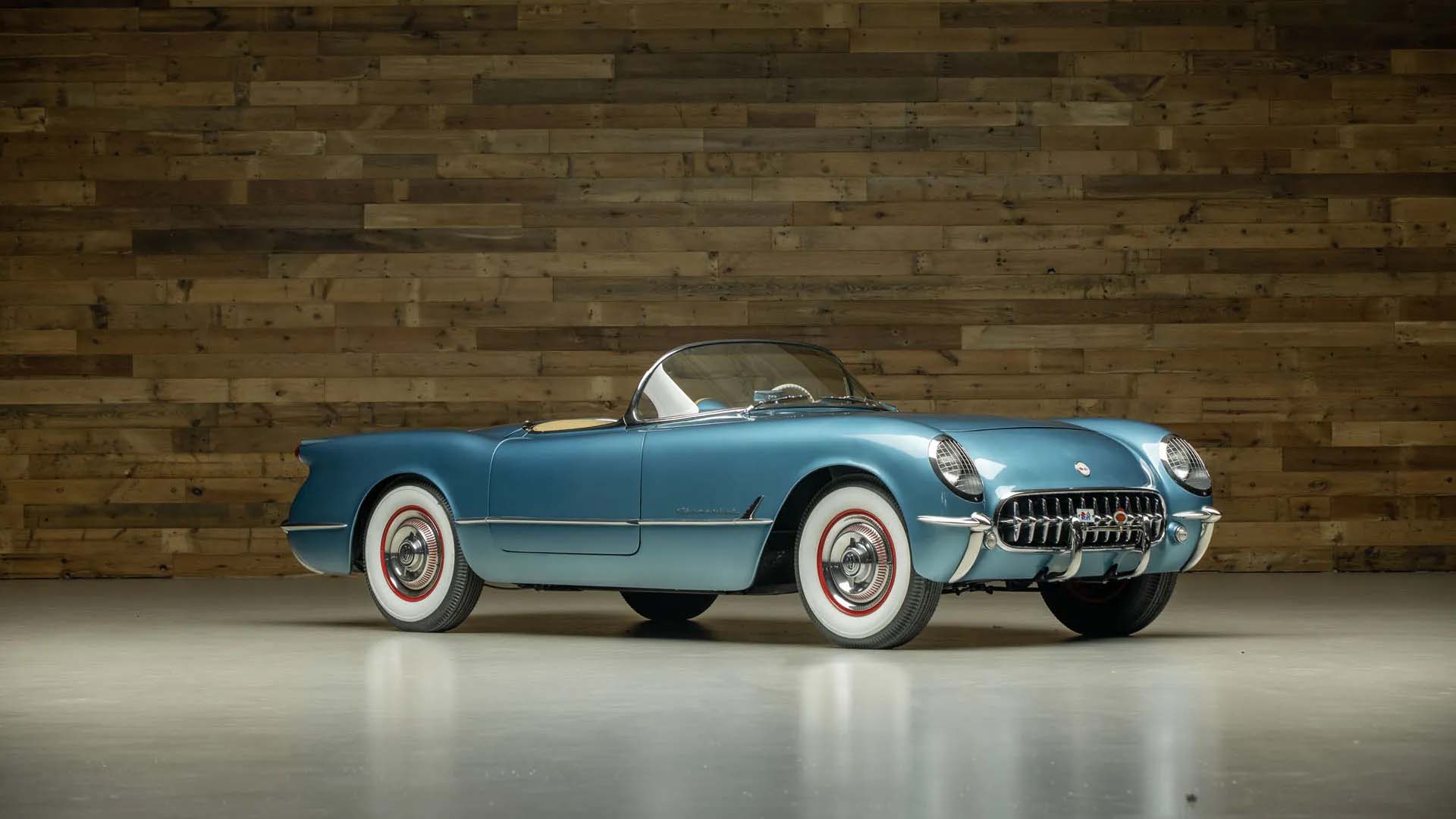
FRONT 3/4 VIEW
The central body section is quite thick and rather blunt, with a big vertical surface bludgeoning the air mass in front of the car.
Transparent aerodynamic fairings were not allowed in the ’50s, but these wired covers were. The car’s profile greatly benefited from their presence.
These four vertical bars across the front end were not really proper bumpers, but they did provide a bit of protection while looking svelte.
Harley Earl loved the 13 “teeth” in the grille, and hung on to them long after they should have disappeared. They were nicely framed, though.
Discreet and unobjectionable turn-signal lamps were further proof of restraint in styling.
No doubt about it: This is one of the slickest, most elegant windshields ever seen on a sports roadster.
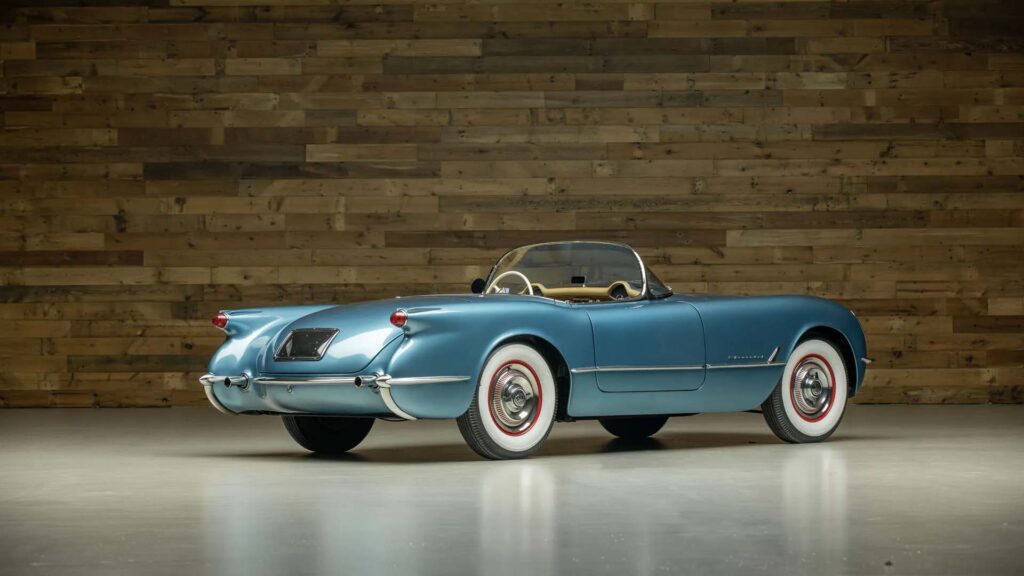
REAR 3/4 VIEW
A perfect detail. The exhausts are straight, direct and a clear statement of power (implied but absent).
The tubular taillight extensions, complete with tiny fins, are the least-attractive part of the design, eliminated early in the Corvette’s life cycle.
The steel wheels were painted red and the dozens of radial indentations in the wheel covers were as well. Also, 1954 was the first year there were four body-color options. All body colors got the same red wheels and radial flashes on their covers.
The simple chrome strip down the side is nice, but on this specific car it seems to kink at the rear door cut to point at the fender trim piece. That’s probably a fitment issue but is a jarring visual disconnect.
The total lack of sun visors allows this simplified and very elegant windshield frame. But it’s also impractical.
The thickness of the body shows the age of the design more than any other aspect of the visuals, including the whitewall tires so desired in 1954.
INTERIOR VIEW
The cockpit looks exactly like the Motorama show car that the Corvette was originally; its seats are set into chrome frames behind them and look really comfortable. The steering wheel seems more suitable for a family sedan than a roadster, and the rows of gauges and controls are ergonomically disastrous, but the layout appears orderly and efficient even if it’s clearly not so. What was unfortunate about borrowing the Jaguar’s dimensions is that headroom with the top up was severely limited. It is interesting to see the sheet-metal-type flanges inside the door openings, making it obvious that the engineers involved knew very little about composite structures and simply replicated details they knew from tin-bending.