
Buy What You Love, Pay What You Should
Thor Thorson
-
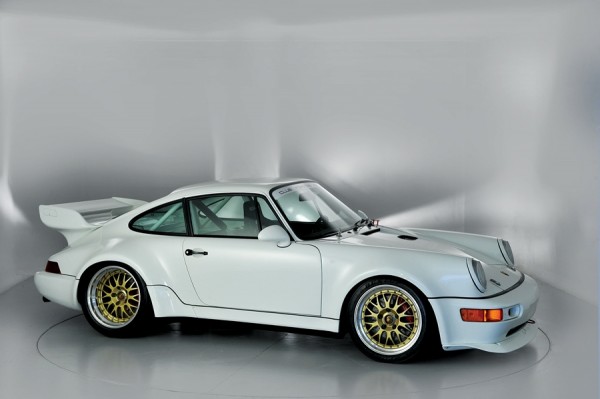
1993 Porsche 911 Type 964 Carrera RSR 3.8-Liter Competition Coupe
Built for privateers to go international GT racing, the phenomenally successful RSR was one of the final developments of the Porsche 911 Type 964, which on its launch in 1989 had represented a major step forward in the development of Porsche’s long-running sports car. Two versions were offered — the Carrera 4 and Carrera 2…
-
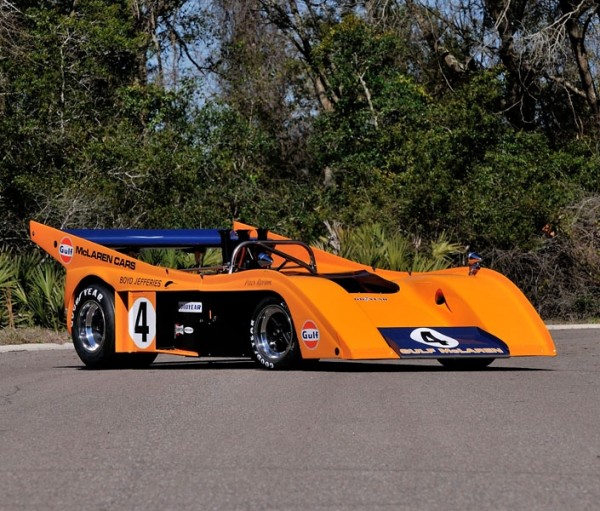
1972 McLaren M20 Can-Am
After several years dominating the Can-Am series with a series of school-bus-yellow racers, McLaren Cars stood up to the developing Porsche challenge with the brand-new 1972 M20. Designers Gordon Coppuck and Tyler Alexander departed from standard McLaren practice in the M20 by removing the radiator from the front of the car and replacing it with…
-

1966 Brabham-Repco BT20 F1 and 1968–69 Lotus-Cosworth Ford Type 49B F1
1966 Brabham-Repco BT20 F1 When the FIA announced in late 1963 that a 3-liter limit would be imposed on Formula One racing in 1966, a scramble ensued among competitors to develop suitable new engines. Jack Brabham turned to Repco, an Australian parts supplier. Development centered on Oldsmobile’s F-85 V8 block, which offered the advantage of…
-

1954 Ferrari 375 MM Plus Competizione
In the winter of 1953–54, Enzo Ferrari concentrated his engineers’ attention upon perfecting a line of large-capacity sports-racing cars for customer sale, backed by a secondary line of smaller variants. To promote and publicize the new sports cars, he approved development of a muscle-bound, outsized “big bazooka” for his Works team. Mr. Ferrari authorized construction…
-
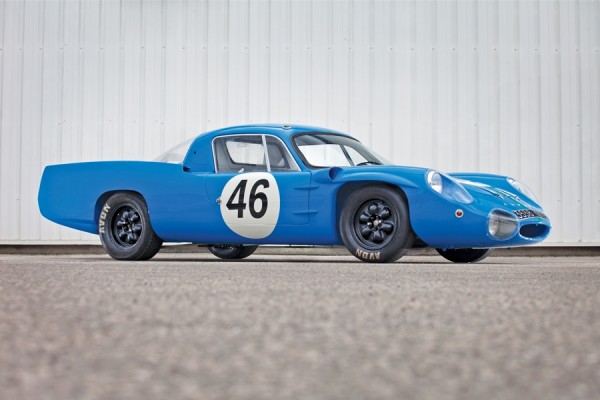
1964 Alpine M64
In 1955, Alpine was founded by Jean Rédélé, who originally modified and campaigned Renault 4CVs but quickly found success in many of the world’s most illustrious sports car races. Soon enough, Rédélé started building his own cars on the 4CV chassis and mechanicals, with the A106 being produced in 1955. Nevertheless, Rédélé’s passion for racing…
-

1968 Porsche 907 LH “Longtail”
Today, Porsche remains the uncontested champion of more endurance races than any other manufacturer, having amassed the most outright wins at Le Mans, Daytona and Sebring. Yet in the early 1960s, Porsche remained an unconventional, small-displacement manufacturer only capable of winning class victories. At the onset of the prototype era, however, Porsche’s strategy on motorsports…
-

1966 Lola T70 Mk II Can-Am Spyder
Lola Cars was founded in 1958 by former Quantity Surveyor Eric Broadley, who was located in Huntingdon, England. His first “production car,” the Lola Mark I, was so superior that it immediately made obsolete Colin Chapman’s previously unbeatable Lotus 11s — as well as all Elvas and Coopers. One of Broadley’s most interesting cars was,…
-

1955 Ferrari 750 Monza Spyder
This car is equipped with a 260-hp, 2,999-cc DOHC inline 4-cylinder engine with two Weber 45 DCO/A3 carburetors, a 5-speed manual transaxle, independent front suspension with transverse leaf springs, De Dion rear axle with parallel trailing arms and semi-elliptic leaf springs, four-wheel drum brakes, and a tubular steel frame. This car finished 5th overall at…
-

1961 Alfa Romeo SZ-1 Coupe
Alfa Romeo’s successful Giulietta range debuted in 1954 with the arrival of the Bertone-styled Sprint coupe, the Berlina (saloon) not appearing until the succeeding season. Veloce models with improved performance followed, and the agile Giulietta SV quickly established an enviable record in production-car racing, notable victories including a Gran Turismo class win in the 1956…
-

1964 Ferrari 250 LM
As Marcel Massini, the pre-eminent Ferrari historian declared, “Ferrari’s 250 LM is one of the most spectacular mid-engined sports cars ever built — a true competition race car rarer than the legendary 250 GTO, and the last Ferrari to win the grueling 24-hour race at Le Mans.” Chassis number 6107 is the 24th car of…