
We were driving our 1971 Jaguar E-type home from a cruise-in at Portland International Speedway. It was rush hour and we were moving along at 5 mph. It was about a 15-minute trip. Suddenly a car cut across a lane and squeezed in front of me. To avoid a collision, I had to lock up all four brakes.
This was unpleasant, but not unusual. The biggest danger in driving old cars in today’s traffic is that a newer car, with its superior suspension and brakes, can turn and stop faster than any classic car.
On the practical side, the hoods to E-types were fitted individually to each body, so if I crunched mine, getting a replacement to fit properly would be nearly impossible.
But the body damage would be inconsequential compared to any physical injury. This car was built 20 years before airbags were mandated. The shoulder harnesses have retractors, but I don’t have much faith in them. I don’t know if the steering column has a safety u-joint in it, or if the neck of the fuel filler has any safety features.
I’ve recently been giving a lot of thought to the lack of safety features in the classic cars we enjoy driving.
As I have mentioned, now that the engine in our 1975 Porsche 911S Sportomatic has been freshened by Matt Crandall’s Avant-Garde Collection (911r on Bring a Trailer), I will have him sell it for me. I like going on the local Porsche Club events, and as they run rain or shine, day and night, I simply want a car I feel safer in, especially as many of the events run through urban areas.
I’ve decided a safe but still sporty choice for me would be a Tiptronic 996. Airbags, good brakes, fast enough, and with factory heat and A/C that actually works.
The 1975 911, while being more “fun” to drive, has none of those attributes. It’s too cold in the winter, too hot in the summer, and on wet surfaces the rear end often likes to overtake the front in turns.
So if you know of a good 996 Tip for sale, email me at keith.martin@sportscarmarket.com.
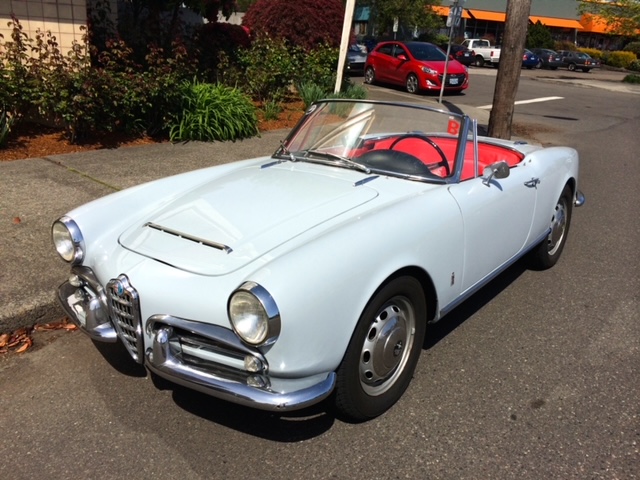
Which brings us back to the initial question. How much do thoughts of car safety concern you when you are driving your classic? Have you put shoulder harnesses in all your cars? (Our 1965 Alfa Romeo Giulia Spider Veloce has only lap belts, and there is no way to easily install shoulder belts.) I look forward to reading your thoughts in the comments.
What do you consider to be a “safe” classic for touring? Are you more worried on freeways or on two-lane roads? When would you stop driving your classic because it doesn’t have airbags or anti-lock brakes. Look forward to reading your answers below.


Read my previous blog posts here.
Subscribe to Sports Car Market and get 12 issues, plus six Insider’s Guides, including access to our complete archive going back 37 years. Join here.
24 responses to “Keith’s Blog: At What Point Does Safety Matter?”
Keith,
You can’t stop driving a classic car just because it lacks modern safety features – it’s in your blood to drive it!
Concerning “or if the neck of the fuel filler has any safety features”, I wouldn’t worry about that either – probably the worst offender is the first generation Ford Mustang with the drop-in tank in the trunk – I’m sure you’ve seen it – it’s an explosion just waiting to happen. I even saw the late, great Lee Iococca on an investigative program telling the interviewer that anybody with an older Mustang should get a new, modern, safe Mustang. They made these Mustangs with the drop-in tank from 1964 1/2 through the 1970 model year, about 2.6 millon, and people STILL drive them, so just enjoy your car (slowly), and let the other obnoxious drivers do what they want away from you.
Glenn in Brooklyn, NY
Safety is a requirement for any driver who has people who love them, full stop. Your kids at the very least. As someone who has has had a stroke and is your age, we need the advantages safety offers. The general driving population is either distracted, aggressive, or metaphorically asleep at the wheel. I am a lapsed Alfisti and not a classic car buff per se, so may not be fully cognizant of the appeal, but suggest you get a 997 PDK, a comfortable EV with good ingress, and keep your favorite classic.
Keith, I am with you. I stopped driving my 64 Alfa spider several years ago because there is no good Alfa mechanic in my area and in today’s traffic I do not want to get hit in the rear. The Alfa has disk brakes in the front and can stop with the best of today’s cars but with Memphis drivers I am not sure that they will stop before I do.
I am the original owner of a 1974 MG Midget. As a poor college student at the time , safety was never a thought only cost. I have one grandson who is almost 6 and is obsessed with cars. He attends cars and coffee events just about every weekend. I have promised him my car and he is excited. On the other hand his mother, my daughter is concerned there are not any air bags and the car is not safe. I only use the car for local club events and think it will be safe for him to do the same. It’s the other drivers you need to be worried about but so far everyone has given me space and a thumbs up when I’m on the road.
Classics are more dangerous on a per-mile basis than modern cars, but are only driven 1/10th as many miles. (It’s the same equation as how much pollution our engines generate.) I stay off busy roads at rush-hour and think about my route in terms of blind turns, dangerous hills and the like. I upgraded the headlights on my ’66. I’ve installed a dual-circuit master cylinder. Shoulder belts won’t work. Safety gear that doesn’t lose me points in a show, yes. Fretting about a classic not having automatic braking and lane departure warnings, nope. There’s real safety and there’s “safety theater.” BTW, I volunteer teach the AARP Smart Driver course. I started doing it so that in the “sharing the road” segment, after talking about motorcycles, bikes and pedestrians, I could harangue students about giving classic cars more space!
Airbag equipped cars are a problematic metric for safe.
That rules out not just classics but older moderns AND, horseback riding, vintage racing, cycling, skiing, scuba diving, general aviation… the list goes on and on.
Have always had a concern about driving my 1966 Shelby GT350 for all of the reasons mentioned. I’ve had it since 1988 and always worried about being hit from the rear, so I drive with one eye on the road and the other in my rearview mirror (also in all cars). Complicating this is a crossmember in the roll bar directly behind my head. During covid, I finally got around to replacing the stock Mustang seats with high back race-style seats. Other safety upgrades include shoulder harness and quartz halogen headlights, even though I hardly ever drive it at night.
I’ve only driven it about 10,000 miles in the 37 years of ownership, so the milage odds are tilted in my favor.
How times change. Back when I was in high school I drove a ’67 VW bug; can you imagine allowing that now with all the 3 ton SUVs and pickups on the road? I’m not sure new lap and shoulder belts would make all that much difference, especially in a smaller vehicle not designed with crumple zones, etc. I think the answer is to be judicious regarding what roads you drive on, and always drive defensively when in traffic. One of my vehicles is a 2005 Jeep GC with only 2 airbags, and while it still runs fine I’ve been thinking of getting a newer model just for the added airbags and other safety features.
Keith. As you well know, as a fellow past TSD competitor , BRAKES are the most critical for any classic sports car; in addition , having a DUAL brake Master Cylinder is critical to avoid a catastrophic failure at speed.
Disc brakes are also preferable to “ Drum”.
I converted my ‘56 Porsche 356A to a Dual Master Cylinder set up , and now I feel more at ease at speed, even with the original Drum brakes. Your idea of a 996 Tip is a good one and with fewer and fewer early 911 mechanics still wrenching , IT’s TIME to make the switch ! DO IT !
I’ll never stop driving my classic cars but what I will do is drive them with ultimate caution and choose my routes carefully.
I think that it was 1969 when the combination of head rests, padded dashboards and collapsing steering columns appeared- later, shoulder harness/restraint systems were added to the mix. Compared to what was mandated before, this was (from a safety standpoint) a big deal. And I hated it. I used to know a guy, an architectural draftsman who worked for Welton Becket (the guy who designed, among other things, the Capitol Records building and the Cineramadome). Dan one day was showing me his collection of vintage fountain pens and went on to describe the machinations of actually using a vintage fountain pen. After telling me about bladders and proper ink I asked, “Why?”. He answered, “Just look at it”. That’s how I feel about metal dashboards, low-slung bucket seats and other, death defying things of beauty.
You’ve got to drive the right classic. Pagoda roof Mercedes were one of the first cars with crumple zones if I’m not mistaken. The R107 series that followed had crumple zones, shoulder belts, and a windshield frame that could support the entire car upside down. Later versions (post ‘84?) even had airbags and antilock brakes. Volvos have had shoulder belts forever. There have been numerous examples of accidents posted on benzworld.com where the car was totaled and the occupants were unharmed. Plus, it’s much easier to find an automatic Mercedes than a Porsche.
For me, the metric is reversed.
I just sold my 1964 Mooney M20E after 46 years and four engines. In spite of his age and antiquated systems, we routinely toured South America, US, Canada, and the islands.
Vehicle safety was not so much the limiting factor.
I reached the intersection of poor hearing, diminishing eyesight, short-term memory lapses, and unreliable waste disposal.
For me, the risk of death or injury has been much less prioritized than the possibility of missing out on all that life might offer.
But, I hope I’m not done yet.
We have one more hurdle to jump and I hope to import my 1977 S2 to Colombia, where we now live. They’ve completed the highway up to and circumnavigating El Volcan del Ruiz. I think the road tops out around 14,000’, and presents about two hours of unbroken curves alongside the mountain sides.
Don’t let life grind you down!
I installed lap belts in my VW in 1955, engineered four-strap belt-shoulder harness in my 1964 356 Super coupe in 1956 for the trip to Sebring from Detroit that year, installed shoulder harnesses in my 1967 Corvair. There is always a safe way to get belts into a car, however much work it may be. So do that, but don’t go crazy worrying about all the things that might happen, just drive and enjoy it, safely belted in.
It’s all relative. And risk vs return. My daily and usual long-distance driver is a 20-year old Mercedes-Benz wagon with ABS, half a dozen airbags, fantastic brakes, a tank-like structure, etc. On the other hand, my fun car, built using the finest French electrical conduit, would literally fold up around me in a serious crash. Of course, I don’t drive it on the interstates, where the wagon excels. When enjoying the 2CV’s unique character, I leave a little more space for braking and console myself that it’s far less dangerous than a motorcycle or even a bicycle.
This topic is rather humorous and reminiscent of conversations I’ve had with others regarding the transportation of children in cars. Now, we dress our kids up in hockey attire, complete with helmet and put them in car seats guaranteed to survive a crash landing on the moon, just to go to the corner store. When we were kids, our parents threw us on the first available seat – front or back, which may or may not have had a seatbelt. My friends and Iused to love folding down the back and middle seat of the station wagon while Mom drove up the twisties on upper Market St. in San Francisco and bounced us from side to side like we were in a pinball machine. Try that today and someone would call Child Protective Services.
Those who survived, mostly thrived, and I suspect did a lot less worrying and required a lot less Prozac. In the same way, people really enjoyed their cars and felt safe in them 30 years ago because they didn’t know better. They had the best tires, brakes and safety glass available at the time and drove accordingly. Now, with cars that do half the driving for us, we’re scared at the thought of going back to those rudimentary times.
I just took my Shelby GT 350 on an 800 mile rally in Northern California last month. I did appreciate that it has shoulder harnesses. But driving it was a lot of work on mostly two lane roads for three days. It was an entirely different experience from my AMG GT roadster. It did not stop on a dime, in fact, I worried about the brakes heating up coming off the mountains. I had to actually pay attention changing lanes because the mirrors didn’t light up if there was an obstruction. The seats did not massage me when I was getting tired at the end of the day, nor warm me up on cold coastal mornings. But I can’t remember the last time I have felt so connected with the road. And that’s exactly why I have it and all of my other older cars, and always will.
Unfortunately I think the answer to your dilema goes beyond a discussion about the safety and mechanical abilities of your classic vehicle(s). Acknowledging our age and physical ability is at least as important a part of this conversation as the cars that we are driving. In my opinion when it’s all said and done that “reality” should be our first safety consideration.
I’ll simply do a “Masten Gregory”, and leap out of the moving car if a crash looks inevitable.
I have a ’69 Dodge Charger that I used to enjoy driving to car events but haven’t within the last five years or so. It is a very original car and is still equipped with it’s original 10″ non power drum brakes. I recently had the brake system completely refurbished which included fitting new drums on all four corners. The brake system works as designed but can’t match the stopping distances of modern disc systems that also include ABS. I still take this car out every other week when traffic is light for maintenance runs but when the wife and I go to car events, we usually take my ’18 Dodge Challenger R/T Scat Pack for safety reasons.
On “The Car Show” (KPFK, Los Angeles), the late Len Frank once addressed child safety issue as follows:
“When riding in cars, children should be kept safe by remaining locked in the trunk at all times”
In the late 1980s (pre-electric-car days), Len also suggested alleviating traffic congestion in L.A. by simply banning the electric (or other power-assisted) starter for internal combustion engines
Miss that show a lot…
Most of my collector cars are big Detroit iron, most with shoulder belts and, after upgrades, disc brakes, with radial tires and gas shocks. They are “OK” as far as handling and crash performance.
The real safety factor is that I drive them in daylight, dry weather, in light traffic and avoid known problem areas. Statisitcs show late, dark, inclement weather and heavy traffic are factors in highest incidence of serious accidents. My yellow 1966 Chrysler Town and Country at least won’t be overlooked by all but the most inatentive drivers.
It’s not perfect but it improves my odds to an acceptable level.
Any Mercedes-Benz built in the 70s or later is safe enough for me. DB was far enough ahead of their time that I feel safe in their cars pretty much anywhere. And we certainly have our share of homicidal fools in our MD traffic.
I have zero faith in airbags. Between the Takata recall and unknown issues as the systems age I have much more faith in a well designed and comfortable belt resistant system. That said I’m also concerned about the effectiveness of aging seat belts. As for rush hour driving I’d be less concerned as seems most incidents then would be low speed low impact events. When driving my 1986 Ferrari 328 I find myself trying to be even more defensive than when driving my everyday car especially when I have a passenger. As to the lucky gentleman who flew the Mooney for many years the construction of that aircraft had a strong almost roll cage around the passenger compartment. Quite a safety feature compared to other single engine aircraft of its design period
Are our cars fit to be driven? Are we fit to drive our cars?