
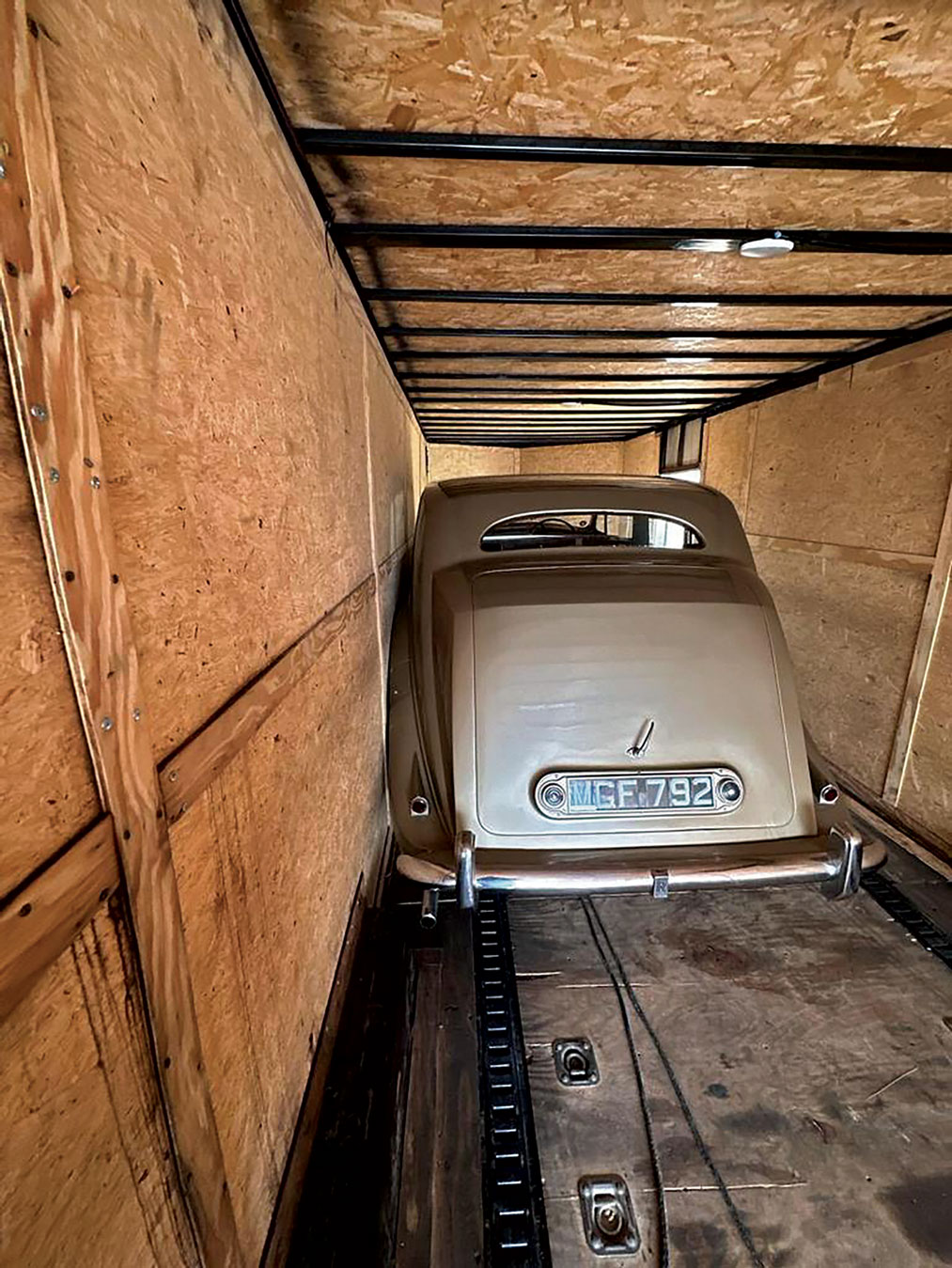

Memory Lane Motors has been a collector car fixture in Portland, OR, for over 40 years, dealing largely in mid-range American and European classic cars. Manager Elan Davis says that in all that time, it has never sold a car at auction. To his regret, he made his first attempt early this year. The dealership had a beautiful 1951 Rolls-Royce Silver Wraith that was languishing in inventory. The ask was a modest $65,000, but it seemed that the right buyer was not to be found locally. So, it consigned the Silver Wraith to the next McCormick’s Palm Springs auction, thinking that […]
Memory Lane Motors has been a collector car fixture in Portland, OR, for over 40 years, dealing largely in mid-range American and European classic cars. Manager Elan Davis says that in all that time, it has never sold a car at auction. To his regret, he made his first attempt early this year.
The dealership had a beautiful 1951 Rolls-Royce Silver Wraith that was languishing in inventory. The ask was a modest $65,000, but it seemed that the right buyer was not to be found locally. So, it consigned the Silver Wraith to the next McCormick’s Palm Springs auction, thinking that would be a better market for this car.
SoCal or bust
Time was short to get the car down to California, and Memory Lane’s regular transport companies were not available. Davis contacted an auto transport broker that the dealership had worked with for 30 years, and the broker quickly located a company that could get the Rolls to Palm Springs in time for the auction.
Soon, two drivers arrived with a two-car enclosed trailer and loaded up the car. Some 25 hours and 1,068 miles later, they arrived at McCormick’s.
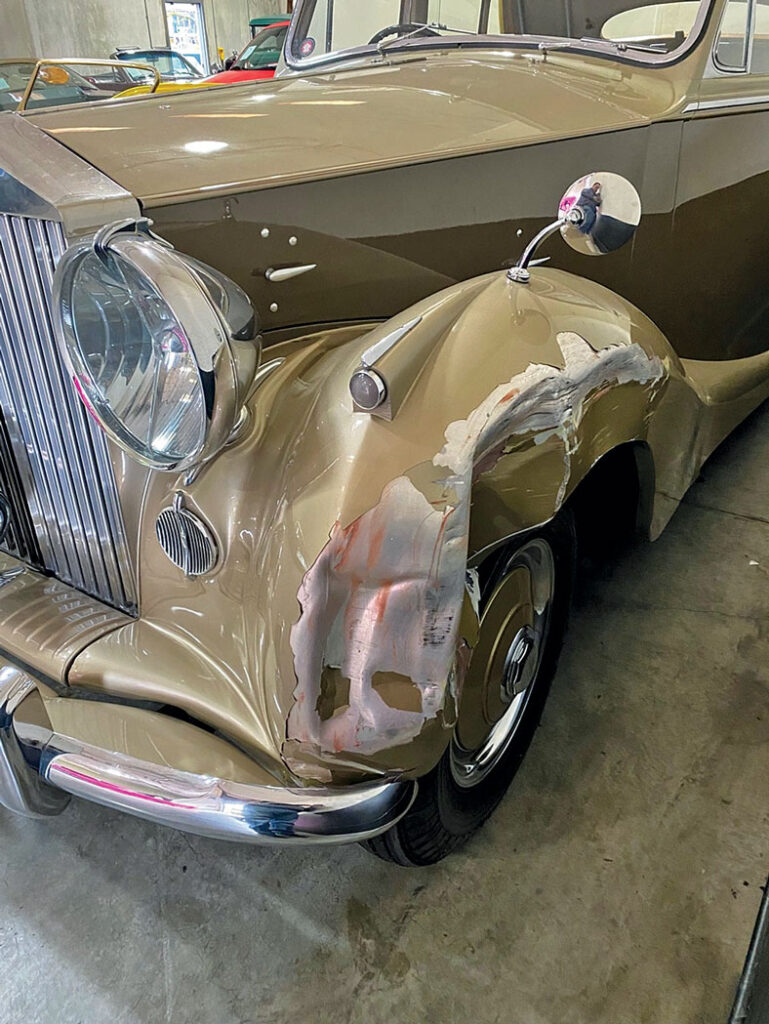
A dealer colleague of Memory Lane was there to accept delivery of the Rolls. As the drivers quickly off-loaded the car and started to drive away, he stopped them and insisted on an inspection. He immediately saw that the Rolls had suffered extensive damage. The left side of the car was mangled, and the wooden frame had been broken.
What happened?
Communicating with the drivers was not easy, as they were non-native English speakers, so it took quite a while to piece together what had happened. They had driven straight from Portland to Palm Springs, stopping once along the way to drop off the second car that was in the front of the trailer. They had to unload the Rolls to do that, and all hell broke loose when they tried to reload it.
Clear, written instructions on how to start and stop the car had been left on the dashboard, but the drivers either couldn’t read them or just ignored them. They had left the electrical switches on, which had killed the battery. Unable to start the car, they decided to winch it into the trailer. They didn’t realize that they had also left the transmission in gear.
Of course, once they started winching the car, that movement bump-started the engine and the Rolls began driving under its own power. It came to a halt only when it had thoroughly jammed itself against the left side of the trailer and couldn’t go any further.
An insurance nightmare
Davis contacted the transport company owner, who apologized for the damage and readily shared his insurance information. However, it turned out that the carrier was no longer the transport company’s insurer. The owner was contacted again, and again he apologized, explaining that he had changed carriers and gave the wrong contact information. After a lot more runaround, Davis finally did connect with an insurance company that actually insured the transport company. Unfortunately, the policy was written to cover only general freight — not cars — so there was no coverage to be had.
About that time the owner stopped answering his calls, and the transport company now seems to have disappeared.
Davis had been reluctant to get Memory Lane’s carrier, Hagerty, involved. It had just written the policy about a month before the damage occurred and he had hoped to handle the claim with the transport company’s insurer. But now he had no choice.
Happily, Hagerty was great to work with. It quickly resolved the claim and paid Memory Lane the $40,500 it had paid for the Rolls. That left Memory Lane out the $1,250 it had paid for the transport, the $500 auction entry fee, and any hope for turning a profit.
The system and its shortcomings
Shipping a car isn’t as easy as just calling a transport company and asking it to pick the car up the next day and deliver it two days later. To keep the service both affordable and profitable, trucks need to always be as full as possible, so a transport company can’t ship your car until a truck with an open spot is available for your trip.
Transport brokers serve the useful function of connecting transport companies and customers. When you contact a broker, they will send your requirements to an entire network of transporters to find one that can meet your criteria. Although large transport companies are easy to find, the smaller ones don’t have the same presence and can be largely unknown to consumers. Brokers make this process easier and quicker than you could manage yourself, saving you time and effort.
Interested in knowing what can go wrong here, I contacted Bob Sellers, Vice President/COO of Reliable Carriers, for some insights. Although Sellers recognizes that transport brokers serve a useful function, his chief complaint is that they don’t really vet the transporter. Instead, many of them simply look for the cheapest price.
“When you place an order with a broker, they shop the haul on an online ‘central dispatch,’ usually getting a number of responses. All too often, they just take the lowest quote,” he says. “Say that is $1,000. They will mark it up to maybe $1,250, keeping the difference as their fee. The more experienced brokers might know that $1,250 is the going rate and quote that to you up front, then shop the job. Maybe they get lucky and get a quote for $800, so they keep $450 as their profit.”
Obviously, these economics are such that brokers are incentivized to go with the cheapest quote, regardless of quality or reliability. Sellers adds, “The brokers do have access to information about the transporters, but it is usually not very detailed and doesn’t provide enough to properly vet the transporter. If brokers are going to fully vet the transporters, that will take deeper digging and much greater effort.”
Liability, or lack thereof
When your car is damaged, legal liability lies with the transport company, not the broker. All the broker did was connect the two of you, so they aren’t liable for any damage. Transport companies are legally required to carry insurance to cover damage to the cars they transport. However, the legally required coverage is only $250,000 per load. Obviously, that is not enough for many collector cars.
Sellers says that his competitors spread a lot of misinformation about their insurance coverage. Some advertise large amounts of insurance, which turns out to be their third-party liability coverage. Their cargo coverage is what covers you, and it can be very limited. It also needs to be automobile-specific coverage — general cargo coverage excludes automobiles.
“One of my competitors advertises that they carry $20 million of insurance coverage,” Sellers says. “But when you ship your car with them, their bill of lading specifically limits their liability to $500,000 per car. So, how much insurance do they really have?”
If you think you would be better off dealing directly with the transport company than a broker, Sellers points out that you will still need to watch out for companies that do both. One company with a fairly strong internet presence has a relatively small fleet of its own trucks and uses them to transport cars. But when it doesn’t have a truck available, it will often broker the job to another company. How that is disclosed to you may be such that you don’t even notice the switch.
The bottom line is that if you have to use a broker, do so, but ask the right questions. As with any transaction of this sort, be sure you read a contract or bill of lading closely. That’s what governs your agreement, not some general statement on a website or something you might have been told. But generally, I’d suggest you stick with the major transport companies if the car you’re shipping is truly valuable. ♦
John Draneas is an attorney in Oregon and has been SCM’s “Legal Files” columnist since 2003. His recently published book The Best of Legal Files can be purchased on our website. John can be contacted at john@draneaslaw.com. His comments are general in nature and are not intended to substitute for consultation with an attorney.
One response to “The Case of the Runaway Rolls”
I’m logged in but the site still won’t let me read the article!