
Buy What You Love, Pay What You Should
Profiles
-
1972 Maserati Ghibli Coupe
By the time the Maserati Ghibli left the factory in Modena, the company had been successfully building luxury supercars for more than a decade. At the heart of their designs were two outstanding engines: the 3,500cc six and the 4,719cc V8, both of which had twin overhead camshafts and provided enough power to sweep the…
-
1970-73 Porsche 911S
The E-type and the 911 share the distinction as two of the most recognizable sports car shapes of all time. Both cars conceptually leapt ahead of the competition when introduced and both had teething troubles in their infancy. But after eight years of production, the E-type had lost its edge and had become somewhat dated,…
-
1973 Porsche 914-4
A completely different Porsche emerged for the 1970 model year to replace the rather short-lived 912. This one carried either the 1679cc Volkswagen four-cylinder or the earlier 2.0-liter Porsche flat six with its 125-horsepower rating. The big difference was that the engines were mid-mounted. The 914 was born out of a joint venture between Porsche…
-
1953 Cadillac Eldorado Custom
n 1953 the Cadillac Motor Car Company introduced the Eldorado line of cars. Original sales brochures described the car as “dramatically styled by Fleetwood to capture the heart of all America.” The standard equipment list read like a menu and it was far and away the most luxurious car America had mass produced in its…
-
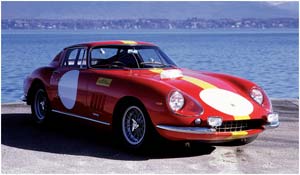
1966 Ferrari 275 GTB/C
This immensely desirable and highly usable Ferrari 275 GTB/C is the third of only 12 such Berlinetta Competizione models produced by the world-famous Maranello factory, and is absolutely not to be confused with the normal, standard production GTB models. Here was a purebred endurance-racing competition car whose fundamental bodyshape and basic technical specification were almost…
-
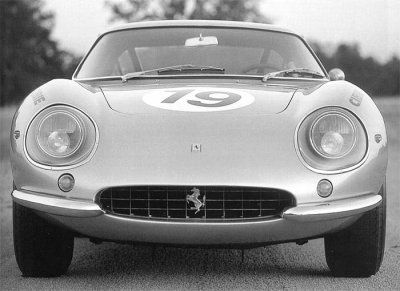
1966 Ferrari 275 GTB/C
The aggressive 275 GTB is today more coveted by collectors than the Lusso, even though the Lusso’s design has endured the test of time-generally agreed as among the most pure and beautiful products to come out of the collaboration between Ferrari and Pininfarina. The 275 GTB has other distinctive attributes, not least its place as…
-
1960 Austin-Healey 3000 Competition
In preparation for the 1960 Sebring 12-Hours World Championship-qualifying race, the Donald Healey Motor Car Company’s experimental workshop at The Cape, Warwick, transported the 3000 competition coupe to the team’s Sebring base at Murphy’s Garage, Avon Park, Florida. The car offered here, UJB141, carried race number 19 and to aid in the identification from the…
-
1937 Bugatti Type 57 S Cabriolet
The Type 57S (S for sport) Bugatti together with the preceding Type 55 model are the two ultimate and most sought after sporting Bugattis of the ’30s, with only about forty examples of each being built. While the Type 55 was closely related to the Type 51 GP with roller-bearing crankshaft and supercharger, the Type…
-
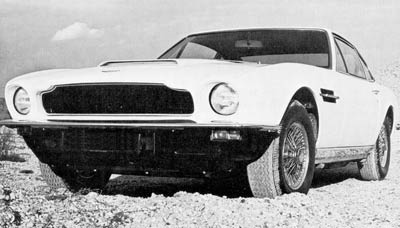
’67-’72 Aston Martin DBS Coupe
A 1967 to 1973 Aston Martin DBS 6 (known briefly in 1972 and 1973 as the AM Vantage) is a fine automobile, equipped with the ultimate version of the twin-cam 6-cylinder motor that powered most of Aston Martin’s post-war cars. These elegant coupes were initially designed for the Aston V8 engine but when the V8s…
-
1985 Porsche 911 Cabriolet
he Porsche 911 is probably the single most recognizable car shape in the world, an instant “Classic.” For those who wanted to feel the wind in their hair while enjoying 911 motoring, Porsche manufactured for many years a “Targa” version of their immortal coupe. This “Targa” incorporated a rollover bar behind the cockpit as crash…