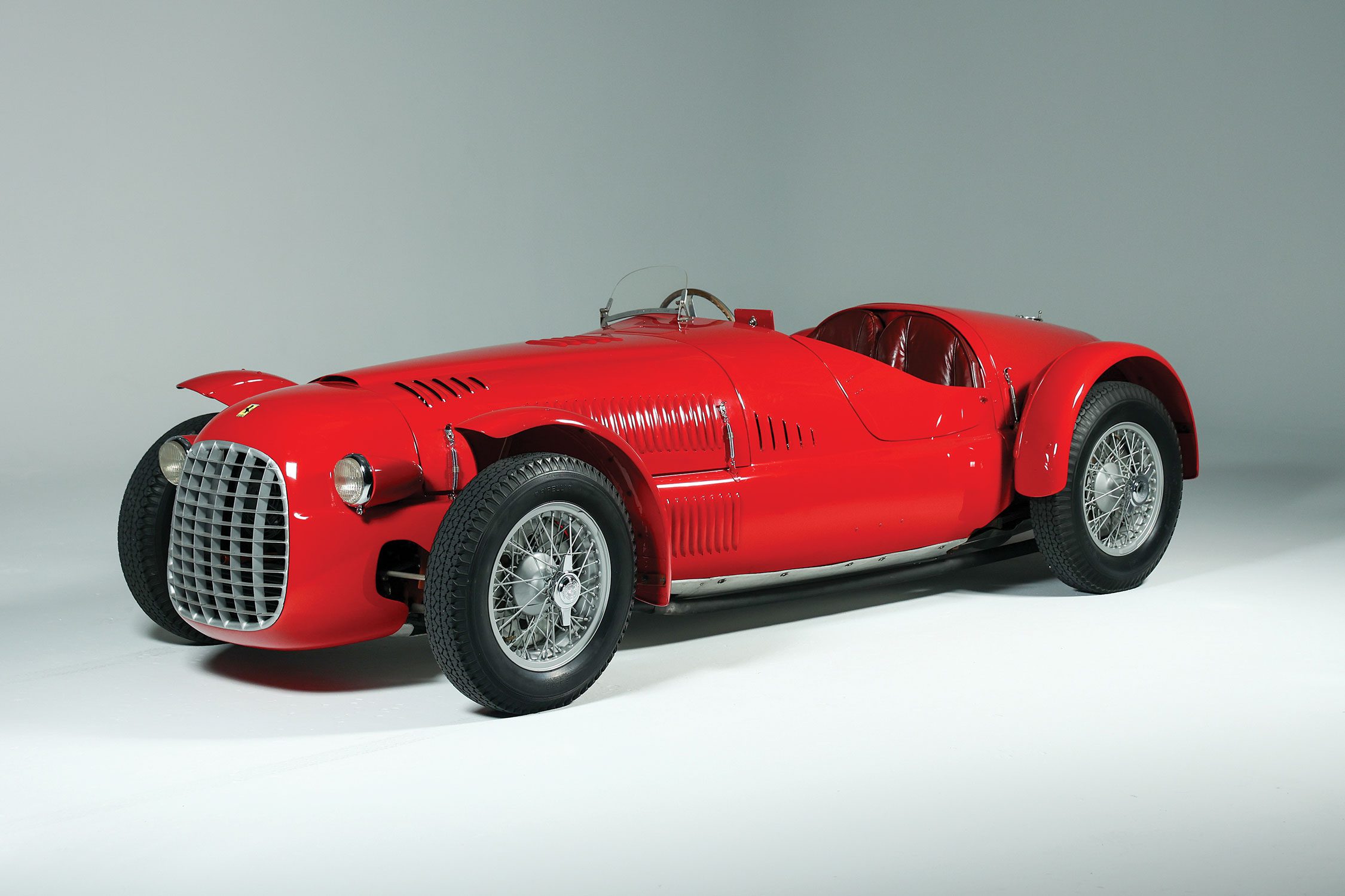
This car, Lot 214, sold for $8,525,192 (€7,543,750), including buyer’s premium, at Broad Arrow Auctions’ Cernobbio, ITA, sale on May 25, 2025.
I have long wanted to write a book on early Ferrari race cars, not to produce a resource for others, but to study the subject myself. In my many years around Ferraris, I have found this niche the hardest to learn. The problem is twofold. First, Ferrari was evolving rapidly, and a car might be configured differently from one race to the next. Secondly, and a greater problem, is that much of the written history is second-, third- or fourth-hand. Mistakes written decades ago have been copied and republished, making them seem like facts.
Enzo Ferrari was concerned with winning races, not producing a cohesive history. Money was always tight around Maranello, and if a used chassis could be upgraded to a new model, Enzo had no concern about creating confusion for historians 40 years later. If a race-entered car was damaged beforehand, switching that chassis number to a different car was not out of the question. Have a tax or political issue? Switching the chassis number of a client’s new car with the number of their old car saved some clients from answering prickly questions.
Enzo’s first order
Brothers Gabriele and Soave Jr. were blessed to be born into the family of Count Soave Besana. He owned a snack food company in Milan (which still exists today), and his fortune allowed his sons to live the lives of playboys. One of their indulgences was a venture into motor racing.
Their quest for the best equipment led them in 1947 to Enzo Ferrari, who was just beginning his journey as a race-car manufacturer. Enzo’s company had developed and successfully raced cars for its in-house team; he was now ready to start selling cars to privateers. Being rich Italians, the brothers were a perfect place to start.
The Besanas became Ferrari’s first customers when they took a leap of faith and ordered two 166 Inter Spyder Corsas, still under development. The Spyder Corsa bodies were attributed to Carrozzeria Ansaloni of Modena. The bodies featured cycle-style fenders and headlights that could be installed for sports-car use or removed for Formula 2. True to the contradictory-history theme, Carrozzeria Ansaloni, which specialized in the conversion of Fiat sedans to station wagons, reportedly wasn’t founded until 1949, which would have been after the brothers’ Spyder Corsas were built!
The brothers quickly put the cars to work. Gabriele received chassis 002C and immediately sent it to South America for the Temporada races, a series of competitions designed to promote Argentina as an international racing hub. Soave received chassis 004C, keeping it in Italy for domestic events. The cars ultimately competed in hillclimbs, Formula 2, the Targa Florio and the Mille Miglia.
Interestingly, Gabriele’s debut race in Palermo, Sicily, was three days before 002C was reportedly delivered to him. This discrepancy was probably clerical, but in an Autosport forum on the Temporada races, contributors noted they could not document whether Gabriele even competed in the races. Contradictory history strikes again.
Raced and retired
Chassis 002C saw competition a couple more times before being rebodied with a sports-car-style body and relegated to non-competition use. A colorful life in the U.S. would follow. Chassis 004C, however, would continue to compete for several more years before being retired. Following a lead, Ferrari historian and dealer Stan Nowak tracked 004C to a Parisian owner in 1964. He purchased the car for $2,800 and brought it to the U.S. for restoration.
Nowak reported 004C’s body had taken some bruising, but the mechanicals were in surprisingly good condition. Recognizing the cost of restoring the car was beyond his means, Nowak sold it to Henry Austin Clark Jr., an heir to the Jack Frost sugar fortune. Mr. Clark was a serious automotive enthusiast and world-class character, as foretold by a business card that titled him as “Photographer of Old Cars and Young Girls.” He collected cars and trucks, as well as automotive photographs and papers. In 1948 he founded the Long Island Automotive Museum, where many area enthusiasts got their first taste of collector cars.
Clark had the resources and interest to properly restore 004C. Nowak oversaw the work, and upon completion of the restoration, Clark’s museum became its home. The 166 was transferred in 1973 to Clark’s son James Clark, who took possession sometime before 1980, when the museum closed.
First, last and other titles pertaining to Ferraris should be carefully researched before being believed. The lowest serial number might not be the first of a model delivered, and the highest serial might not be the last. Nowak once claimed that 004C was the oldest surviving Ferrari. Parsing the claim, it appears he was referring to the oldest example still wearing its original bodywork.
Eye of the beholder
I would love to know how Broad Arrow Auctions came up with its estimate of $6.2m–$8.5m. I have no issue with the car, its accolades, or even the final price — I would just like to know the process used for the appraisal. Ferrari built eight to 10 166 Spyder Corsas, so they are not particularly rare for a competition model. Chassis 004C had a decent competition history, but nothing compared to the 166 MM Barchetta 0008M that won the 1949 Mille Miglia and the 1949 24 Hours of Le Mans. Or the 166 Barchetta 0010M that won the 1949 24 Hours of Spa. Chassis 004C won Best of Show at a major Ferrari concours, but that was back in 2003, so it hardly counts.
The highest previous sale of a 166 was $6,490,000. That was for a 166 MM coupe, arguably a better-looking car. Fifty years of the same family ownership carries some bragging rights, but does it really add value? No previous 166 Spyder Corsa auction had posted a particularly outstanding result, so Broad Arrow must have placed a value on 004C based solely on it being the oldest complete Ferrari.
Collectors like trophies, and 004C was a catch for any serious collector. Most Ferrari historians will concede 002C is older, but the body change puts an asterisk on that. It also knocks 002C out of top concours awards and probably rules out a Ferrari Classiche certification. Ultimately, 004C is such an outlier that valuing it really comes down to what a buyer will pay.
SCM’s auction analyst noted it was “a once-in-a-lifetime opportunity… for a tiny pool of buyers.” Two in the pool wanted 004C badly; one of them paid dearly for the opportunity.