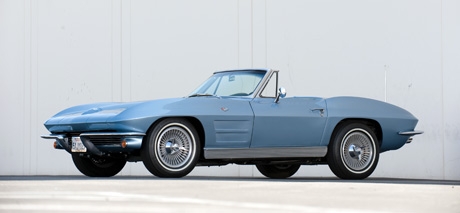
This 1963 Corvette convertible sold for $66,000 at the RM Art Astor sale in Anaheim, California, on June 28, 2008. The estimate range was $60,000–$80,000. So was this car a bargain? Well, yes and no. But before we get to value, a little background.
The redesigned 1963 Corvette was a smash, doubling sales from the record-setting previous year and causing a lead time of up to two months on deliveries. Most orders were placed at full retail; dealers did not have to listen to offers, because demand out-stripped supply.
Demand for both the convertible and the new coupe was so strong that a second shift was needed at the St. Louis facility. Production totaled 21,513, with sales almost evenly split between the coupe and convertible.
Styling exercises for the all-new Corvette began in 1956 with various projects, and the car would eventually be based on Bill Mitchell’s 1959 Sting Ray racer. The C2’s humpback fenders and name were lifted from that car. Mitchell considered the Sting Ray his car, and he worked on the body while Zora Arkus-Duntov refined the chassis.
Second to none
The X-brace frame was gone, and in its place a ladder-type chassis was designed with five cross members. This improved the lateral stress rigidity that was required due to the stress the new independent suspension put on the frame. The wheelbase was shortened by four inches, which improved handling. Car & Driver enthusiastically stated that the Corvette was “now second to no other production sports car in road holding and is still the most powerful.”
Mitchell’s styling was equally stunning. The quad headlights were now hidden, a first since the 1942 DeSoto. Dummy vents in the hood were non-functional due to the accountants’ pencil, and they were often criticized, as was the difficulty in accessing the luggage storage. But the new Corvette looked fast even when parked, and depending on the options, it was capable of world-class performance. In fact, a Z06-equipped coupe won the Los Angeles Times Invitational Race at Riverside on October 13, 1962, besting Carroll Shelby’s new Ford-powered Cobra.
The convertible example offered as lot 333 from the Art Astor Collection was equipped with a 4-speed and the L76 327-ci, 340-hp engine, which was a $107.60 option. However, the auction catalog was noticeably silent about whether this was the original engine to the car. The original four-wheel drum brakes had been converted to discs, and either aftermarket or 1964 knockoffs had been installed.
This Corvette convertible sold at the low end of expectations. The modifications, both seen and unseen, were one reason. But the primary reason was that as iconic as the 1963 Split-Window coupe is, the 1963 convertible is far down the food chain of C2s. Collectors look for the higher-horsepower, disc-braked 1965–67s. Which, in the end, can make 1963s and 1964s good values today.
There was big money in the room for the right cars; a ’63 injected coupe, with a number of body issues but otherwise correct, sold at this auction for $110,000.
With over 10,000 convertibles built in 1963, there will always be plenty of them for sale. Few Corvettes have survived the past 45 years without being changed in one way or another, and the market has shown over and over again that nearly every change from stock diminishes value. For those who are inclined to “improve” their ’Vettes, take note of the potential cost of your handiwork.
Given the overall very nice condition of the car, but also considering the modifications from stock, I’d have to call this priced just right.