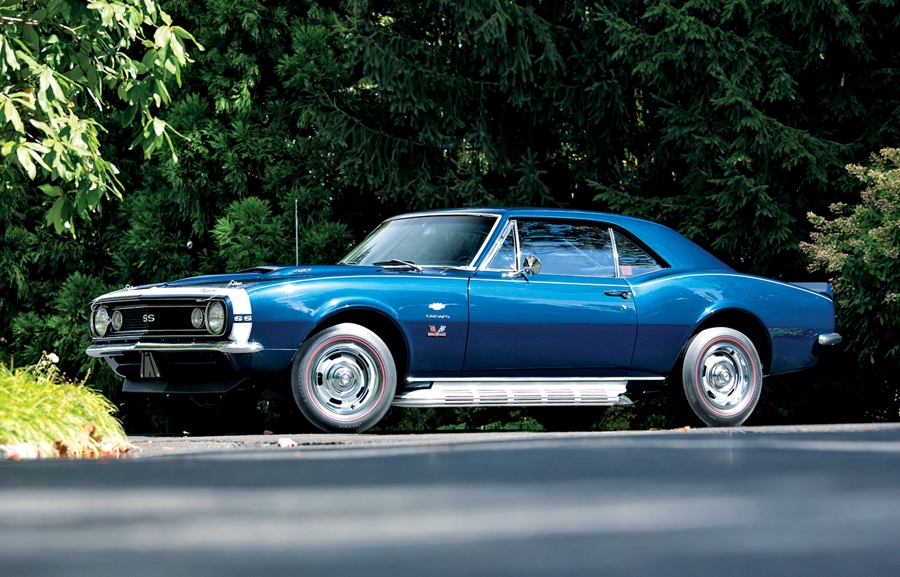
This car, Lot 146, sold for $357,500, including buyer’s premium, at the Gooding & Company auction in Scottsdale, AZ, on January 17, 2015.
Don Yenko was truly a Renaissance man. He possessed a 140 IQ, was an accomplished sculptor and jazz pianist, and learned to fly at age 16. He also served in the Air Force as a meteorologist, then earned a degree in Business Administration from Penn State University, where he was president of the school’s debate club. But it wasn’t until he was 30 years old that Don Yenko returned to his father’s business, Yenko Chevrolet in Canonsburg, PA, and began to make history.
First came SCCA A-Production national championships in 1961 and 1962 racing Corvettes. Then, after he “got tired of looking at the rear bumper of Mark Donohue’s Mustang,” he developed the “Yenko Stinger” Corvair.
In an interview that took place just weeks before he was killed in a crash while landing in his Cessna 210, Yenko told Muscle Car Review magazine, “I was racing when Carroll Shelby came out with his cars. I was pretty much a GM devotee as well as a Chevrolet dealer, so I got to thinking I’d like to be Shelby’s counterpart in Chevrolet.” During 1966 and 1967, Yenko built about 185 of the modified Corvairs, which dominated D-Production racing for many years. But with the introduction of Chevy’s Mustang fighter, the 1967 Camaro, Don Yenko could now battle his friend Carroll Shelby on his own turf.
The Yenko treatment
More than 220,000 Camaros were produced that first year, but just 54 received the Yenko treatment. When introduced, the Camaro’s top powerplant was the 295-hp 350 V8, while the 325-hp 396 big-block V8 was available after November ’66. Working with famed drag racer Dick Harrell, Yenko developed a 427 conversion package for the Camaro.
Whether a 350 or 396 car, Yenko replaced the original engine with a 427-ci L72 crate engine — the same fabled powerplant optional on the 1966 Corvette. The L72 was originally rated at a staggering 450 hp and is considered by some to be the most powerful Corvette engine from the ’60s, although by October 1966 the engine was downgraded to 425 hp, probably to placate the insurance companies. Dyno tests reveal the 450-hp number was probably correct. With this much power on tap, Yenko also upgraded the suspension and brakes to match, and added his own styling touches, such as Yenko graphics and the unique fiberglass “stinger” hood.
So how fast was Yenko’s missile? We have a pretty good idea. A Chevrolet engineer, Doug Roe, invited Car Life magazine to take his 427 Camaro development car for a blast. “That’s my pet,” Roe said. Why would a Chevy engineer build such a beast when corporate edicts prevented them from ever manufacturing one? “We want to keep abreast of what some of our customers are doing,” he told the magazine. Those customers with reputations for performance included Dana Chevrolet in Los Angeles, Nickey Chevrolet in Chicago, Berger Chevrolet in Michigan, and of course, Yenko Chevrolet. With 4.88:1 gears, headers, open exhaust, and Goodyear slicks, Roe was able to crack a 13.5 second quarter at around 100 mph, and thought he could get in the 12s with a little work.
Ringing the bell
So what price glory? Yenko documents show our feature Camaro cost $4,115.20 — over $1,330 more than a basic SS 350. To put it in perspective, a new VW Beetle cost $1,758 in 1967. Also, since this was a dealer conversion, the factory warranty was null and void. “In 1967 and 1968, I had to cover the cars with my own warranty, with no backing from the factory at all,” Yenko told Muscle Car Review. Considering that a factory 396 Camaro was over 1.5 seconds and 9 mph slower, the Yenko Super Camaro made sense for anyone with the need for extreme speed.
It’s believed that just 10 of the 54 Yenko Camaros built in 1967 still exist. That makes them exceedingly rare, yet there have been a few sales in recent years. In March of 2013, Gooding & Co. sold one for $350,000 (ACC# 215565), and Mecum sold another for $344,500 in May of 2012 (ACC# 210882).
Before the Great Recession, ’67 Yenkos were selling for about the same price — I think their rarity and performance potential has helped keep them stable in the market. But a few Nickey Chevrolet 427 conversions built in 1967 have sold for as much as $90k more, which seems odd as I would think the Yenko name and reputation should at least be on a par with Nickey’s. Still, the sale of this Yenko Super Camaro is right on the money in today’s market compared with the previous sales we’ve seen, and both the seller and buyer should be very happy with the result.
(Introductory description courtesy of Gooding & Company.