
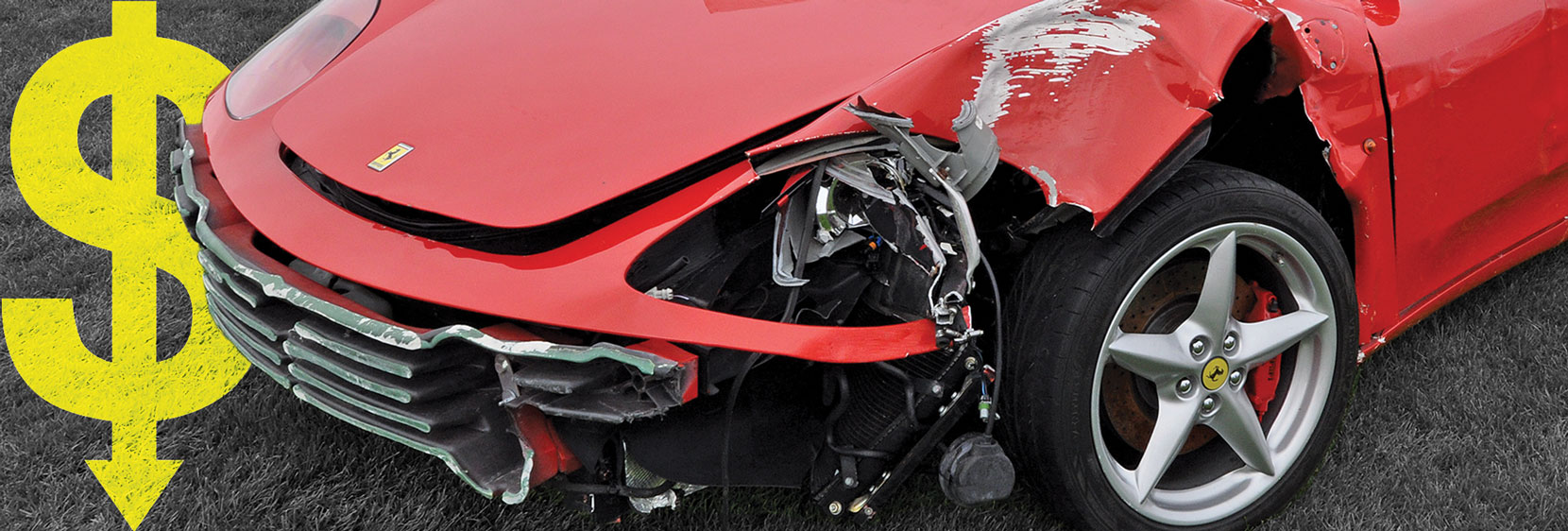

It sure seemed like a great idea. “Pete” was flying all the way across the country for Monterey Car Week, and there was a Ferrari he wanted for sale in Monterey. He planned to check out the car, buy it if it was a good one, and ship it back home with an experienced collector-car transport company. He was already looking forward to taking it on a proper weekend drive when he got back home. Everything went according to plan — until the car arrived. As soon as the Ferrari came off the transporter, Pete saw the front-end damage. The driver […]
It sure seemed like a great idea. “Pete” was flying all the way across the country for Monterey Car Week, and there was a Ferrari he wanted for sale in Monterey. He planned to check out the car, buy it if it was a good one, and ship it back home with an experienced collector-car transport company. He was already looking forward to taking it on a proper weekend drive when he got back home.
Everything went according to plan — until the car arrived. As soon as the Ferrari came off the transporter, Pete saw the front-end damage. The driver admitted that the damage was the transport company’s fault, apologized profusely, and assured Pete that their insurance carrier would cover the damage. The celebratory drive would have to wait.
The Ferrari was loaded back onto the transporter and the transport company hauled it to the nearest Ferrari-authorized collision center, free of charge. The repair estimate was just shy of $40,000. The repairs were done perfectly and the insurance company paid the bill.
But Pete pointed out that his previously perfect Ferrari was now a smashed-and-repaired Ferrari — and now worth considerably less. This is called “diminished value.”
“Sorry,” the insurance adjuster replied. “We don’t cover that.”
Pete contacted his regular lawyer, New Orleans attorney and lifelong Porsche guy Ernest A. Burguières. He then brought in a diminished-value specialist, Houston lawyer Mike Shoemaker. You may remember Shoemaker from “Stealth Claim” (“Legal Files,” June 2019).
As hard as this is to believe, Shoemaker and Burguières had to give Pete some bad news. There were two very good reasons why there was nothing they could do about his plight — the transport company’s bill of lading, and the Carmack Amendment.
Limited liability
When the Ferrari was picked up in Monterey, the driver presented Pete with a number of documents to review and sign. One of them was his contract with the transport company, which was called a Bill of Lading. Everything looked fine — the shipping fee was as quoted, standard insurance was included, and the delivery date was to be as promised. Pete signed the bill of lading, watched the Ferrari get loaded onto the transporter, and headed for Laguna Seca.
Unfortunately, Pete did not think anything of the language on the bill of lading which stated that the agreement was subject to all of the terms on the reverse side. That included a number of “standard” but highly undesirable contract terms:
The shipper agrees that the transport company will not be liable for any loss of market value or loss of use during any vehicle repair.
The rights of the parties are governed by New York law.
Any lawsuit must be brought in Suffolk County, NY.
In a dispute, the prevailing party is entitled to recover their attorney fees from the losing party.
Pete was astounded by these provisions. “I never saw them, and if I had, I never would have agreed to them,” he said.
Unfortunately, Shoemaker and Burguières had to explain to Pete that none of that mattered. He signed the front. It referenced the provisions on the back, making them part of the contract. Ignorance is not much of an excuse, and the liability limitations were very likely to be enforceable.
Because Pete didn’t read the back of the bill of lading, he gave up his right to be compensated for diminished value and loss of use damages — each of which was a potentially $200,000 claim. To make matters worse, if Pete tried to challenge these provisions, he would have to litigate the case in Suffolk County, a long way from home. And if he lost, he would have to pay the transport company’s legal fees.
More bad news
Even if the terms of the bill of sale could be challenged successfully, Pete might still be out of luck due to federal law.
The Interstate Commerce Act of 1887 was adopted to regulate the relationship between shipping companies and the owners of goods being shipped. Before its adoption, state laws regulated these relationships. Where goods were shipped between two or more states, not only was there confusion about which state’s law would apply, but the laws themselves could differ dramatically.
The Interstate Commerce Act was revised in 1906 with legislation referred to as the “Carmack Amendment.” Named after the senator who introduced it, it applies to the interstate shipment of all types of goods, including cars.
Under the Carmack Amendment, the transport company is liable for the actual damages to cargo that is damaged during transit, whether or not the damage is due to their fault. This strict liability (there are some limited exceptions for things like acts of God) is a good thing for shippers, as they don’t have to go through the finger-pointing of who caused what.
But the transport company’s liability has traditionally been limited to the cost of repairing or replacing the damaged goods. It has traditionally not included what the law describes as “consequential damages.” Consequential damages are generally indirect damages that are incurred as a consequence of the loss. Direct damages in our case would be the cost to repair the vehicle. The consequential damages would be the diminished value and loss of use.
Some modern courts have recognized that consequential damages can be recovered under Carmack because they are part of the actual damages that the transport company is liable for. But that interpretation of the law has not been accepted in all states. In Pete’s case, his situation was to be governed by New York law, which is not favorable on this point.
Stuck without a remedy
What about Pete’s insurance policy, which was written by a well-known collector-car insurance company? Shoemaker and Burguières tried that approach but learned that the policy excluded coverage for diminished value and loss of use.
They were stuck between the proverbial rock and hard place. The bill of lading denied Pete’s claims. Even if they got over that hump, Carmack could cut them off. If they tried to get past these barriers and lost, Pete would be liable for the transport company’s legal fees, as well as his own. That made litigation prohibitively expensive and risky. The decision was made not to pursue a suit at this time.
Takeaways
What can we learn from Pete’s unfortunate experience? First off, read what you are signing. Don’t get fooled by “standard” contracts. What makes them “standard” is that they always benefit the party who wrote them. Read them and know what you’re getting into.
Second, look for specialized insurance coverage. When you are in a crash and it’s the other driver’s fault, their insurance policy has to cover your diminished value because the other driver is liable to you for it. But when your claim falls under your own policy, most car insurance policies, whether written for collector cars or non-collector cars, exclude diminished-value coverage. That’s why Pete’s insurer was not responsible for that part of the loss.
We asked Paul Morrissette, President, Chubb Insurance Solutions Agency, if there was anything that could be done to expand the typical coverage. “Chubb does offer diminished-value coverage on an optional endorsement basis. The endorsement is offered on a car-by-car basis or for an entire collection, and the additional premium is individually underwritten in each case. The additional premium varies based on the model, age and value of the car,” he said.
That makes perfect sense. Diminished value is less of a problem for more “normal” cars, but would be highest for a never-restored Ferrari GTO with all its original paint still in good condition.
Hagerty CEO McKeel Hagerty adds, “Moving cars is risky. There are companies that offer transport coverage, but it is often very limited in nature.” As for diminished-value coverage, Hagerty states, “Many of our policies offer (it). It’s dependent on the policy type and state in which the policy is written.”
All this sounds like you should be sure to call your insurance agent before your car gets loaded up. ♦
John Draneas is an attorney in Oregon and has been SCM’s “Legal Files” columnist since 2003. His recently published book The Best of Legal Files can be purchased on our website. John can be contacted at john@draneaslaw.com.
ERNEST A. BURGUIèRES is a civil litigator in New Orleans and can be reached at neworleansatty@gmail.com.
MIKE SHOEMAKER is an attorney in Houston and can be reached through MikesLawPractice.com.
Their comments are general in nature and are not intended to substitute for consultation with an attorney.