
Buy What You Love, Pay What You Should
Columns
-
1969 Renault Alpine A110
Presented at the Paris Auto Show in 1963, Jean Redele unveiled the Alpine A110 after his prior successes with the A106 and A108. The A110 was a true departure for the company as styling was largely revised and the Dieppe-based firm began building one of their more respected models that would remain in limited production…
-
My Green Ferrari
The car hauler should be pulling up any day now, delivering the newest addition to the Martin-Banzer menagerie. Or is that collection?It’s a 1984 Ferrari Mondial Cabriolet, in the distinctive color of light metallic green, with a tan leather interior. A birthday present, sort of, it came into my life this past December 22, the…
-
1970-75 Citroën SM
In its day, the Citroën SM was a deserving member of the supercar ranks. Capable of 0 to 60 in 8.6 seconds, and with a top speed of 140 mph, the Citroën SM offered a unique blend of Gallic insouciance and Italian con brio. When introduced to the US in 1971, the SM was selected…
-
1967 Mercedes-Benz 230SL Roadster
The 230SL, along with its later variants, the 250SL and 280SL, comprise the third generation of the Super Leicht (“super light”) models that began with the 300SL in the 1950s. This new model introduced in 1963 at the Geneva Motor Show was an immediate hit, doubling the sales rate for even the best year of…
-
1966 Shelby GT350 H
The Mustang was the first of the pony cars and the most charismatic. When equipped with a high-performance, 289-cubic-inch, 271-horsepower engine, they became favorites at the stoplight drags. However, once sports-car maestro Carroll Shelby got his hands on the Mustang, they entered a different league. With subtle but critical modifications to the chassis and engine,…
-
1928 Alfa Romeo 6C 1500 Sport Zagato
After joining Alfa Romeo in 1923, Vittorio Jano created the all-conquering P2, an expedient design based largely on Jano’s experience with Fiat’s 1923 Tipo 805 GP car. Jano refined the best elements of the Tipo 805 and designed around some of its weaknesses. But this was not the creative Jano, it was the practical engineer…
-
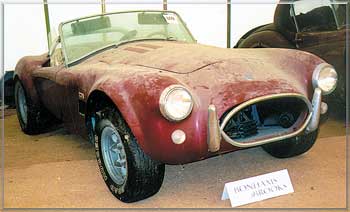
1959 AC Ace “Cobra” Roadster
The success of Cliff Davis’s successful Tojeiro sports-racer prompted AC Cars to put the design into production in 1954 as the Ace. The Davis car’s pretty Ferrari 166-inspired Barchetta bodywork was retained, as was John Tojeiro’s twin-tube ladder-frame chassis and Cooper-influenced all-independent suspension, but the power unit was AC’s own venerable two-liter long-stroke six. This…
-
1989 Lamborghini Countach Anniversary
The Countach debuted at the Geneva Auto Salon as a show car in 1971 and was introduced to the European market in 1974. In polite terms, the name Countach is Italian slang for “Good Lord!” or simply, “Wow!” This exclamation aptly describes most car lovers’ response on seeing the car for the first time. Wildly…
-
Mooners and Masterpieces
January and August are the two busiest months on the collector car calendar, but they are as different as desert and ocean. August in Monterey is a three-day spectacle of disposable wealth, with million-dollar cars selling haphazardly across the Peninsula the way oils are splashed on a Jackson Pollock painting. January in Arizona is more…
-
1979-85 Mazda RX-7
In 1979 Mazda jumped into the two-seat sports car market with the basic, no-frills, rotary-powered RX-7. The car was an instant winner, and Road & Track referred to it as “a major breakthrough for the enthusiast.” Its primary competition, the once lean and mean Datsun 240Z of the early ’70s, had become the 280ZX, an…