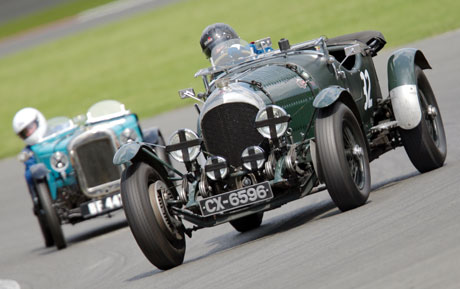
This car sold for $356,400, including buyer’s premium, at H&H’s auction in Buxton, Derbyshire, England, on December 9, 2009.
This is one of those cars that ends up with check marks in virtually all of the collector interest and value boxes-both the good ones and the bad ones-and as such is a great study in what matters and why when it comes to vintage English bad boy toys.
First, I need to lay some groundwork so what comes later makes sense. It’s useful to understand that the architecture of all Bentley engines is basically the same: a single overhead cam, four-valves-per-cylinder arrangement with a cast cylinder block incorporating the combustion chambers and sitting on an alloy crankcase that includes the cam drive.
This was the layout for the 3 Liter and was simply expanded for later models, though the cam drive changed substantially.
Next, the chronology of vintage Bentley models is a bit different than most people assume. The 3 Liter came first and was a great success, in production from 1921 through 1929. The problem arrived when customers and coachbuilders wanted heavier bodies than the 3 Liter could effectively propel.
The solution was simple; expand the 3-liter four to a 4½-liter six (with a silent cam drive more appropriate to luxury motoring). This was accomplished and the prototype completed in time for it to be W.O. Bentley’s personal transportation to and from the 1924 Le Mans race.
The 4½ Liter was meant to fill the gap
The car worked just fine, except that Bentley happened upon the prototype Rolls-Royce Phantom on the way home and got thoroughly thrashed in some impromptu but spirited road competition. Immediately after this the 4½-liter six concept was thrown out and dimensions were increased to 6.6 liters, officially called the 6½, or Standard Six. This model entered production in 1926 and continued through until the demise of the independent company in 1931.
The 4½ arrived shortly after the introduction of the 6½ and was intended to fill the gap between the relatively light 3 Liter and the now seriously big six in Bentley’s product line. The engine was created by effectively taking two-thirds of the 6½ block and fitting it onto the 3 Liter crankcase, so the dimensions of the 3- and 4½-liter engines were pretty much the same.
Legend and common knowledge have it that Bentley was a high-performance and racing car company, and indeed that was a passion at the top, but the reality was that what supported the business was building luxury saloons for wealthy Englishmen. The 4½ chassis was designed with a twelve-inch-longer wheelbase and was substantially heavier than the short 3 Liter, so it could carry bankers’ bodywork, not racers’.
The fact that the new 4½ engine could bolt right in to replace a 3-liter was not lost on anyone at the factory, though. The first 4½ was fitted to a 3 Liter chassis for Le Mans in 1927 (the only true “factory” 3/4½, it went very well until the chassis broke), and Bentley built nine 4½s to special order using the short chassis of the Speed 3 Liter (mostly for racing use). These “shorties” quickly became legend as the most potent and best handling Bentleys of the vintage era, and they were the inspiration for what we now call the 3/4½ Bentley.
Bentley collectors less demanding about “original”
So exactly what is a 3/4½? Basically, it’s a replica “Shorty” 4½ created by taking a used short 3 Liter chassis and installing a 4½-liter engine, along with whatever sporting bodywork and upgrades match your fancy. There is no such thing as a “matching-numbers” 3/4½. They are all, by definition, hot rods built up by private enterprise long after the factory ceased production. They are “bitsas,” but in a good way.
One of the interesting characteristics of Bentley collectors is that they are much less demanding about “original everything” than many of their Italian marque counterparts. Cars with original engine, body, etc. are far more valuable than those assembled from “bitsa this car and bitsa that one,” but nobody is excluded from the club or even disparaged for owning one; everybody is welcome to play.
In fact, people playing with exactly this kind of car originally formed the Bentley Drivers Club in the 1930s. In the 3/4½ category, the relative values are a function of both how long ago the car was created and its period history. There were at least a few (nobody knows for sure how many) built in the 1930s and raced in period, and there were many more created in the 1950s and ’60s. Generally, older is more desirable.
This example appears to have been built in the ’80s and almost undoubtedly has a new engine and transmission (both of which are easily available); the body makes no claim to being old. As a result, it isn’t as collectible as more “real” examples, but it’s going to be faster and more usable (you don’t have to worry about damaging history) while still almost as universally acceptable.
If you wanted to own the “best” Bentley short chassis 4½, with all its original components, factory racing history, etc., you would expect to pay well over $2 million, even in today’s market. A period-built 3/4½ with racing history from the 1930s on will cost at least $500,000; the post-war conversions are appropriately less.
This car fits well down the value scale, but the point is that it is on the same scale. It is accepted in the Bentley world, will be welcome wherever Vintage Bentleys play and compete together, and it will be bloody fast and well fettled to boot. Considering all that, I’d say correctly purchased and sold.