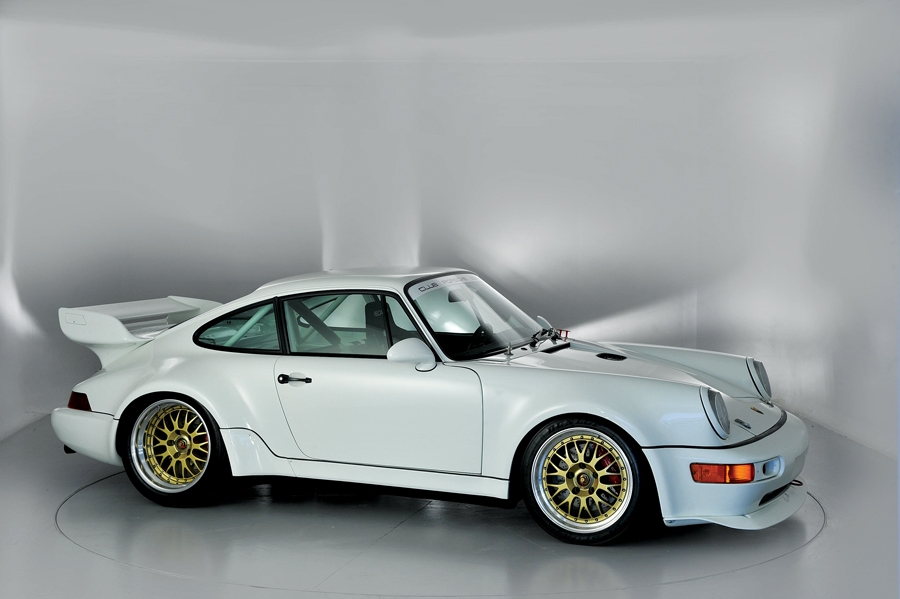
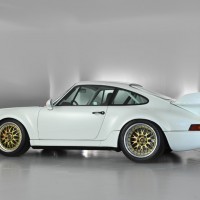
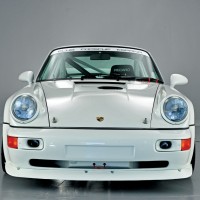
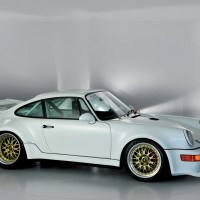
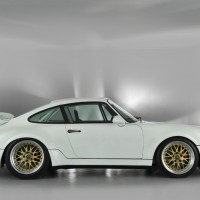
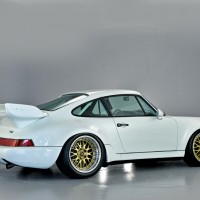
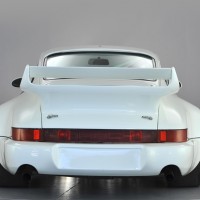
Built for privateers to go international GT racing, the phenomenally successful RSR was one of the final developments of the Porsche 911 Type 964, which on its launch in 1989 had represented a major step forward in the development of Porsche’s long-running sports car.
Two versions were offered — the Carrera 4 and Carrera 2 — the former marking the first time that four-wheel drive had been seen on a series-production model. Porsche had experimented with four-wheel drive on the 959 supercar, and many of the lessons learned from the latter influenced the design of the new Carreras’ chassis and suspension.
Face-lifted but retaining that familiar shape, the newcomers had been given a more extensive work-over mechanically, 87% of parts being claimed as entirely new. The pair shared the same 3.6-liter, flat-six engine, and power-assisted steering (another 911 “first”). Anti-lock brakes and a 5-speed manual transmission were standard on both, with the Tiptronic auto gearbox a Carrera 2-only option. Its new engine enabled the 964 to out-perform the old 3.2-liter yet still meet the latest emissions regulations.
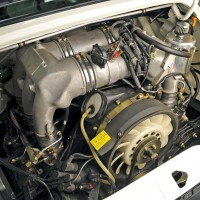
Evoking memories of the legendary 2.7- and 3.0-liter RS and RSR “homologation specials” of the 1970s, in 1992 Porsche introduced a Type 964 Carrera RS, which was a lightweight variant like its illustrious forebears. It was based on the Carrera Cup competition car and sold exclusively in the European market. The Carrera RS retained the 3.6-liter engine, albeit boosted in maximum output to 260 horsepower, but for the following Carrera RS 3.8, the bore size was increased by 2 mm for a capacity of 3,746 cc. Maximum power went up to 300 hp, and this M64/04 engine was installed in a wider, Turbo-style body, also used for the RSR competition version. It is estimated that only 55 of these 3.8-liter cars were made.
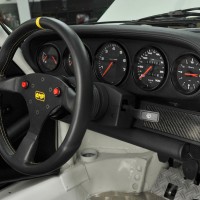
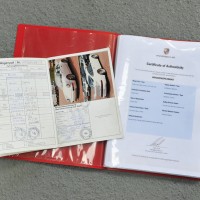
This particular RSR was delivered from the factory in May 1993 to Joest Racing, the famous Porsche exponents and many-times Le Mans winners. Joest Racing’s letter on file states that the RSR had been purchased for use in the newly conceived Warsteiner-ADAC GT Cup series. Offered with the aforementioned documentation and Porsche Certificate of Authenticity, this car represents a possibly once-in-a-lifetime opportunity for collectors to acquire one of these ultra-rare and highly sought-after RSR racers.
This car, Lot 272, sold for $729,662, including buyer’s premium, at Bonhams’ Goodwood Revival auction on September 13, 2014.
In the early 1990s, Porsche had an interesting problem on their hands. As a company it was doing well and its cars were actively raced all over the world, but only in regional and national series like IMSA in the United States and ADAC in Germany, and in club Carrera Cup events virtually everywhere.
With the end of FIA Group C (prototypes like the 962) and having somewhat ignominiously exited both U.S./Indy Car racing and Formula One, Porsche found itself with a 40-year tradition of international dominance in motor racing suddenly at risk. They had chosen not to participate in the successor series to the FIA Group C, so the only viable approach was to make a stand in GT racing. The problem with this was that international GT racing had more or less disappeared from the scene.
This was a very tough period for sports-car racing in general, with even Le Mans in serious financial difficulty and no clear international promotion available. The FIA had a GT class, but it was not an international series. Jürgen Barth observed that there were eight different sets of GT regulations in place at the end of 1992, so trying to build a suitable car and create an appropriate series to run it in presented a challenge.
Porsche solved this by getting together with a small group of European promoters to establish a single set of rules — and then talking Le Mans into going along with them.
Making the 964 into a race car
The next challenge had to do with coming up with a suitable car for the series. The shortcomings of the 964 series of cars were not lost on Porsche (heavy and not very agile by their standards, particularly as applied to the flagship Carrera 4 series) and the successor 993 was well into the planning stages, but they needed a car for the 1993 season. So the 964 Carrera 2 was chosen as the place to start.
The result was the 1993 Carrera RS 3.8. It received a substantial — if subtle — reworking of the pistons and intake system for more horsepower and torque, front brakes from the 3.6-liter turbo, wider wheels, aluminum doors and front deck, fiberglass rear deck and spoilers, and suspension settings learned from the Carrera Cup cars.
There are several important things to mention here: The RS 3.8 was a strictly European-specification car that was never imported into the U.S. — the RS America that was sold in the States was a completely different car, and the RS 3.8 was in fact just a homologation special to meet production rules for the new series.
A German magazine opined that anyone who bought one for use on the road “had too much money and too little sense.” The car was expensive, noisy and uncomfortable — but served its purpose.
Out-of-the-box racer
The purpose, of course, was to serve as the basis for a very serious Porsche factory racing car, the 3.8 RSR. The engine from the RS was further modified with more compression, more aggressive mapping of the engine-management electronics, and a freer exhaust, giving officially 325 hp at 6,900 rpm, but it was really more like 350 hp at 7,400 rpm. The chassis got a racing clutch and bigger brakes, along with a fully rose-jointed suspension and even wider wheels with appropriate bodywork, and an even more aggressive rear wing/spoiler assembly.
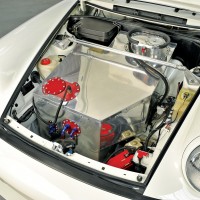
Its running weight was just over 2,500 lbs. — about 350 lbs. lighter than the base car. The entire package was offered complete from the factory for $160,500, with the only options being center lock wheels, on-board jacking, and a passenger’s seat if you wanted one. Although it seems like a lot of money, the car as delivered was absolutely complete and ready to race out of the box, no additional preparation required.
And it proved to be an extremely competitive car. In 1993, RSRs won outright at the 24 hours at Interlagos, and Spa, and took class honors at Le Mans. They remained very competitive through 1994 and were getting class wins into 1995.
Too new and too old
I will step back at this point and mention that this is a far newer car than I would normally write about. When it was introduced new, I was well over five years into the vintage-racing-car business, so it is comfortably outside the realm of cars that I am accustomed to or understand.
So I have spent substantial time trying to understand what it is that makes the 3.8 RSR special — and presumably collectible. It is simultaneously too new to race in vintage events and far too old to race as a contemporary racer, so whether it can run at the front is not a serious consideration.
My discussions with Porsche anoraks suggest that the era of the “air-cooled” Porsche more or less peaks with the 3.8 RSR. As the original 911 evolved and got ever better, there were variations, and in general I get the impression that the 964 was less than the greatest of the series: They tended to be heavy and a bit clumsy — more fast tourers than true sporting/racing cars.
With the 3.8 RSR, however, Porsche went back, addressed the problems, and created pretty much the ultimate air-cooled Porsche. Although it is strictly a track car, I’m told the RSR is a joy to drive, light and precise in the steering, a wonderfully balanced combination of stick, handling, and power, and with absolutely phenomenal brakes. It also still pretty much looks like an original 911 — much swoopier than the 993s that came along next and marked the official end of the air-cooled Porsche.
Air-cooled Porsches skyrocket
As arguably the last of the great air-cooled Porsches and certainly one of the most iconic of the newer ones, it is also heir to the market value they carry. Bruce Canepa observed recently that every really good air-cooled Porsche — 356 to 993 — has more or less doubled in value in the past year. Nobody knows (I certainly don’t) whether this is a spike or a trend, but in either circumstance it makes spending lots of money on a car like this one seem like a rational decision. I would say fairly bought. ♦
(Introductory description courtesy of Bonhams.)
1993 Porsche 911 Carrera Rsr Comp Coupe Bbswheel
1993 Porsche 911 Carrera Rsr Comp Coupe Driversfront
1993 Porsche 911 Carrera Rsr Comp Coupe Driversinterior
1993 Porsche 911 Carrera Rsr Comp Coupe Driversrear
1993 Porsche 911 Carrera Rsr Comp Coupe Engine
1993 Porsche 911 Carrera Rsr Comp Coupe Front
1993 Porsche 911 Carrera Rsr Comp Coupe Fuelcell
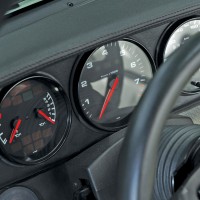
1993 Porsche 911 Carrera Rsr Comp Coupe Gauges Closeup
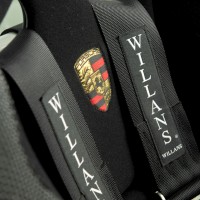
1993 Porsche 911 Carrera Rsr Comp Coupe Interiorharness
1993 Porsche 911 Carrera Rsr Comp Coupe Passfront
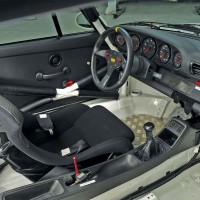
1993 Porsche 911 Carrera Rsr Comp Coupe Passinterior
1993 Porsche 911 Carrera Rsr Comp Coupe Passinterior Closeup 1993 Porsche 911 Carrera Rsr Comp Coupe Passinterior Closeup
1993 Porsche 911 Carrera Rsr Comp Coupe Passprofile
1993 Porsche 911 Carrera Rsr Comp Coupe Passrear
1993 Porsche 911 Carrera Rsr Comp Coupe Provenance