

For as long as I can remember, I’ve been in love with the automobile. I find the sights, sounds, smells and sensations intoxicating. Long before I had the financial wherewithal to begin collecting cars, I was an enthusiast. I was born in 1960, and my earliest automotive “education” came from television, movies and the pages of Road & Track, Car and Driver and Hot Rod. My family and friends had little interest in special cars, so it was a passion I initially developed largely on my own. Over the past 30 years, the car hobby has brought me incredible experiences and […]
For as long as I can remember, I’ve been in love with the automobile. I find the sights, sounds, smells and sensations intoxicating. Long before I had the financial wherewithal to begin collecting cars, I was an enthusiast. I was born in 1960, and my earliest automotive “education” came from television, movies and the pages of Road & Track, Car and Driver and Hot Rod. My family and friends had little interest in special cars, so it was a passion I initially developed largely on my own.
Over the past 30 years, the car hobby has brought me incredible experiences and cherished friendships. It has also brought me a world of charm, allure and continuous discovery. As for the vehicles I collect, that takes a bit of explaining. Whereas many collectors focus on specific marques or nations of origin, my collecting approach is defined by a combination of characteristics that excite me. The overlapping circles in my Venn diagram of collecting are rarity, design, engineering and history. Although I do own some “name brand” collectibles, I tend to be drawn to cars from wonderfully talented but less-well-known manufacturers.
Rarity, design and engineering
If there is a theme to my collection, it is low-production, often coachbuilt, post-war sports cars. These include examples from Italy, France, Austria, Japan and the U.S. Whatever I am hunting for, I strive to acquire the rarest model or sub-model produced. For example, Lancia built a total of 721 Appias with lightweight Zagato coachwork between 1957 and 1962. My ’57 Appia is the rarest “GTZ” variant; it is Mille Miglia-eligible and one of only a handful with rear fender fins and a double-bubble roof.
While I have no formal aesthetic training, I believe I can recognize a great design when I see it. I enjoy noticing compelling details and trying to figure out what makes styling elements work on certain cars. I am particularly attracted to curvaceous, swoopy and streamlined forms, especially when these are constructed from aluminum. Over the years, I’ve slowly learned to trust my automotive instincts, which has led to some rewarding acquisitions.
My career as an orthopedic surgeon involves solving difficult cases relating to fractures that won’t heal. Solving these problems often requires novel human-engineering approaches, sometimes with one-of-a-kind metallic implants of my own invention. While I am not very knowledgeable when it comes automotive engineering, I have a deep appreciation for mechanical wizardry. I’m a sucker for exotic speed equipment, including rare engines that were highly advanced for their time. Big-bore, multi-carbureted American performance motors and high-revving DOHC Italian and Japanese engines are categories I especially covet.
History and archaeology
Automotive history fascinates me. Through automotive books and magazines, I am always studying and learning, which constantly reignites my passion for the hobby. I enjoy writing articles for automotive magazines and am currently coauthoring my fourth book. I am especially interested in the history of racing events in Europe, North America and Japan, and enjoy writing on these topics.
The history of the automobile is full of amazing tales of triumph and failure. During my studies, I have often identified gaps of knowledge which have stirred the automotive archaeologist within me. If I were to add a fifth circle to my Venn diagram of collecting, it would be the hunt. I greatly enjoy the challenge of tracking and finding long-lost automotive treasures. As the Pebble Beach Concours d’Elegance is arguably the greatest of its kind, I have chosen to debut many of my restored discoveries at this event.

Lost treasures
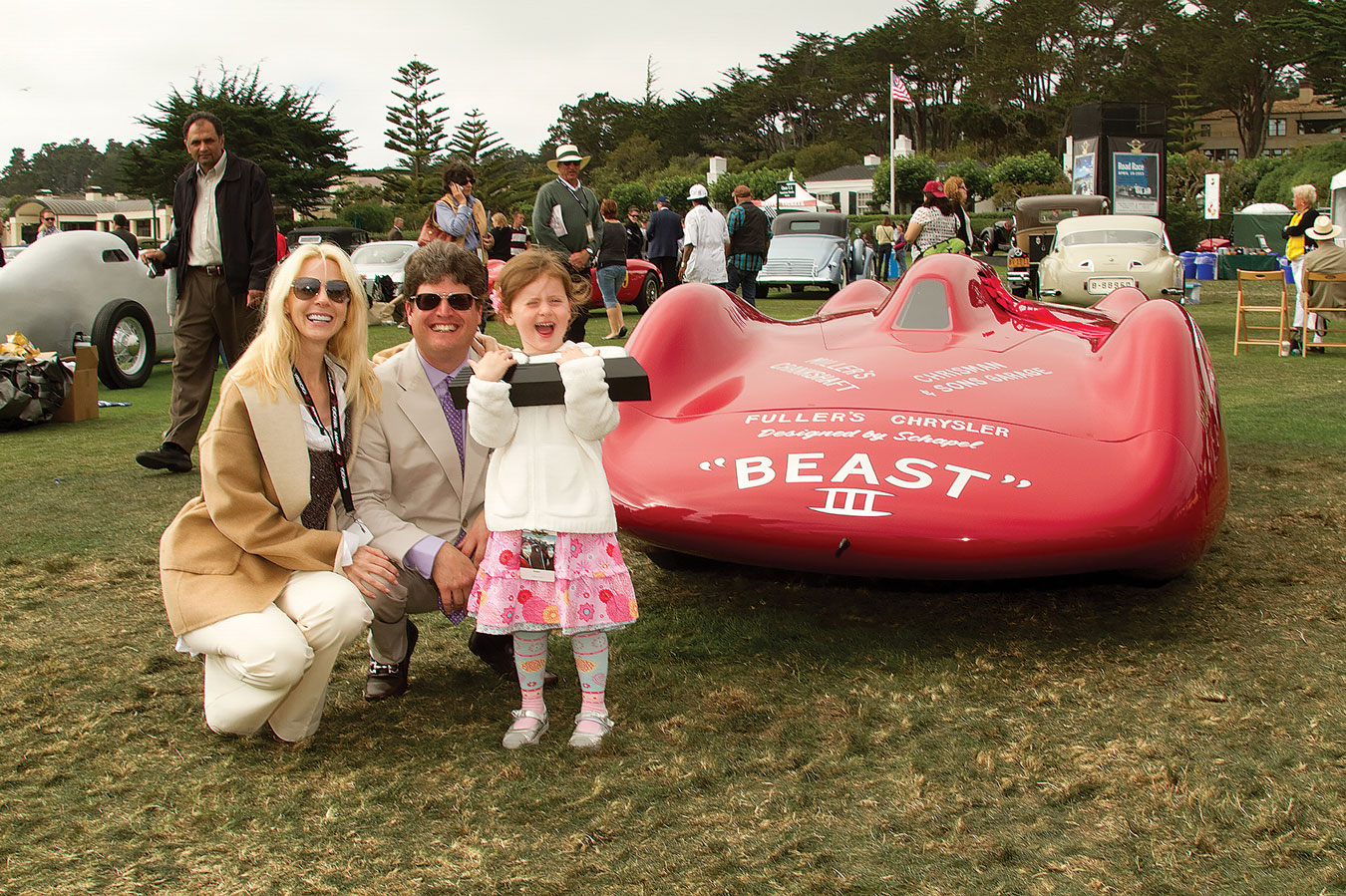
In 2009, with the help of a specialist, I discovered Chet Herbert’s astonishing Beast III streamliner in a warehouse where it had sat for decades. Racing legend Art Chrisman had piloted this Hot Rod cover car to 238 mph at the Bonneville Salt Flats in 1952. When I found the Beast, I had just started racing at Bonneville and was immersed in studying its history. To me, Beast III was the perfect confluence of style and speed. It was an honor to reintroduce this car at Pebble Beach in 2010. The restoration brought me a cherished friend in Chrisman, who, no doubt, was laughing under his breath as I idled his famous, 20-foot-long monster over the awards ramp at under 15 mph.
Another engaging hunt involved a historically significant American Special that had been missing for decades: the Mameco-Ardun. This car was professionally constructed on a tube-frame chassis with a Ford Flathead V8 equipped with a pair of Arkus-Duntov’s innovative Ardun OHV heads. Best yet, Bill Pollack had successfully raced the car in California in 1953. After years of searching, a colleague and I eventually found the car, and I was able to purchase it in 2007. Pollack was on hand at Pebble Beach in 2012 when we unveiled this historically significant racing machine, now fully restored. The highlight of the weekend was driving the car over the original Pebble Beach road course with Pollack narrating. Winning the Dean Batchelor Trophy wasn’t too bad, either.
In 1965, Herb Adams, of Pontiac Trans Am fame, built an aluminum-bodied spider that he called the Vivant. At the time, Adams was working as an engineer at Pontiac and had access to all the best Super Duty components, including an experimental race engine. For years I had searched for the missing Vivant, a car with jaw-dropping looks and 405 horses under its hood. I was able to acquire this one in 2011. Six years later, Adams and his family celebrated as the restored Vivant rolled over the ramp to accept its First in Class trophy at Pebble Beach.
Most recently, I unveiled a car designed and built by Bob Sorrell in 1953. Today, Sorrell’s contributions to the field of automotive design have been largely forgotten, but his SR-100 sports car was nothing short of a visual masterpiece. After 12 years of pursuing the aluminum-bodied Kurtis Sorrell SR-100 prototype, I became its next custodian, and a six-year restoration commenced. Completed only a few days beforehand, Sorrell’s six-carbureted beauty thundered over the ramp at Pebble Beach in 2023 to claim a First in Class trophy.
What’s next?
In 1949, Lou Fageol shocked the world with his 150-mph Fageol Supersonic. Streamlined beyond words, this car was professionally designed and built for the burgeoning U.S. superhighway system. The car debuted at the 1949 Indy 500, where Wilbur Shaw drove it in exhibition laps. Sometime later, the Supersonic body was lifted off its chassis and fitted to a production Hudson chassis. The original Supersonic chassis then received a second body, and that car became known as the Fageol Pataray. As insane as it may sound, I have spent my entire adult life chasing the dream of owning the Fageol Supersonic.
This would require that the original Supersonic body on the Hudson be reunited with the running chassis of the Pataray. After decades of twists and turns in a seemingly never-ending story involving thieves, unscrupulous car dealers, Fabio (yes, the romance-novel cover model), a private detective, attorneys, and help from countless friends, I ultimately was able to acquire both cars. My most exciting automotive adventure is yet to come — unveiling the all-original Fageol Supersonic at an upcoming Pebble Beach.