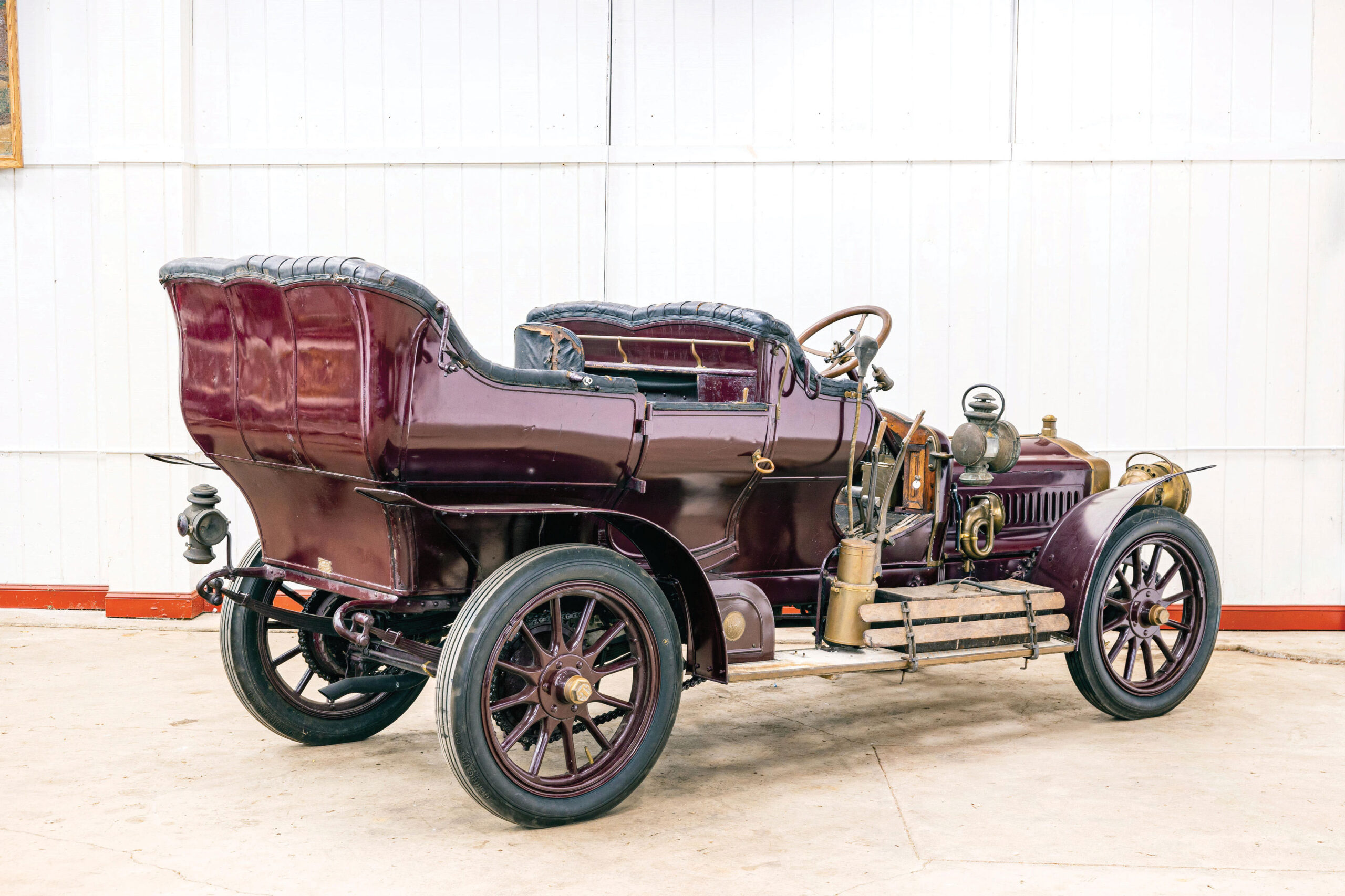
This car, Lot 510, sold for $841,000, including buyer’s premium, at Bonhams Cars’ auction in Middletown, RI, on April 29, 2023.
There’s a small cadre of highly esteemed American big brass marques: Simplex, Mercer, Lozier, Stutz, Stevens-Duryea and — of course — Thomas. Well over a century ago now, these cars were technical leaders, capable of high performance. They were relatively expensive, so they were most often owned by the rich and famous. Survivors with great provenance have been sought out and acquired by major collectors for decades.
Like many of the great marques of its era, Thomas didn’t make it past World War I. After a splendid start, the company rested on its laurels. Subsequent models were not up to the early standards. After flagging sales, receivership descended in 1912 and despite an influx of executives from Packard, all was soon lost. The Thomas company assembled a few cars as late as 1918 but was out of business by 1919. That said, the early cars and “The Great Race” laurels make the legendary Thomas Flyer an enduring winner as a collector car.
Harrah provenance
It’s believed that our subject car spent time in California before it went to Oklahoma, where it was owned by John Krittenbrink in the 1950s. Bill Harrah spent several years pursuing the car before he was able to buy it. Uncharacteristically, he resisted commissioning a full restoration. This was probably because he owned several other Thomas cars. This handsome Flyer thus remained in his collection, used sparingly, until after his death.
So the successful bidder received an ex-Bill Harrah Collection car; this alone has meaning, still. The nearly all-original car has been well maintained and has unquestioned provenance. It’s a great-looking piece that needs nothing and it’s capable of modern highway speeds, making it usable and enjoyable for Brass Era tours.
Unique appeal
However, there is still a swath of collectors who would question the appeal of these big brass cars. After all, you’re contending with two-wheel mechanical brakes, the perils of crank starting (although this car has been fitted with an electric starter), primitive suspension, clanky chains, skinny tires, and often no canvas top at all. Plus, there is all that brass to polish — like painting the Golden Gate Bridge, once the task is complete, it’s near time to start again.
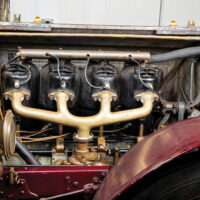
But there’s something truly remarkable about a car that’s over a century old, powered by a massive engine with cylinders the size of coffee cans. Piloting such a vehicle at high speed is thrilling and dangerous, a primal undertaking that captures the essence of what has made automobiles so exciting throughout history. Owning and driving something like a Thomas produces insights into experiencing any car, all the way to a modern supercar.
Touring then, touring now
This Thomas Flyer was the top-seller at the Two Generations Collection auction, held in conjunction with the Audrain Automobile Museum’s Veteran Car Tour. This is a new event, in just its second year. Bonhams’ association makes sense, as the company has built its reputation for Brass Era sales around its annual auction held before the London to Brighton Veteran Car Run in the U.K. Of note is that the London to Brighton eligibility is for pre-1905 cars, while the Audrain event cut-off is pre-1908.
Cars like this Thomas were top-tier touring cars in their time, and that appeal holds true today. For those who can afford a car of this stature, there are a number of other exclusive events to use them on, most notably the Annual Brass Era Tour, organized by respected collector John Mozart, who owns some superb examples. Brass Era tours are also regularly staged by the Antique Automobile Club of America, Horseless Carriage Club of America and other organizations, with varying eligibility requirements.
This sale was the latest in a long line of important Brass Era cars that Bonhams has auctioned. The pinnacle, of course, was the record-setting $4.8m 1912 Simplex sold at this year’s Scottsdale auction (see “Market Moment,” May 2023, p. 82).
There have been several other Brass Era cars that have made seven figures over the past few years, pointing to strength in the segment for the best examples. Although this high-six-figure winning bid did not reach those levels, it was still a substantial sum, far exceeding its $400,000–$500,000 estimate.
But it is a highly original Thomas Flyer, one with all the boxes checked, including a nearly unmatched provenance. Considering all this and its competitive set, this car was well bought. ♦
(Introductory description courtesy of Bonhams Cars.)