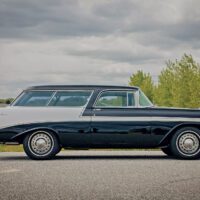
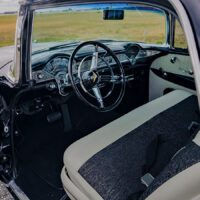
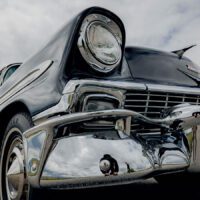
This car, Lot 146, sold for $68,200, including buyer’s premium, at RM Sotheby’s online auction on June 4, 2025.
The all-new, freshly restyled and nimble 1955 Chevrolet represented a marked change from previous Blue Flame 6-powered models and a home run for giant automaker General Motors. Advertisements called it “The Hot One,” and its sales momentum quickly accelerated. Chevrolet’s six-figure volume was so large that GM could afford to redesign and retool its bodies for each year from 1955 to 1957 (and for the next few years, for that matter).
The ’55’s new lightweight, high-revving, overhead-valve, 265-ci V8 was catnip to hot-rodders, just as Ford’s flathead V8 had been 23 years previously. Ford had introduced an OHV V8 in 1954, but at 239 ci and just 130 hp, it wasn’t a match for the 162-hp Chevy, which offered 180 hp with the Power-Pack option. Internal GM champions, such as ex-racer Zora Arkus-Duntov, ensured Chevy management realized they now had an engine that would make the brand a NASCAR star.
Style over sales
Late to the introduction year, the stylish Nomad was a Chevrolet-showroom traffic siren. But that didn’t translate to sales. Just 8,386 Nomads found homes in 1955, a fraction of regular 4-door-wagon volume. Some 7,886 units moved in 1956, and 6,103 were sold in 1957, after which the Nomad was discontinued. In fact, the Nomad was the lowest-selling Chevy model each year through 1957.
Meanwhile, GM’s sister division Pontiac sold 10,988 Safaris from 1955 to ’57. The Safari was a longer-wheelbase, 2-door station wagon that was offered simultaneously. Both the Safari and the Nomad were likely seen as poor value propositions, being among the more-expensive offerings from their respective brands when they were new. Four-door wagons from both Chevy and Pontiac were cheaper to buy.
The reason for that was Nomads shared almost no sheet metal with standard Chevy station wagons, and they were expensive to build. They also tended to suffer from water leaks and premature rust, somewhat tainting their reputation. But the sporty wagon (they were never called estates or shooting brakes) still struck a responsive chord with enthusiasts. After the model went out of production, eager hot-rodders bought them in such great numbers that it was hard to find a stock example. That’s still true today, with most Nomads you’ll find in the classifieds or at auction having been extensively modified.
Tri-Five fascination
Through the decades, the 1955–57 Chevrolet became a collector-car darling. Convertibles have topped the $125,000 mark, and the best ones cost even more. For years, they just kept inching upward. Today, the story is different. Interest has been declining for the better part of a decade as the traditional owners age out, while younger collectors have yet to fully appreciate these cars. Values for the best cars are holding steady for the most part, for now, anyway, but future appreciation is not likely as the pool of buyers continues to shrink.
It’s hard to find a decent, rust-free stock example in a desirable body style below $30k to $35k, but prices range widely. Two-door coupes, hard-tops and convertibles are still popular, and priced higher. The ideal driveline combination is a 3-speed manual with overdrive, and the 180-hp Power-Pack V8 with a 4-barrel carburetor.
At the top of the pecking order is a 283-ci V8 ’57 with fuel injection (new that year, and delivering a claimed 1 hp per cubic inch).
Yesterday’s upgrades
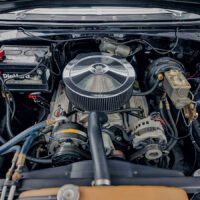
Our subject car is an older resto-mod, with most of the work said to be done in the early 2000s.
“Resto-mods don’t adversely affect values,” says Joe Caputo, an upstate New York vintage-car dealer, “especially if the car has stock wheels and hubcaps, and it basically looks original. But you need to carefully check for rust and floor patches.”
Four-speed manuals were never available in-period and today, modern 5-speed conversions are common, as are later automatic transmission swaps.
“If you start noticeably customizing these cars,” Caputo adds, “values drop like a rock.”
Despite a repaint in different colors from original, this 1956 Nomad sold for all the money. The ’56s are the least-desirable year — one source called them “the middle child” — but this car’s factory appearance and powertrain upgrades are acceptable, as is the discreet A/C installation. It makes the car a much better driver, even though the C4 Corvette engine installed is outdated. If this car was being resto-modded today, it would have a modern and more-powerful LS-series engine.
This Nomad’s history with previous owner actor Michael “Kramer” Richards, and that funny “Assman” vanity license plate, enhances its lasting appeal for those who fondly remember the “Seinfeld” sitcom. We’d call this a good deal for both seller and buyer.