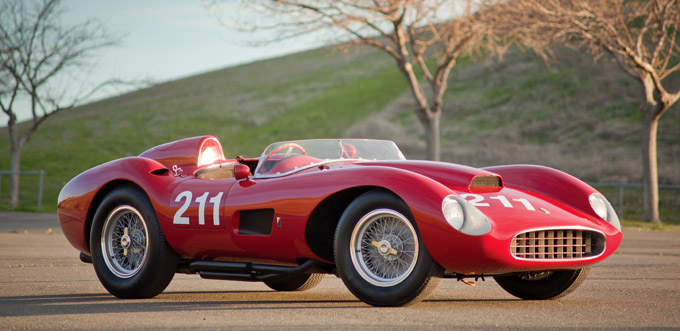
This car, Lot 345, sold at RM Auctions’ Monaco sale on May 12, 2012, for $6,526,800.
Ferrari production during the classic years was divided into odd and even serial numbers. Even serial numbers were used for race cars, and odd serial numbers were used for production cars.
Ferrari was a prolific producer of race cars, but the depth of their ability to build a car for a particular purpose is lost to a casual observer. Ferrari produced fewer than 400 race cars between 1947 and 1960. Those cars used close to 30 unique Ferrari-designed and manufactured engine types — and more body configurations — than I can count.
A slice of five consecutive chassis numbers (remember, competition cars use even numbers) will give you an idea of why early Ferraris are so hard to follow. Chassis number 0296MM is a 250 MM Vignale Spider, chassis number 0298 is a 250 MM Pininfarina Berlinetta, number 0300 is a 166 MM Oblin Spyder, number 0302 is a 625 TF (Targa Florio) Vignale Berlinetta, and 0304 is a 625 TF Vignale Spider. The production list is a kaleidoscope of different engines, chassis and bodies that kept changing as Ferrari research evolved.
Le Mans and marketing
Our subject car is a wonderful example of Ferrari’s ingenuity in racing and marketing. Ferrari’s strategy for the 1956 24 Hours of Le Mans was to put de-tuned 2.5-liter (625) 4-cylinder Grand Prix engines in three Touring Spider bodies. The cars were called 625 LMs. After Le Mans, 2-liter (500) engines were put in the 625 LM bodies, and the 625 engines were moved to the parts room to gather dust.
In 1957, West Coast Ferrari distributor and racer Johnny von Neumann wanted a new car to get an edge on the competition. The traditional story is that von Neumann approached the factory about building a special car. Searching their parts room, Ferrari came across the 625 Le Mans engines and offered him two (the third engine had been sold) for special cars.
Von Neumann agreed, and Ferrari put the engines in Scaglietti-built TRC bodies, which became 625 TRC number 0672MDTR and 0680MDTR. Ferrari historian Marcel Massini’s research indicates our subject car’s 625 engine was built after the Le Mans race and so was not used in the race. Either way, the 625 TRCs are very special cars with unique engines.
A long, colorful race history
Both 625 TRCs were raced extensively, as chronicled in Michael Lynch’s meticulously researched book, American Sports Car Racing in the 1960s. The 625 engines were not up to the task, and both 625 TRCs got engine swaps.
Chassis 0672 went from the 4-cylinder 625 to a Ferrari V12 to a Ford V8 and back to a Ferrari V12. Chassis 0680 went from the 625 to a Chevy V8 and then to a Ferrari V12. The original 625 motors became separated from both cars. The current engine in 0680 is a Ferrari 250 V12 that Berkeley, CA-based Ferrari magician Patrick Ottis built up.
There was no need to baby the built-up engine, so the seller was free to run the pants off of it — and he did. Our subject car has been a common sight at events along the West Coast of the United States. The car often arrived on an open trailer, and was driven with the vigor usually reserved for a far less valuable car.
RM was able to find 0680’s original 4-cylinder 625 engine, and it is included in the sale of the car. It is missing a few parts and has the wrong carburetors, but it is not far from being able to reunite with the chassis.
First time on the market in decades
Ferrari race cars are the pinnacle of the automotive kingdom, and very few Ferraris are more valuable than the TRCs. There were only two 625 TRCs built, and at the moment, neither moves with its original engine. The buyer of 0680 has the ability to return the car to its original configuration and have a unique piece of Ferrari history.
There are no comparable 625 TRC sales to base a value on. This car hasn’t changed hands for more than 30 years, and the only other 625 TRC belongs to a collector who bought it years ago.
The closest comparable, a 500 TRC, changed hands last year for just shy of $4m. The 625 TRC is far rarer than a 500, and with its original 625 engine, 0680 should be worth more than a 500 TRC.
A 250 TR sold at Gooding & Company’s 2011 Pebble Beach auction for more than $16.4m, but 0680 isn’t in that league. RM predicted a sale in the range of $3,875,000 to $4,780,00, which seemed reasonable. The hammer fell at $6,526,800, including fees.
The result was more than 50% higher than the low estimate, and while it was stunning at the moment, it quickly became yesterday’s news as rumor spread of the private sale of a TR 58 at a reported $25,000,000, and then the sale of a 250 GTO at $35,000,000. All three sale were records for their type, with the GTO sale being the highest known price ever paid for an automobile.
Our subject car is ultra-rare, with a well-documented race history. The buyer got an outstanding car that will get him into any event in the world. The seller will miss his old friend, but he can have comfort in knowing that it went to a buyer who really, really wanted it. I’d have to call the sale in favor of the seller, but it’s the buyer who came out with the prize.
Note: Ferrari historians David Seielstad and Marcel Massini both generously opened their files for help on this article.