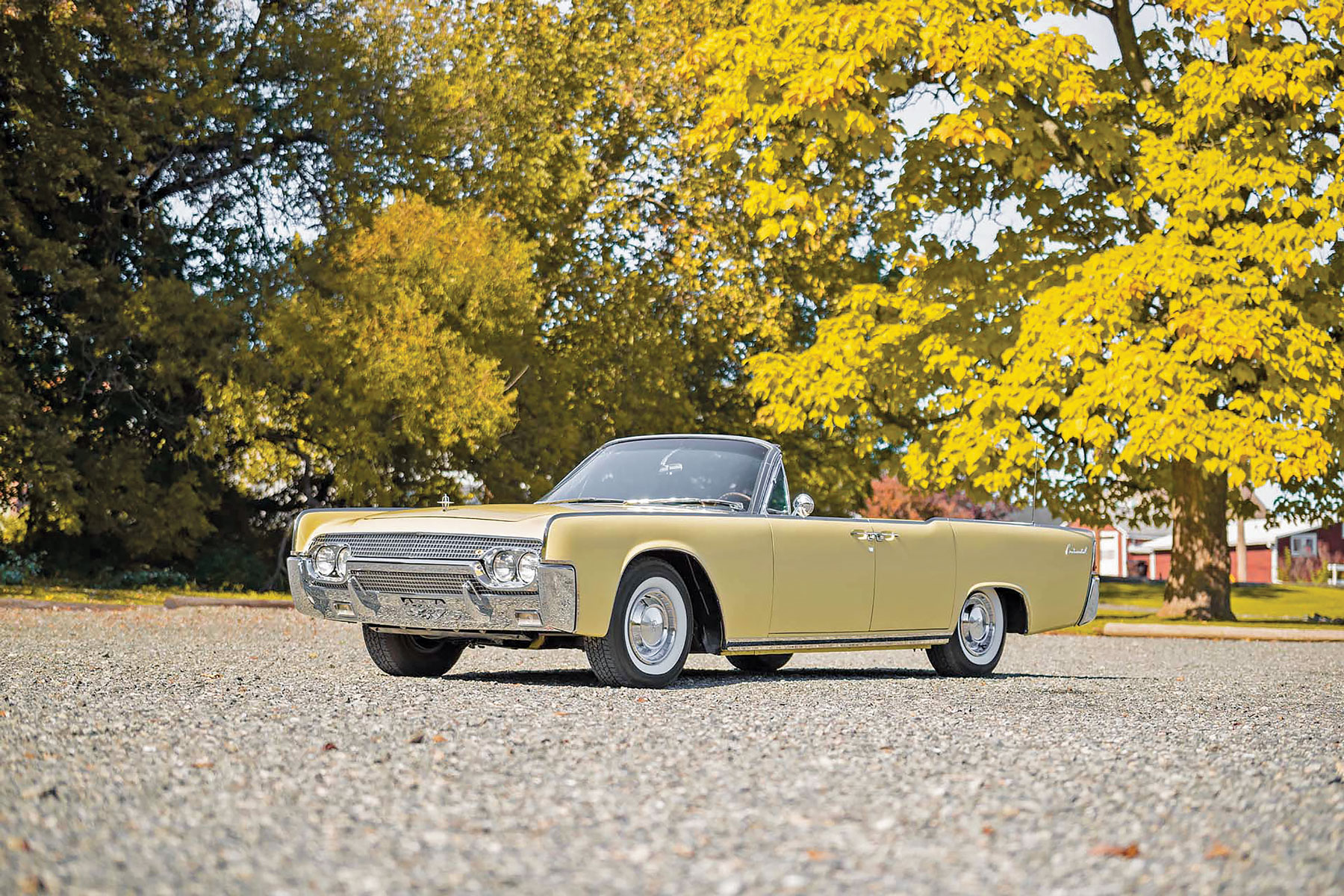
This car, Lot 2049, sold for $117,600 at Broad Arrow Auctions’ West Palm Beach, FL, sale on November 19, 2022.
The 1961 Lincoln Continental was the biggest game-changer in the domestic-luxury-car market since the 1949 Cadillac with its overhead-valve V8. It so profoundly changed the perception of what a luxury car should be that its effect is still felt today.
In an era of cars growing ever more porcine and gawdy, the crisp, chiseled look of the new Lincoln said the era of tailfin debauchery was over. Like a suave gentleman in a tailored suit, the car showed that taste and tact had returned to the luxury-car market. Embraced by people of means, none more important than the youthful new president, John F. Kennedy, the Continental became the car to be seen in.
While Cadillac still retained the stalwarts of its conservative market, it too saw the writing on the wall. By the time the assassinated President Kennedy was laid to rest, both Cadillac and Chrysler’s Imperial were under way with new styling protocols that were seeing more taut body lines and a hasty retreat of tailfins.
Last stand
The 1961 through 1969 Lincoln Continentals have been doing quite well in the collector-car market, even before the pandemic. This is especially true of the convertibles, produced through 1967. Rare for a post-war convertible, it was a 4-door design, which also proved to be the “last stand” for this body style. Some of this popularity may be due to pop culture influences (see: “Entourage,” HBO’s Emmy-winning series that ran for eight seasons from 2004 to 2011), but this is also a case of egg vs. chicken.
The sole 2-door variant produced during the era, the 1966–69 hard top, is actually the market laggard of the group, trading mostly in the $20k-and-under range. Sedans often double that price, with the best convertibles trading at an even larger premium.
The 2023 SCM Pocket Price Guide lists a value range of $29k–$63k for convertibles, but when considering only fully restored cars, the top end is likely light by at least $20k. None of this series of Lincolns are particularly rare, and the market is flooded with mediocre examples (also plenty of resto-mods and customs). The high-water mark for a convertible is $330k, paid for a freshly restored 1965 at Barrett-Jackson Scottsdale in 2020.
Early vs. late
Our subject car is a first-year example from 1961. It still has its 430-cid V8 under its hood, oddly referred to as a “7.0-liter” in the auction catalog. Quite a few folks prefer the 1961 models above others of the “slab-side” generation; however, I’m not one of them.
The pointed grille and large headlight surrounds, sunken in behind extended front fenders, make the Continental look more like the 1961 Ford Thunderbird, with which it shares a platform. Also like the “Rocket Bird,” backseat legroom is anything but spacious.
A better-sorted restyle began in 1964, with a slightly longer wheelbase for proper luxury-car roominess, especially for the rear cabin. The cars also progressively adopted more-cohesive styling, with the 1965 abandoning its convex front end for a more-formal grille. In 1966 the car got even longer and adopted a torquier 462-cid V8.
The Ford Board
This car previously sold in RM Sotheby’s Dingman Collection sale, making $103,600 in June 2018 (SCM# 6877700). Michael Dingman was on the board of directors of Ford Motor Co.; he acquired the car in 2014, post-restoration, from another well-known Lincoln enthusiast. It showed 853 miles in 2018 and only 1,398 when consigned to the Broad Arrow sale. It appears to be a turn-key show car, which would be expected given its provenance.
While well built when new, with a host of electric conveniences, even the Continental sedans are complicated cars to restore. That goes up by a factor of 10 for convertibles. While similar to the 1961–66 T-Birds, Lincoln added more complexity to the folding-top system. It was the first domestic production car to have the rear door glass automatically drop slightly when the door latch button is pressed, necessary to clear the roof-rail seals when opened. Also, not only do all four pieces of side glass automatically drop when operating the top, but all four are on the doors, unlike the 2-door hard top. There’s a lot going on in these cars.
The cherry on the top is that parts availability is getting harder by the day. While these cars enjoy a good network of parts suppliers and marque expert shops as well as active club support, it’s simply not inexpensive to restore one. You’re gonna pay — and these cars don’t play nice with work done on the cheap. (Let’s not even talk about dealing with rust, as these cars use unibody construction.)
This sale is another instance where paying up for a car that’s “done” is a shrewd move. The sale price here, for a well-sorted example with a good history, was market-correct and fair to both parties. ♦
(Introductory description courtesy of Broad Arrow Auctions.)