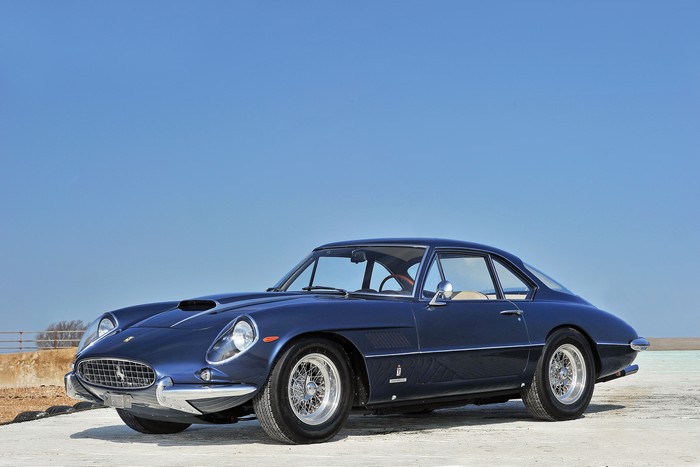
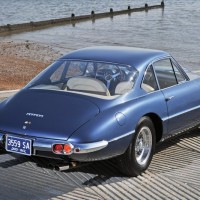
This car, Lot 120, sold for $2,839,200, including buyer’s premium, at RM’s Villa Erba auction on May 25, 2013.
A Ferrari starts as an engine. It is the engine that a series of Ferraris is built around, and it is the engine that the series is traditionally named after.
While other manufacturers may offer a choice of block sizes for the same model, a Ferrari model generally starts life with one block size that is kept through the model run. Take, for example, the 365 series: The 365 GTB/4, 365 GTC/4, 365 GT 2+2, 365 GTC, 365 GTS, and 365 GT4 2+2 all use the same basic block. The range envelopes two-cam, four-cam, three-carb, six-carb, down-draft, and side-draft configurations, but the blocks are virtually the same. The logic applies to nearly all Ferrari models.
12 cylinders, 4 liters displacement
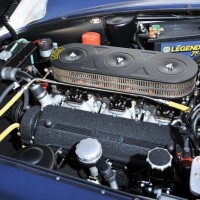
The 400 Superamerica began with a Ferrari Type 163 engine. The engine was a direct descendant of the Gioacchino Colombo-designed 1.5-liter 12-cylinder used to power Ferrari’s first model. The “Colombo” engine became the basis for almost all Ferrari production models — and the majority of their sports racing models.
The Type 163 was named the 400 SA for its total 4-liter displacement and its intended use — in the 400 Superamerica. This was the first time a Ferrari production car engine was named for the total displacement of the engine rather than a cylinder displacement, but then Ferrari nomenclature has always been an inexact science. The special name was perhaps an announcement of the greatness of the car.
While the physical size of the 400SA block was similar to Ferrari’s popular 250 block, the displacement was a third greater. The rated horsepower was 340, an optimistic number that was probably chosen to compare the model favorably with its 410 predecessor rather than representing true output.
No matter — as the Superamerica’s performance eclipsed most other Ferraris of the time.
Pininfarina Aerodinamico
The 400 Superamerica is part of Ferrari’s exclusive “America” series. The Americas were a line of premium Gran Touring models aimed at the enthusiast who wanted the best in the world with little regard to price.
The series began in 1950 with the introduction of the 340 America. It would progress through the 342 and 375 Americas to the 410 and 400 Superamericas —then to the 500 Superfast, named after the Superfast series of Superamerica show cars.
Ferrari would later resurrect the America name for the 330 America and the flip-top 575M Superamerica, but these later offerings were not in the same class as the über-premium models that preceded them.
The total production of 400 Superamericas topped out at 47 examples: 36 coupes and 11 cabriolets. As they were all built to order, the variations were so diverse that the engine was the predominant commonality of many examples.
The first of the series was a one-off coupe built for Giovanni Agnelli of Fiat fame. His car featured a square grille and looked nothing like any of the Superamericas that followed it. Several examples borrowed liberally from 250 designs, including one that closely resembled a 250 California Spyder. There are long-wheelbase examples and short-wheelbase examples. There are coupes and cabriolets, open-headlight and closed-headlight examples, but the paramount 400 Superamerica design has to be the Coupe Aerodinamico.
The Coupe Aerodinamico design came directly from Pininfarina’s Superfast series of show cars. It was avant-garde in period and still looks modern today. When offered as an available design for the 400 Superamerica, about 19 clients chose the coachwork. Each Coupe Aerodinamico is subtly different from the others, yet each is immediately identifiable as part of the series.
A good car sold well
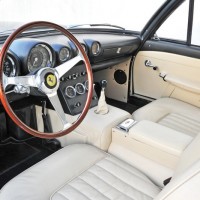
RM’s 400 Superamerica Coupe Aerodinamico 3559SA was a well-documented example in reportedly excellent condition. SCM’s Platinum Auction Database notes that it was sold at RM’s 2011 Monterey auction for $2,090,000, presumably to Mr. Barber. This most recent sale could have netted Mr. Barber an enviable annual return of about 11%. Expenses would have put a good dent in that number, but in all, there are few current investments that would have given a better return.
The sale was at the high end of the market, but it was certainly not unexpected. This was an important car in show condition with a good pedigree at a very exclusive auction.
Additionally, it had the Classiche certificate, which is becoming increasingly de rigueur for high-end Ferraris. Mr. Barber didn’t get the out-of-the-park home run some long-term owners have been seeing lately, but for a short-term gain, he should be happy. Well done and well sold. ?
(Introductory description courtesy of RM Auctions.)