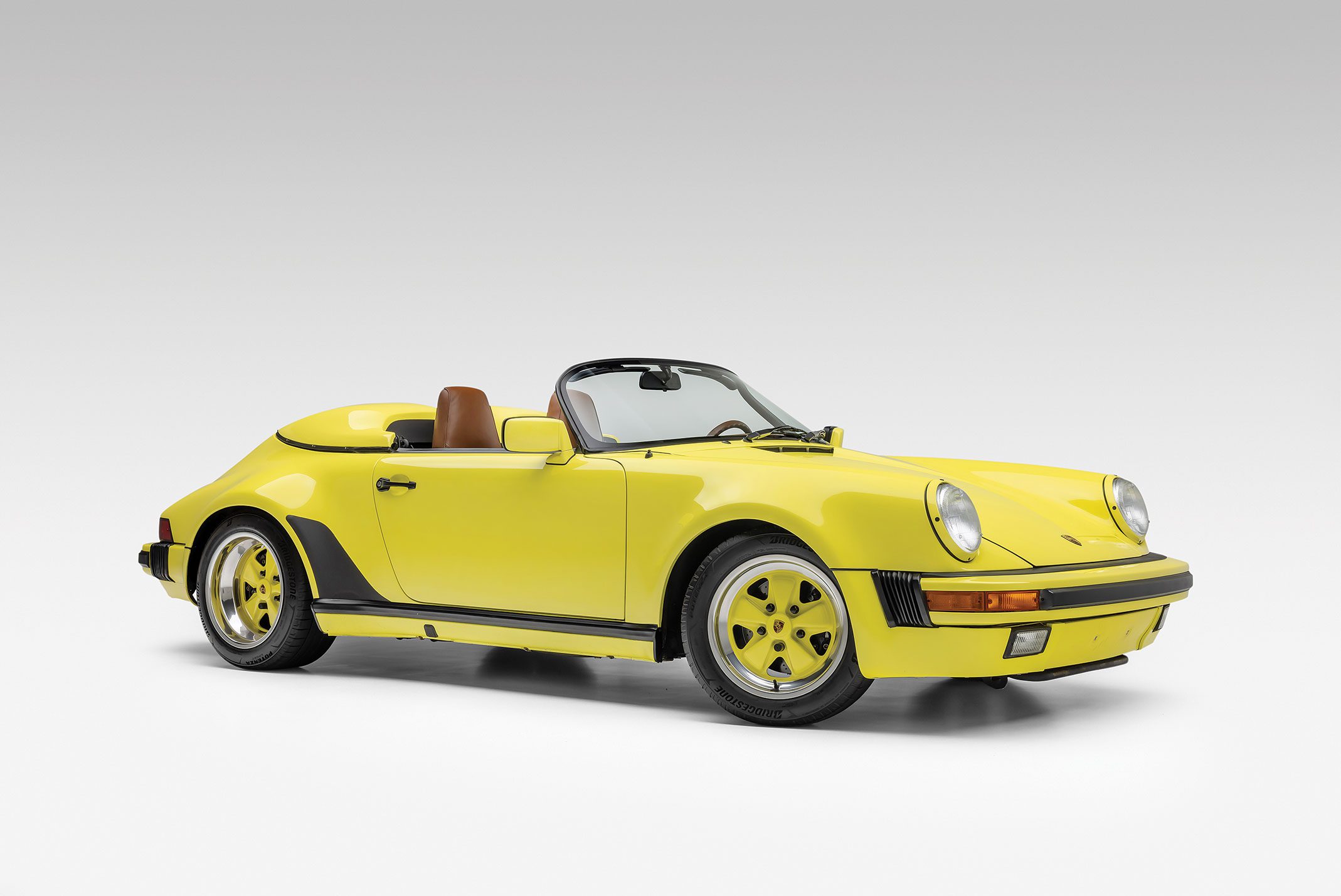
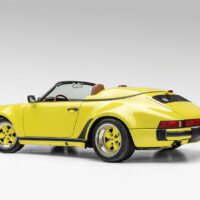
This car, Lot 231, sold for $282,750, including buyer’s premium, at Broad Arrow Auctions’ Costa Mesa, CA, sale on April 7, 2025.
The history of Porsche 356 Speedsters is well known to most SCM readers. The first U.S. distributor for Porsche, New York City-based Austrian Max Hoffman, needed a low-cost Roadster to compete with the 1950s British invasion of Austin-Healey, MG and Triumph. Initially, the 356 Speedster was priced at $2,995 to be competitive, albeit with some “optional” but always built-in bits like a tachometer and spare tire.
The little Roadster (with side curtains, not roll-up windows) had a removeable top and windshield which made it 170–200 pounds lighter than a coupe, but with a higher drag coefficient until the windshield came off and a tonneau cover was added. It was a sales success in warmer climates and a favorite of SCCA and Cal Club road racers for its favorable power-to-weight ratio. Speedsters won national championships up through the mid-’60s with “King Carrera” Bruce Jennings winning SCCA C-Production in 1960 and 1964 in Carrera-powered examples. Joe Cogbill (in a later Convertible D but with the exact same tub) and others carried that torch well into the 1980s.
Porsche built 4,145 356 and 356A Speedsters across six model years, with the vast majority sold in the U.S. Coupes were favored in northern Europe’s poor weather, and sports-car competition there emphasized hillclimbs, where coupes were preferred.
Speedster redux
In the late 1980s, Porsche needed sales volume. Special 911 models such as Anniversary and Ferry Porsche Birthday Editions helped. Wanting more, Porsche designed and built a Speedster prototype off a 1983 SC Cabriolet. (That model was Porsche’s first fully open-roof car since the 1965 356C.) A rakish three-inch-lower windshield, shell-like top and large fiberglass “double bubble” tonneau did the trick. A prototype was built in 1983, then a second in 1985. It was shown at the 1987 Frankfurt Auto Show. Production followed a year later.
The 1989 Speedster took a Carrera Cabriolet shell and either kept the “narrow body” over 6- and 7-inch-by-16-inch wheels, or added “wide-body” 930 Turbo flared front fenders and rear quarters over 7- and 9-inch-by-16-inch wheels. Porsche built 1,933 wide-body and 171 narrow-body examples. The engine was a standard Carrera 3.2-liter flat-6 of 215 (U.S.) or 234 (RoW) horsepower and 195 lb-ft of torque, with the 5-speed G50 gearbox. Power-to-weight was slightly improved, with about 150 pounds removed versus a stock 911. That all provided 0–60 mph runs in six seconds and a top speed of 150 mph.
True to the Speedster ethos, these were simplified cars. Storage bins replaced the rear squab seats, power windows were jettisoned and a manual antenna was moved back to the front fender. (It was short, so it did not look like a patrol-car whip over the low Speedster.) Presumably, incorporating a wire antenna into the short run of special windshields did not make sense. The “Speedster” script did not come on the 1989 versions but did starting on Type 964 models. Many owners have added it to their ’89s. Turbo brakes and suspension weren’t included under the wide body unless you added option M491 on top of the M503 Speedster package, in which case you also got an ungainly “tea tray” tail and a front spoiler. Reportedly, about 70 cars had M491.
Not a speedy seller
The 1989 Speedsters were anticipated but not well loved when dealers were taking orders in 1988–89. A friend ordered a white example with air conditioning from Porsche of Avon, CT, and paid less than $60,000. He ended up with the only Speedster in the area.
Type 964 Speedsters were even less popular. While Porsche planned to produce 3,000, only 936 were built and sold, with 427 in the U.S. The engine was a standard 3.6-liter, 247-hp unit. These were mostly narrow-body cars with only 16 wide-body RoW examples specially built. U.S.-market cars had an MSRP of roughly $70,000.
Only two Type 993 Speedsters were built, one for F. A. “Butzi” Porsche and one for Jerry Seinfeld, so they are extremely rare and valuable. Privately cut-down Cabriolets are more common.
The 2011 Type 997.2 Speedsters sold out because only 356 examples were built, most of them in attractive Pure Blue paint. With an uprated 3.8-liter, 408-hp engine, the well-equipped base model carried an MSRP of $204,000.
The 2019 Type 991.2 Speedsters were built in 1,948 examples. They were loaded cars, with a 502-hp 4.0-liter engine and came standard with ceramic brakes, Porsche Active Suspension Management, Porsche Stability Management, Porsche Communication Management and rear-wheel steering. Their MSRP was about $360,000.
Long time coming
The window sticker for this Light Yellow 1989 911 Speedster showed options of Paint-to-Sample non-metallic paint ($2,134), raised steering-wheel hub ($67), Reno radio ($515), short shifter ($67), full power sports seats ($797 each), automatic speed control ($457), alarm system ($278), and air conditioning ($2,665). With a destination charge of $585, the car was out the door at $73,822.
Reviewing 85 Speedster offerings in 2024–25, only one PTS car showed up — our subject car. Among those 85, the color divisions were 30% red, 26% white, 24% black, 9% silver, 5% dark blue, 5% gray, 1% PTS.
Resales of 1989 Speedsters are frequent. This car had just over 13,000 miles, which is not that uncommon. Of the 85 sales in 2024–25, 24 cars had fewer than 20,000 miles, ranging in price from $181k–$308k. We excepted super-low-mileage examples and a rare blue car. They sold at $285k–$357k.
Our auction car was offered for sale regularly through 2024–25. Ryan Friedman Motor Cars (Glen Cove, NY) listed it in March 2024. At the same time, it was for sale at Mohr Imports (Monterey, CA) who then put it on Bring a Trailer in May 2024. It was a no-sale with a high bid of $240,000. Next, in early 2025, Copley West (Costa Mesa, CA) put it out with an asking price of $359,800. Then it was on PCarMarket in April 2025 where it again failed to sell with a high bid of $250,000.
Finally, Broad Arrow got it done at its Costa Mesa Porsche-exclusive auction. With 1989 Speedsters ranging between $210k and $308k for very good cars, this rare PTS Light Yellow Speedster was a fair buy at $283k if you don’t mind the brown interior.