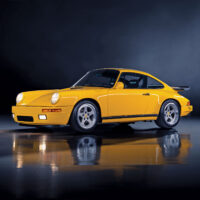
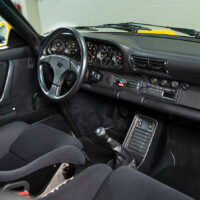
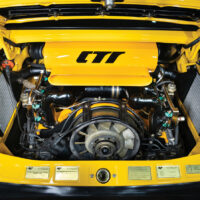
This car, Lot 118, sold for $6,055,000, including buyer’s premium, at Gooding Christie’s Amelia Island, FL, auction, on March 7, 2025.
RUFs have gone from being a desirable second-tier car for a major Porsche collection to being a “must have” at almost any cost. For decades, RUF Porsches were desirable because of two noteworthy production-car land-speed records and one tire-shredding promotional VHS video. They are now iconic, with nose-bleed prices to match.
A German speed shop
Auto RUF was launched in 1939 by Alois Ruf Sr. as an auto-repair shop located in Pfaffenhausen, west of Munich, in southern Germany. It prospered and diversified, manufactured buses in the early 1950s, then began tuning Porsches in the early 1960s. Alois Jr. took over in 1974 and indulged his passion — Porsche 911s. He was adept at hot-rodding these cars and gained a following.
As the shop’s modifications became more extensive, RUF was recognized as a manufacturer by Germany in 1981 and by the U.S. in 1988. In the 1980s, conversion shops were licensed in the U.S. and Japan (and possibly elsewhere) and RUF-modified cars became more common. All of RUF’s converted cars, including those modified in Pfaffenhausen, kept their Porsche-issued 17-digit serial numbers starting with “WP0.” RUF also manufactured cars in Pfaffenhausen from the ground up, based on Porsche-supplied shells and subassemblies. These had RUF’s own manufacturer’s serial numbers starting with “W09.” Today, there is a huge value difference in favor of the W09 cars.
The world’s fastest car
RUF leapt into U.S. enthusiasts’ popular consciousness when Road & Track conducted a “fastest car in the world” test in 1984. At 184 mph, a RUF BTR won that shootout — a big boost for RUF, but peanuts compared to the follow-up.
In April 1987, the magazine rented the 15.5-mile Volkswagen-owned Ehra-Lessien test track, where two seven-mile straights would allow serious mashing of the loud pedal. Nine supercars were gathered, including an AMG Hammer, Ferrari 288 GTO and Testarossa, Lamborghini Countach 5000 QV, and four Porsches: a Koenig RS, 959 Komfort, 959 Sport and a RUF CTR. Four cars ran over 190 mph, and they were all Porsche-based. The 959 Komfort hit 197 mph, the 959 Sport did 198 mph, Koenig’s RS went 201 mph, and the overall winner was the Blossom Yellow RUF CTR at a jaw-dropping 211 mph. R&T writer Peter Egan penned the nickname “Yellow Bird” at the VW test track as he watched the car fly by. Alois and Estonia Ruf liked it, thus adopting the “Yellowbird” moniker ever after.
Ex-Formula 1 World Champion Phil Hill was one of the test drivers and his input was insightful: “I cannot forget the last RUF car we drove for top speed [the BTR in 1984]. It was the quickest, but it was also skittery and a little scary. But the new one is just steady as a rock — and it’s about 39 km/h faster. I must say that it is pretty extraordinary to take a car you can drive on the street and go this fast.” The CTR’s record lasted 18 years until a Bugatti Veyron broke it in 2005.
Yellowbird’s origin story
Alois Ruf based the CTR on a Porsche 3.2 Carrera because he wanted a lighter, narrow-body car for lower drag coefficients. He used lightweight aluminum doors, hood, and engine cover, with deep fiberglass bumpers. Later, aluminum front fenders were optional. He shaved off the rain gutters and added NACA ducts to the rear quarters. But when RUF discovered that the ducts actually sucked air away from the turbochargers, they were eliminated.
RUF designed its own 5- and then 6-speed gearboxes even before Porsche’s own 5-speed 911 Turbo in 1989. The flat-6 engine was built up to 3.4 L, with the same Bosch ignition system as Porsche 962 race cars. It used two large turbos and intercoolers, with the trademark large yellow RUF air cleaner on top. The car weighed some 400 pounds less than a 911 Turbo at an estimated 2,500 pounds. RUF published specs of 469 hp with 410 lb-ft of torque. (Testers found up to 550 hp with 457 lb-ft.) RUF reported 0–60 mph acceleration in 3.7 seconds, 0–100 mph in 7.1 seconds and a quarter-mile in 11.7 seconds at 135 mph. Over three years, RUF built 29 Yellowbirds, though not all in yellow.
Faszination!
In 1989, RUF took a CTR to Nürburgring’s Nordschleife track with Stefan Roser driving and set a production-car lap record of 8 minutes, 5 seconds — with tourist traffic on the track including three cars and six motorcycles by my count. The record was notable, but the resulting two-lap videotape, “Faszination on the Nürburgring,” was enthralling.
Roser almost never had the car straight. Every corner was a smoke-filled slide-and-catch followed by more plumes under acceleration. The video went viral before viral videos were a thing. Every Porsche aficionado had a copy. (It’s still on YouTube, by the way.) The first lap is shot over Roser’s shoulder, through the windshield. Hang in there for the second lap, which has trackside cameras and helicopter shots — and is much more interesting. Roser drove in blue jeans and loafers with no helmet. Oh my!
Big Bird bidding
Prior RUF CTR sales are predominantly private. RM Sotheby’s sold black CTR #10 with 52k km at Monterey in 2018 for $1,022,500 (SCM# 6878576). Private transactions were in the ranges of $400k–$500k in 2012, then $800k–$900k in 2015, and $1.2m–$1.5m in 2020. Yes, that’s a major updraft. Then along came this one.
Our subject car was and is very special. It was a later model, being #26 of 29. It had just two owners from new: Dynasty Aussenhandels in Germany until 2020, followed by the consignor, a major Detroit-based collector who brought one other RUF — a 1997 CTR2 — to this auction. This CTR was in as-new condition. It was in the lightest RUF configuration, with all-aluminum panels including the front fenders, and the paint was Blossom Yellow. The car had fulsome accessories including papers, manuals, toolkit, tire inflator, two keys and more.
In the catalog, Gooding estimated the CTR “in excess of $6,000,000.” That got everyone’s attention. When this lot crossed the block, the peanut gallery was overflowing, with standing-room-only inside and out. Bidding was steady and strong, and the hammer fell at $5.5m for a final price after buyer’s premium of $6,055,000. The seller, a good friend, told me at the auction that he was quite pleased. Seems dead right.