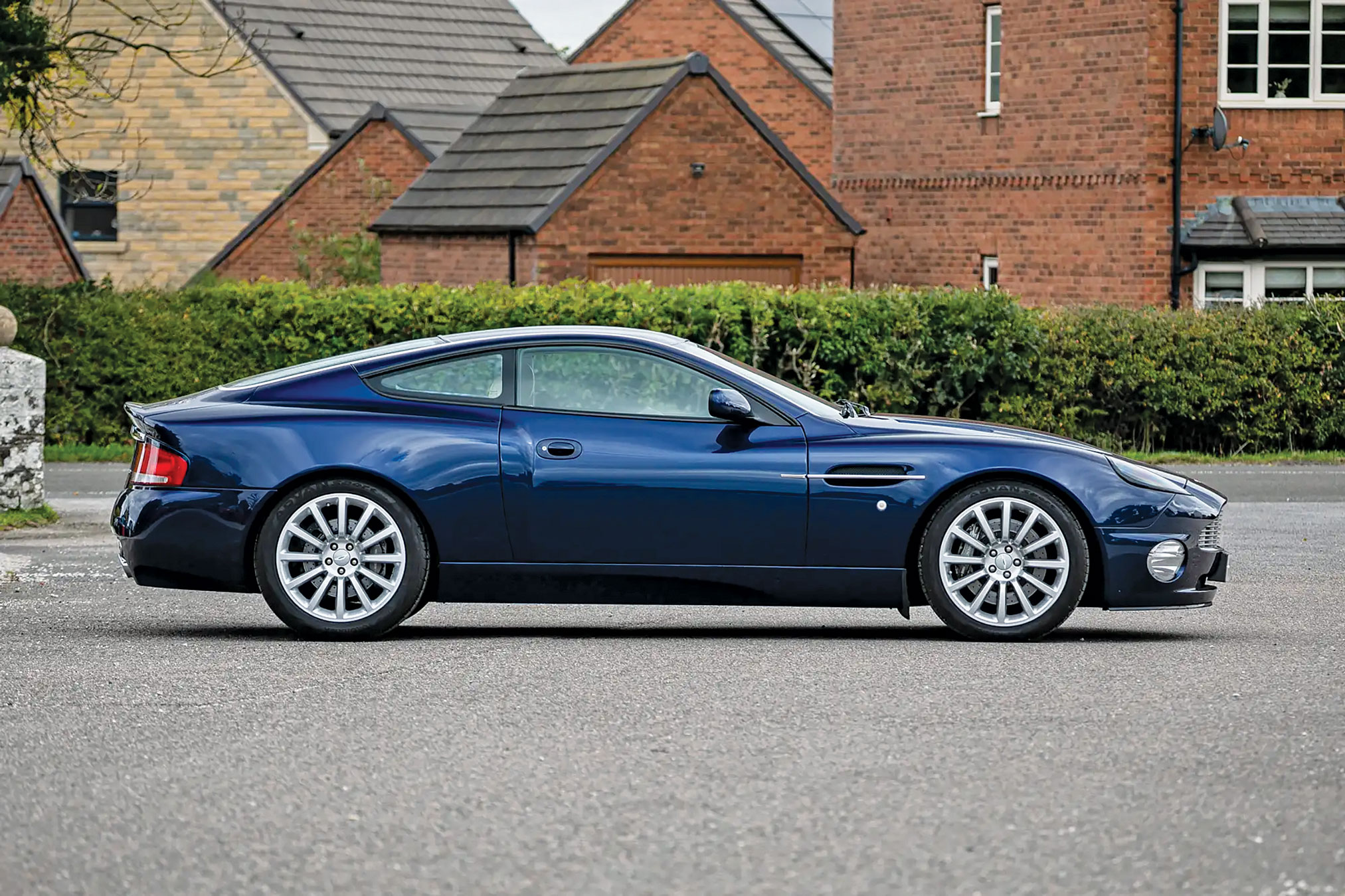
This car, Lot 741, sold for $50,052 (£37,125), including buyer’s premium, at Iconic Auctioneers’ Stoneleigh, Warwickshire, U.K., sale, on February 21, 2026.
For decades, Aston Martin has represented British style and exclusivity, benefiting from a close association with Ian Fleming’s super-spy James Bond since Sean Connery drove a DB5 in 1964’s “Goldfinger.” Although that classic model was still making cameos in Bond films into the 1990s, when the series rebooted with Pierce Brosnan as Bond, the beleaguered British carmaker found itself replaced. BMWs were cast as 007’s gadget-laden ride of choice for a trio of films before Aston Martin made its triumphant return to Q Branch in 2002’s “Die Another Day.” Today, this first-generation V12 Vanquish still stands as the ultimate modern Bond car.
Blue Oval beneath
The V12 Vanquish was conceived and born during a unique period in Aston Martin history. Ford took a controlling interest in the company in 1987, and the heft of Dearborn’s balance sheet positively affected almost all aspects of the V12 Vanquish. From electrical systems to engine development to quality control, the car benefited greatly from Ford’s involvement throughout its development and production. As a flagship car for Aston, the V12 Vanquish had to be special — and it most certainly was when launched in 2001.
Ford exited Aston Martin in 2007, the same year production ceased and the venerable factory in Newport Pagnell closed for good. The V12 Vanquish was the last model produced at Aston’s storied “workshop,” and it was conceived and produced when the company was well capitalized. Thus, it is paradoxically both modern and old-world, a coach-built, handmade car that is still decisively contemporary.
Stunning, but …
Our subject car appears to have been enthusiast-owned and regularly but not excessively exercised. Its mileage is on the high side at nearly 40k, but perhaps some miles are a plus, given that complex British cars tend to deteriorate when left static. Further in this example’s favor is a fairly robust maintenance history, including visits to Aston Martin Works. It’s a right-hand-drive example, which limits its appeal to its home market; however, it was sold here at a U.K. auction.
Many of these cars are seen in the classic and popular Tungsten Silver, as was the Bond car, but this one benefits from its attractive Mendip Blue with a Magnolia interior. This subtle color adds yet another layer of class to an already stunning design.
With the V12 Vanquish, Ian Callum set the tone for all the Astons that have come since. Noteworthy elements include the large-but-tidy signature grille, the muscular vertical indentation in the door, which forcefully but subtly delineates the rear protuberant haunches, and the aggressive-but-classy rear bump-out along the lip of the trunk.
Like all great automotive designs, the V12 Vanquish must be seen in person to be truly appreciated, particularly its interior, which is hugely upgraded from other Astons of the era. It is among the most beautiful modern cars, and over 20 years on, it still looks truly expensive.
Its Achilles heel is a clunky, paddle-shifted automatic manual transmission. At the time of its introduction, the “Sportshift” looked great on paper and represented cutting-edge technology, with a conventional clutch and manual gearbox activated via computer-controlled hydraulics. As with similar systems from BMW and Lamborghini, however, the reality was another matter. Chronic complaints of V12 Vanquish naysayers are not as bad as they might have you believe, but the fact remains that the transmission is a weak point and certainly not up to the standard of the rest of the car.
The market remains fixated on this concern, which is the leading culprit behind the punitive valuations of all first-generation Vanquish models. Paradoxically, the overblown transmission issue is the very thing that makes the V12 Vanquish an attainable supercar.
Ultimatum
The ultimate V12 Vanquish is the mid-cycle refreshed “S” model with a 6-speed manual conversion. All S cars (2005–07) enjoy 60 more horsepower, bigger brakes and suspension upgrades, with a handful transformed to conventional three-pedal operation, post-production, by the factory. These cars sell in at least the mid-$100k range, making our subject car an even better value proposition. Still, it sits at the low point on the Vanquish totem pole, as a first-series car with the stock automated manual.
Total production of all first-generation V12 Vanquish non-S models stands at around 1,500 units, which is certainly appealing to the discerning buyer who wants something rarely seen in the wild. Enthusiasts appear to have few complaints about the reliability of its 5.9-liter V12, and that Ford-era investment shows today in better-than-expected durability, though this is an attribute the market is undervaluing. Despite the preference for the three-pedal S model, the pricing differential here for a well-maintained non-S car is attractive, even factoring in ongoing and potentially expensive routine maintenance and waning parts availability.
The V12 Vanquish remains a milestone car for its time, with complex construction, advanced materials and a liberal use of carbon fiber and aluminum. At $240,000 when new, it occupied a price point near the Ferrari 575M Maranello. The Aston was every bit as capable, and the automotive press spoke fervently about its unique qualitative character. Given the above factors, acquiring one for just $50k represents a bargain. And fortunately for those so inclined, these are not difficult to find in this price range, representing one of the most underrated and best values in today’s frothy collector market.
Troubles today
If there is any caveat, it is that the automotive and financial worlds are again discussing the debt, revenue and cash-flow troubles at Aston Martin. The company has a storied history of building distinct, rare and stunning cars, but it has also been a business mired in financial distress for most of its existence. Today, its future is anything but certain, and that has recently affected the valuation of many modern-era Aston Martins, which have not been enjoying the rapid appreciation of other supercars and exotic marques.