
Buy What You Love, Pay What You Should
English
-
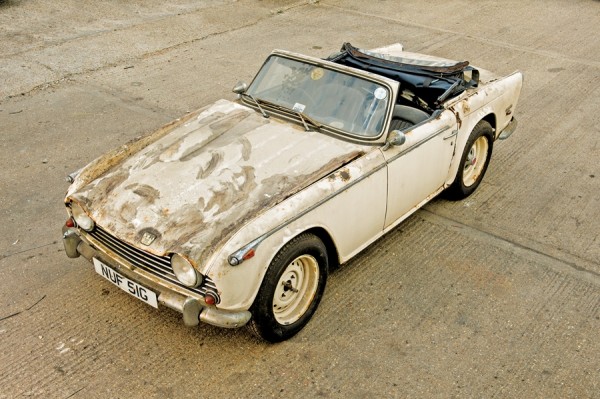
1968 Triumph TR5 Roadster
Similar to the preceding TR4A — the first TR with independent rear suspension — but with Triumph’s 2.5-liter, 6-cylinder engine installed in place of the old 2.1-liter four, the TR5 was produced during the 1968 model year only (October 1967 to November 1968) pending the arrival of the restyled TR6. The bulk of production was…
-
1927 Bentley 6½ Litre Le Mans Sports
As with all great W.O. Bentley-era cars, the legendary 6½ Litre owes its existence to the original 3-liter design. Racing success, including the 1924 and 1927 Le Mans wins, quickly drove sales, with buyers soon demanding ever-more luxurious and heavy custom coachwork, resulting in the more powerful 4½ Litre, which in modified form earned Bentley’s…
-

1974 Jensen Interceptor Series III Sports Saloon
With the Interceptor saloon’s introduction in 1967, Jensen had switched from glassfibre to steel for its car bodies. Underneath, the preceding C-V8’s robust chassis, running gear and 6,276-cc Chrysler engine remained substantially unchanged. With around 280 bhp on tap, performance was more than adequate, The Motor recording a top speed of 140 mph with 100…
-

1938 Jaguar SS 100 2½-Liter Roadster
Launched in 1936 alongside the 2½-liter saloon, the SS 100 Jaguar sports car marked the company’s first use of the Jaguar name. Beautifully styled in the manner of its SS 90 predecessor, the newcomer employed a shorter, 102-inch wheelbase chassis and a revised version of the 2,663-cc Standard Six which produced 104 bhp. In 1938,…
-

1969 Aston Martin DB6 Mk I Vantage Sports Saloon
The culmination of Aston Martin’s long-running line of DB 6-cylinder sports saloons and thus considered by many to be the last real Aston, the DB6 had been introduced in 1965, updating the DB5. Although recognizably related to the Touring-styled DB4 of 1958, the DB6 abandoned the Carrozzeria Touring-developed Superleggera body structure of its predecessors in…
-

1959 Jaguar XK 150S 3.4 Roadster
The final glorious incarnation of Jaguar’s fabulous XK series of sports cars arrived in 1957. The XK 150 was a progressive development of the XK 120 and XK 140, retaining the same basic chassis, 3.4-liter engine and 4-speed Moss transmission of its predecessors while benefiting from a new, wider body that provided increased interior space…
-

1992 Jaguar XJ 220
The XJ 220 prototype was unveiled to the world in Birmingham in 1988. The car was greeted with enthusiasm, and the decision was taken to produce a limited series of 350 examples. As Jaguar was not set up to produce such a small series, the build project was given to Jaguar-Sport, a joint venture between…
-

1965 Jaguar XKE Series I 4.2 convertible
From its electrifying March 1961 Geneva launch, Jaguar’s E-type redefined the term “sports car” at one stroke. Careful development brought improved comfort, and during 1964, the DOHC “XK” engine was enlarged to 4.2 liters and matched to a full-synchromesh gearbox for heightened drivability. Iconic styling cues including beautifully covered headlamps were retained, making these late-Series…
-
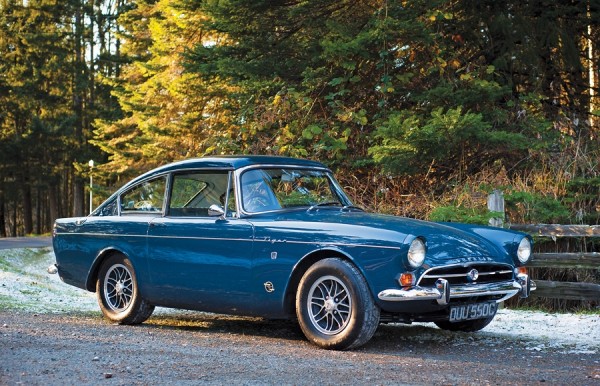
1965 Sunbeam Tiger Mk I Coupe
This car is equipped with a 164-hp, 260-ci, OHV V8 engine with a 4-barrel carburetor, 4-speed manual transmission, independent front suspension with coil springs, live axle rear suspension with semi-elliptic leaf springs, and front-disc and rear-drum hydraulic brakes. British coachbuilders Thomas Harrington Ltd. built only a handful of beautifully crafted fastback Le Mans coupe bodies…
-
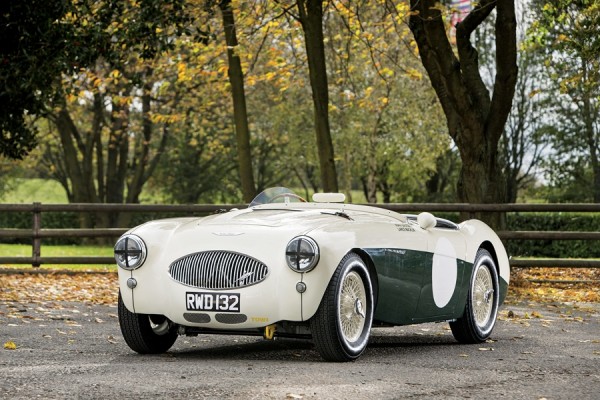
1955 Austin-Healey 100S Sports Racing Two Seater
During the 1950s, the most accessible, most appealing, and in many cases, the most successful club racing car available to any aspiring racing driver was one of the products of the Donald Healey Motor Company’s famous factory at The Cape, Warwick. This particularly appealing, and in period highly successful, Austin-Healey 100S is a shining example…