
Buy What You Love, Pay What You Should
German
-
1973 BMW 3.0 CSL “Batmobile”
The BMW 3.0 CSL “Batmobile” was one of the most outrageously brutal road-going homologation specials ever conceived, designed to exploit several loopholes and bring to BMW a German Saloon Car Championship. In order to homologate a more competitive racing car, the monocoque was formed from thinner-gauge steel, and aluminum was employed to skin the hood…
-
1987 Porsche 911 Turbo Coupe
Porsche street cars had a very strong reputation for excellent durability-Turbos broke that rule {vsig}2006-9_1953{/vsig} In order to compete against bigger-engined rivals, Porsche homologated the type 934 race car in 1974 and embarked on an entirely new phase in race car development. As word spread about the incredible performance, the initial run of 500 cars…
-
1911 Mercedes 37/90 Skiff
I had a customer interested in this car at $2m in the late ’90s before the full story emerged In the early 1900s, Mercedes styling ran the gamut from conservative limousines and landaulets to dashing phaetons and open two-seaters. None, however, approached the style of this one-of-a-kind 1911 Mercedes 37/90 skiff, one of the most…
-
1958 Porsche 356A 1600 S Speedster
In the current market, beauty and condition matter as much as originality Introduced to the United States in September 1954, the Speedster found a receptive audience as the lowest-priced Porsche. In the USA, there was some confusion caused by the fact that when constructing the newest Porsche, the designers left out many components standard on…
-
1968 Porsche 912 Soft-Window Targa
The auction catalog calls the Weber carbs an update, but I call them wrong After years of building its commercial and racing success around the 356 models, Porsche introduced the larger, more powerful, two-liter Porsche 911 model in 1965.Maintaining the company’s success with rear-engine positioning, the all-new design provided an aerodynamic body over a revised…
-
1957 Porsche 356A Coupe
If this car drives as the catalog says, the new owner did very well. If not get busy spending and making it right {vsig}2006-5_1931{/vsig} The 356A was Porsche’s first volume production car, in Coupe, Speedster, and Cabriolet versions. Introduced in 1956, the 356A embodied substantial revisions to the original 356 series, including a one-piece curved…
-
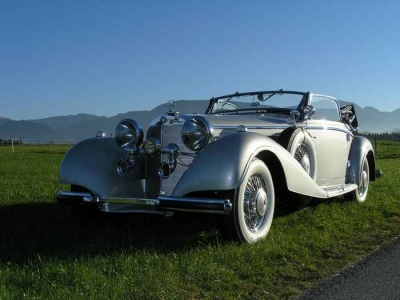
1938 M-B 540K Sindelfingen Cabriolet “A”
Together with its predecessor the 500K, the magnificent Mercedes-Benz 540K was arguably the most noteworthy production model offered by the Stuttgart firm during the 1930s. A development of the 500K, whose independently suspended chassis it shared, the 540K was powered by a 5.4-liter supercharged straight-eight engine. It featured the company’s Roots-type supercharger system, in which…
-
1960 Volkswagen Split-Window Pickup
1960 Volkswagen Split-Window PickupVolkswagen pickups were worked to death and their lifespan was shorter than that of a Roman slave {vsig}2006-3_1917{/vsig} Unquestionably among the most innovative designs of its day, the Volkswagen “dropside” pickup stretched the definition of full-service utility vehicles. Production of the pickup was started in 1952, and it borrowed the cab from…
-
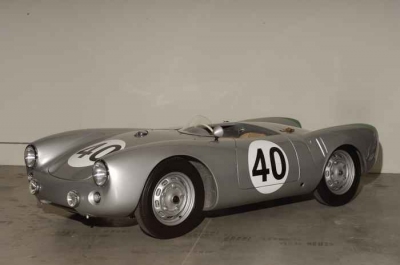
1954 Porsche 550/1500RS Spyder “Le Mans Prototype”
Porsche built four 550 Spyders for the 1954 Le Mans 24 Hours, numbered 10 through 13. This car, S/N 550-10, was assigned to Richard von Frankenberg and Helm Glockler. In practice, it was the fastest of the 1,500-cc 550s, but it was also the first to retire. Only 20 minutes into the race, a holed…
-
1939 BMW 327 Cabriolet
Because this car is a 2+2 and a cabriolet it weighs several hundred pounds more than a 328, and acceleration will be leisurely {vsig}2006-1_1908{/vsig} BMW’s first six-cylinder engine was launched in 1934, and formed the backbone of the company’s racing legacy. A modified version of the new powerplant was developed by Rudolf Schleicher and would…