
Buy What You Love, Pay What You Should
English
-
1930 Bentley 6½-Liter Speed Six
Although the 6½-liter had been conceived as a touring car to compete with Rolls-Royce’s new Phantom, in Speed Six form it proved admirably suited to competition: in 1929 Barnato/Birkin’s Speed Six won the Le Mans 24 Hour race ahead of a trio of 4½-liter Bentleys and Barnato/Kidston repeated the feat in the following year’s Grand…
-
1950 Allard J2 Roadster
An excellent example of a successful Anglo-American hybrid, the J2 Allard offered incredible performance for the period at a moderate cost. As a result, they were very popular in US and European racing and their list of competition successes is most impressive, including first-place finishes at Sebring, Bridgehampton and other race courses throughout America. During…
-
1954 Austin-Healey 100-4 BN1 Roadster
Considered as the original Austin-Healey, the 100 BN1s and BN2s were built from 1953 to 1956. Equipped with a four-cylinder engine, the 100 BN1 series cars featured a production run exceeding 10,000 units, while only about 4,500 of the later BN2 series cars were produced. Most enthusiasts do not differentiate the two series substantially, as…
-
1960 Jaguar XK 150 DHC
Jaguar turned the motoring world upside-down and inside-out when it introduced the XK 120 in 1948. It combined a powerful 160-bhp twin-cam straight-six with the most sensuous body ever seen on a production automobile. The combination of the 120-mph top speed, beauty and value had the celebrities lining up for their copies. Basic specifications called…
-
1951 MG-TD Roadster
World War II saw the start of many romances and among them was the affair between America and Abingdon, where MGs were made. Americans met the MG, fell in love, and pretty soon Abingdon couldn’t keep up with the demand. Like many a love affair, the Smitten One did not notice his Beloved One’s shortcomings.…
-
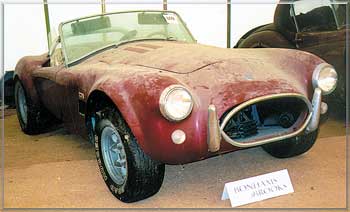
1959 AC Ace “Cobra” Roadster
The success of Cliff Davis’s successful Tojeiro sports-racer prompted AC Cars to put the design into production in 1954 as the Ace. The Davis car’s pretty Ferrari 166-inspired Barchetta bodywork was retained, as was John Tojeiro’s twin-tube ladder-frame chassis and Cooper-influenced all-independent suspension, but the power unit was AC’s own venerable two-liter long-stroke six. This…
-
1935 Squire Vanden Plas Roadster
The “Missing Squire,” S/N X-103, was the second of seven cars built by the fledgling Squire Car Manufacturing Company in 1935 and was purchased by one of the company founders, G.F.A. “Jock” Manby-Colegrave. While the other six of the original Squires were known, the whereabouts of X-103 haven’t been so certain for the last 25…
-
1993 Jaguar XJ220
It didn’t matter that it boasted 542 hp or had a top speed of 217 mph. For $625,000, many buyers felt doubled-crossed {vsig}2005-12_1899{/vsig} This magnificent-looking and supremely well-specified Jaguar XJ 220 coupe is offered here in pristine condition and at a level offering a considerable savings over the list price at launch. The words “supercar”…
-
1957 MGA 1500 Roadster
A successful outing for three EX182 pre-production prototypes at the Le Mans 24 Hours race in 1955 provided perfect pre-launch publicity for MG’s new sports car. Conceived as a replacement for the traditional T-Series MGs and launched in 1955, the MGA combined a rigid chassis with the Austin-designed, 1489-cc engine that had first appeared in…
-
1955 Morgan Plus Four DHC
H.F.S. Morgan’s first four-wheeled Morgan, the Standard 10-engined 4/4, appeared in 1936 and formed the mainstay of production until 1950, when it was superseded by the larger and more powerful Standard-Vanguard-engined Plus Four. We are advised that the Morgan Motor Company has confirmed that this example left the factory in December 1954 and retains it…