
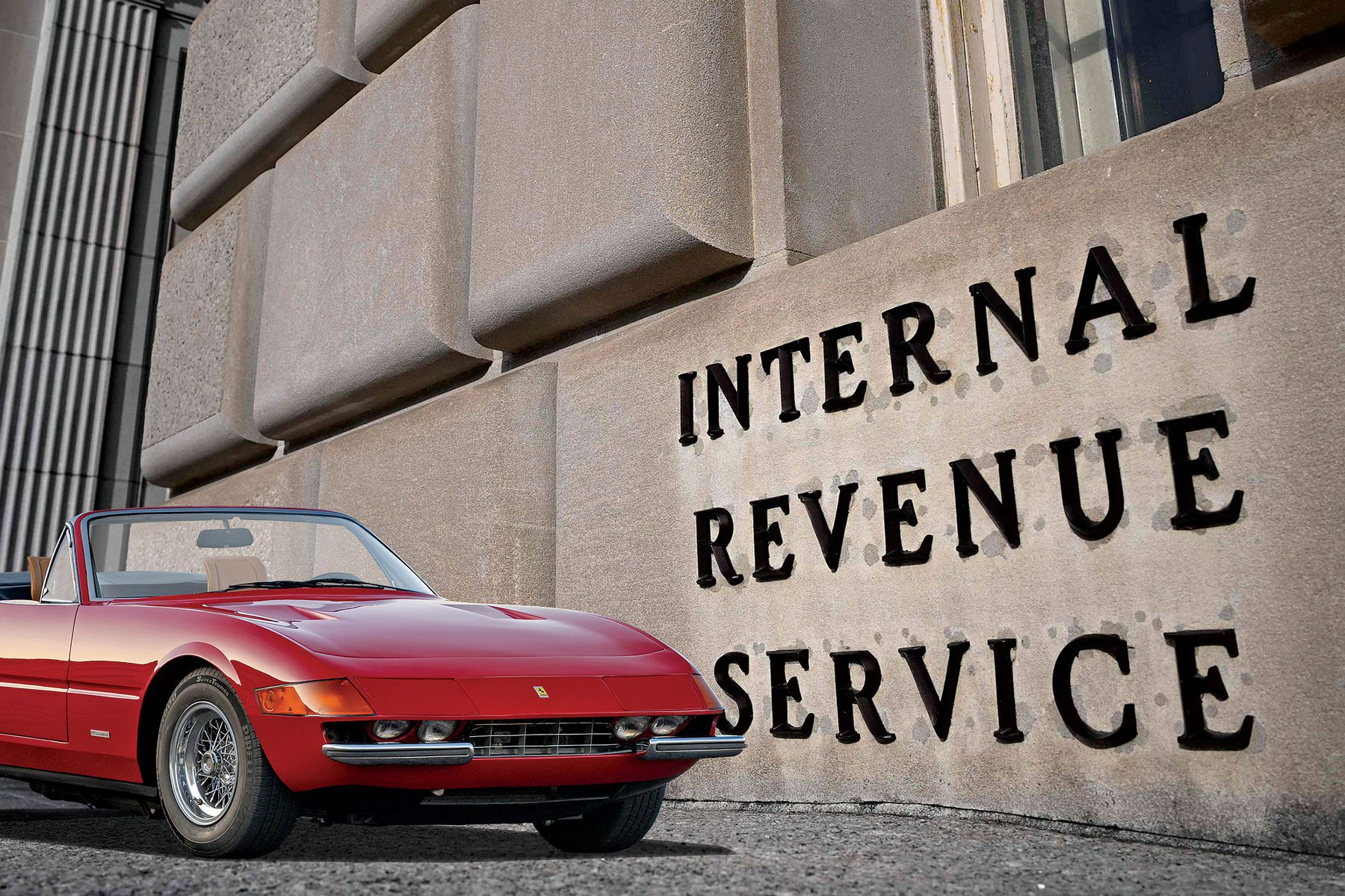

The One Big Beautiful Bill Act has traveled a rough-and-tumble political road, but we now have some certainty about the tax picture for the next 10 years. Collectors are now able to forge ahead on what to do with their car collections from a tax planning perspective. Income-tax rates Sales of collector cars that have been owned for over one year are taxed at the most favorable long-term capital-gains tax rates. The brackets start at zero but escalate quickly to 15%, and then to the top tax rate of 20% at adjusted gross income of $583,750 for married couples filing jointly. […]
The One Big Beautiful Bill Act has traveled a rough-and-tumble political road, but we now have some certainty about the tax picture for the next 10 years. Collectors are now able to forge ahead on what to do with their car collections from a tax planning perspective.
Income-tax rates
Sales of collector cars that have been owned for over one year are taxed at the most favorable long-term capital-gains tax rates. The brackets start at zero but escalate quickly to 15%, and then to the top tax rate of 20% at adjusted gross income of $583,750 for married couples filing jointly.
There is a 28% rate on gains from sales of collectibles, but I (and many others) have no doubt that cars are not considered collectibles for this purpose. Still, some tax preparers believe the contrary, and the top rate remains a matter of dispute. I frequently issue tax opinions as to the 20% top tax rate for collectors who want to be careful to avoid penalties if the IRS proves the opposite (or they just need to comfort their tax preparers).
State income taxes are a different matter. Some states offer lower rates of tax on long-term capital gains, but many treat them the same as ordinary income. My home state of Oregon is in the expensive camp, and taxes them the same as ordinary income — in this case 9%, increasing to 9.9% when your income is over $1 million.
Nearby Washington, long an income-tax-free state, has dramatically changed course. Long-term capital gains are taxed at 7% once their total gets over the inflation-adjusted threshold, currently $270,000. But that rate jumps to 9.9% once the total capital gains exceed $1 million.
Deduction limits
There has been a lot of controversy over the federal deduction for state and local taxes, referred to as SALT. Prior law limited the SALT deduction to $10,000, which has now increased to $40,000.
That’s an improvement for those of us in high-tax states, but it has to cover all state and local income taxes as well as property taxes. It’s pretty easy to use up the entire allowance, and the state tax on the sale of a big collector car is likely not going to be deducted on your federal return. Take the 20% federal capital-gains rate, add the 3.8% net investment income tax, and the 9.9% state tax, and you’re at 33.7% total tax.
The $40,000 SALT deduction phases out as your income exceeds $500,000. Once you get into that range, your effective 35% federal income tax rate jumps dramatically to 45.5% until the phase-out is completed.
Estate tax
The new federal estate tax exemption is $15 million per person, with spouses able to double that to $30 million. The exemption automatically adjusts for inflation in the future. Once you get over the exemption amount, the federal rate is a flat 40%.
Spouses can defer the estate tax until the second person’s death due to the unlimited marital deduction. That is, you can leave any amount of assets to your spouse and there won’t be any estate tax until the spouse’s death, with the spouse inheriting your unused exemption.
There are 17 states plus the District of Columbia that impose their own estate or inheritance tax. These taxes are fully deductible against your federal estate tax, reducing the net effect by 40%. However, many of these states impose their taxes on estates that are too small to owe a federal estate tax, so there won’t be a 40% savings in those situations.
The estate-tax situation recently became extremely onerous for residents of Washington. Its legislature had a big budget hole to fill, and it did so in large part by increasing its estate tax rates. Now, Washingtonians are allowed a $3 million exemption, but the tax rates rise quickly once you get over the exemption amount, topping out at a whopping 35% once the estate gets over $12 million. Washington gets very expensive for those who are subject to the 40% federal estate tax. After factoring in the benefit of the federal deduction for the Washington estate tax, the combined effective rate is 61%.
Estate vs. income taxes
We have a very complex interplay between estate and gift taxes that is critical to understand. Many collectors think they are aging out — they don’t drive their cars much anymore, their kids don’t want them, and it’s tempting to just sell the vehicles to simplify their lives. But taxes play a role in that decision.
Let’s take an example. Say you own a Mercedes 300SL Roadster that is worth $1.3 million and your tax basis in the car (what you paid for it plus the costs of improvements) is $300,000. If you sell it today, you have a $1 million long-term capital gain. This can produce federal and state taxes of as much as $427,000 at the previously mentioned maximum combined rate.
On the other hand, if you keep the Mercedes until your death and let your family inherit it, their basis will step up to its $1.3 million value. They can then sell it without any income tax. That is an important trade-off to understand. But if your basis is higher — say, $1.2 million — then the basis step-up isn’t as valuable, so a sale while you are still alive is not as much of an issue.
Your best strategy depends on the income tax you would pay on a lifetime sale, and the federal and state estate tax you pay at your death. The income tax is levied only on the gain, while the estate tax is levied on either the entire value of the car or the net after-tax proceeds from the lifetime sale. You have to do the calculations to figure out the best plan for your situation.
Tax strategies for collectors
Available strategies differ based upon your individual situation. If your estate is under the federal tax threshold, and the basis step-up is not a significant issue, then gifting your cars to your kids or trusts for their benefit can reduce your state estate taxes. That’s a viable way to get out of even the 35% tax in Washington. Connecticut is the only state in the country that has a gift tax to be concerned about.
If you’re over the federal estate-tax threshold, working to get valuation discounts is a viable strategy because the estate-tax rate is always higher than the value of the basis step-up. Say you have a car collection worth $10 million that you transfer to an LLC. If you give a 10% interest in that LLC to a trust for your kids, simple math tells us you gave them $1 million. But you didn’t, because gifts are valued under the law at what a neutral third party would pay to buy the interest. The gifted interest is a non-voting minority interest in an LLC, which the owner would have a very hard time selling to anyone else. Consequently, our hypothetical neutral third party would pay less than $1 million for it — perhaps as little as $600,000. That is the value for gift and estate tax purposes.
That sounds pretty simple, but it’s only simple if you don’t know how the IRS is able to attack it. You need to have capable legal counsel to create this structure, preferably someone who understands how collector cars work, in order to be able to withstand a potential IRS challenge. Properly designed and executed, it’s a great strategy. Not doing it right can leave you worse off than if you had done nothing.
Relocation
If you live in a high-tax state, there’s another strategy to consider: You can pack up and move. Or if you already have a vacation home in a low-tax state such as Arizona or Florida, you can simply spend more time there, making it your state of residence.
For residents of Washington, this would solve both the capital-gains problem and the estate-tax problem. If you can’t swing a move, you might consider moving your cars to take advantage of an odd feature of the Washington capital-gains tax. You don’t have to pay Washington tax if the car is kept in another state when you sell it. There are two requirements for that to apply. The first is that the car must have been kept in the other state for at least two years before the sale. The second is that you must not be subject to income tax in the other state.
Point to be taken: If any of this seems like it might apply to you, it’s time to get sophisticated tax advice. There can be a lot to gain, but it does need to be done right.
John Draneas is an attorney in Oregon and has been SCM’s “Legal Files” columnist since 2003. His recently published book The Best of Legal Files can be purchased on our website. John can be contacted at john@draneaslaw.com. His comments are general in nature and are not intended to substitute for consultation with an attorney.