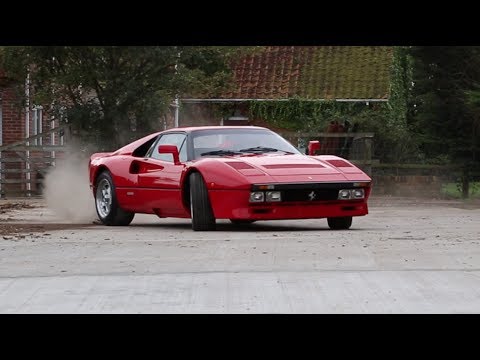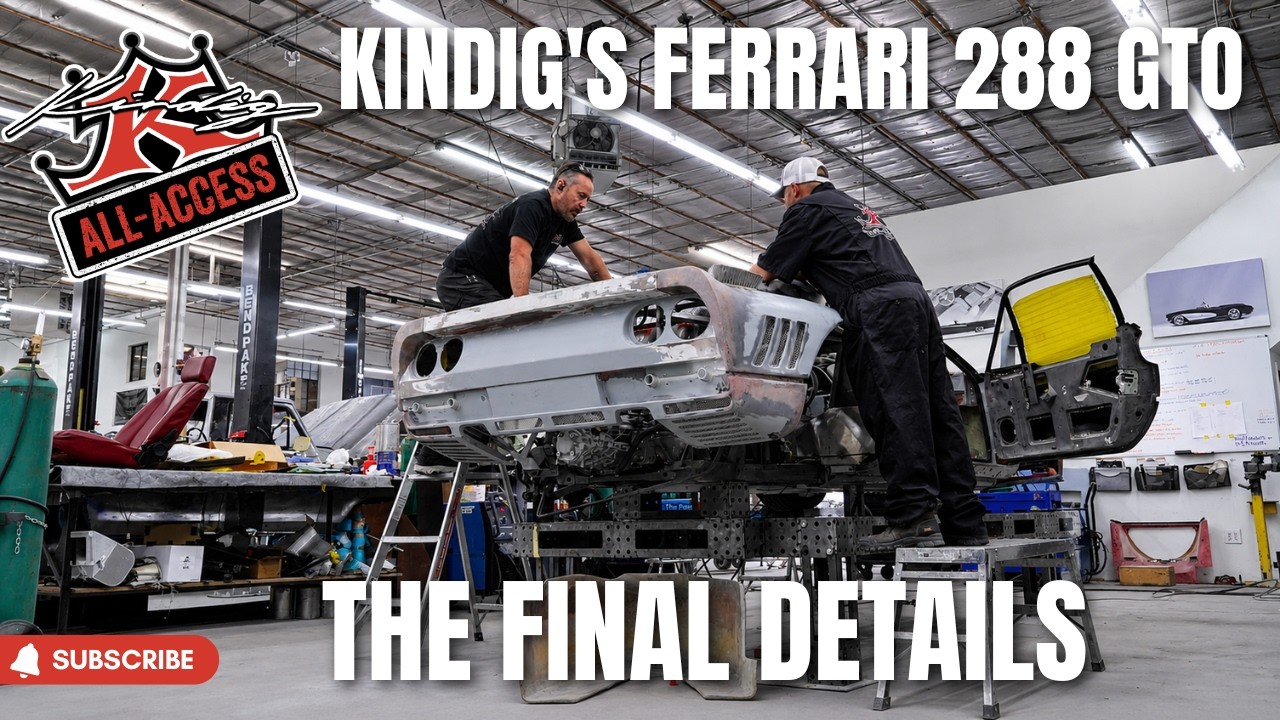
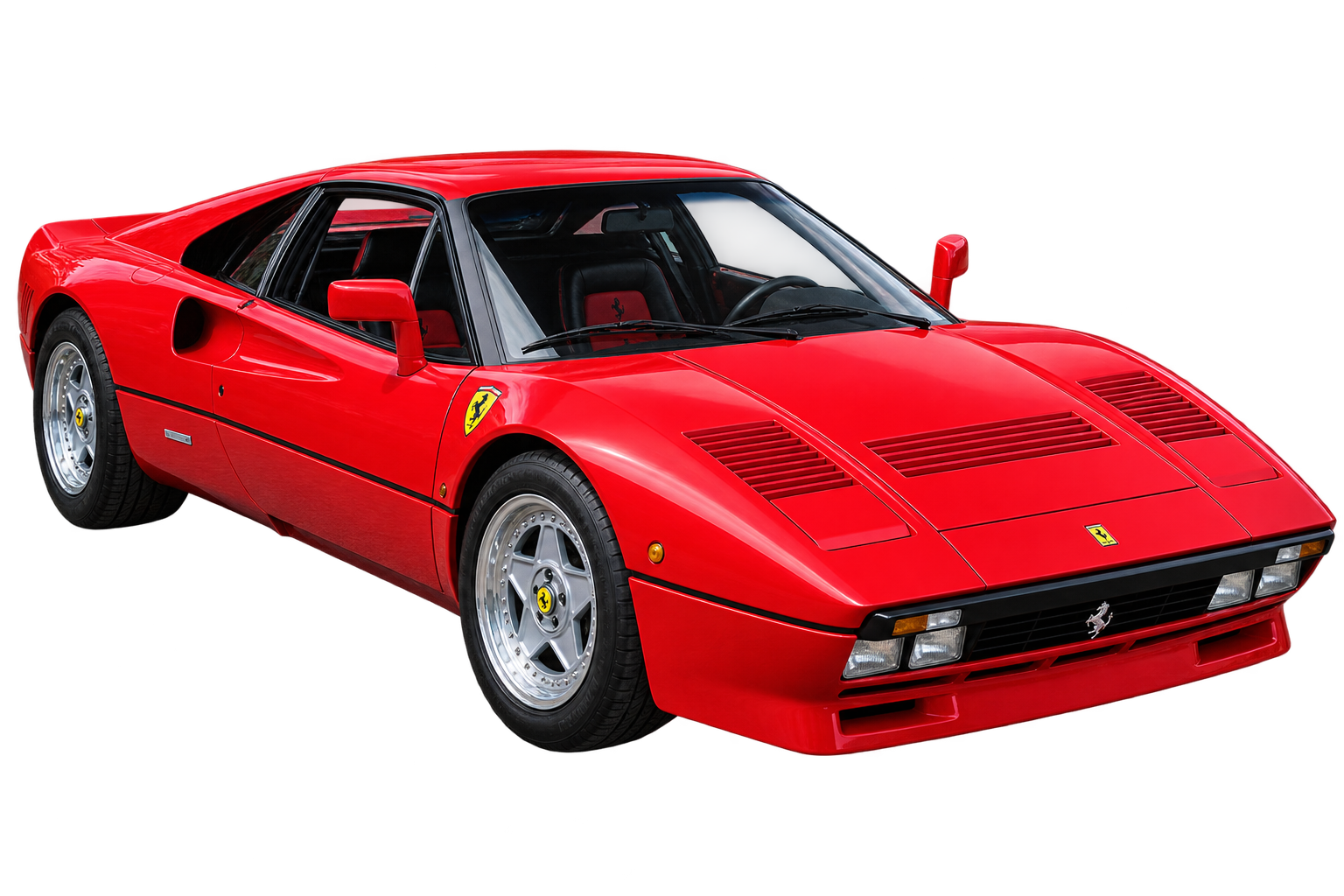
Introduced in 1984, the Ferrari 288 GTO was one of the most important road cars Ferrari had built since the original 250 GTO. Conceived primarily as a homologation special for FIA Group B competition, it combined the basic visual proportions of the contemporary 308 GTB with a radically different chassis, longitudinally mounted twin-turbocharged V8, composite body panels and substantially greater performance.
Its official name was simply Ferrari GTO, but enthusiasts commonly use “288 GTO” to distinguish it from the 250 GTO and later 599 GTO. The “288” designation refers informally to its 2.8-liter, eight-cylinder engine. The “288” prefix (2.8 liters, 8 cylinders) was is used to differentiate it from the 1962–1964 250 GTO and later 599 GTO.
Only 272 production road cars were built, making the 288 GTO much rarer than the F40 that followed it. Ferrari also developed a tiny number of even more extreme GTO Evoluzione prototypes, which became the direct technical bridge between the 288 GTO and the Ferrari F40. Ferrari originally planned a run of 200 units to meet FIA Group B homologation minimums, but increased production due to overwhelming demand.
For collectors, the main distinctions are not between conventional model years or trim levels, because Ferrari did not produce multiple regular-production versions. Instead, value and significance depend on originality, factory specification, provenance, mileage, competition-related history, and whether a car is a standard 288 GTO or one of the ultra-rare Evoluzione cars.
1982: Group B Creates the Opportunity
The 288 GTO was born from the FIA’s new Group B regulations. Group B is most closely associated today with spectacular rally cars such as the Audi Quattro, Peugeot 205 T16 and Lancia Delta S4, but the regulations also allowed manufacturers to homologate high-performance GT cars. Ferrari saw an opportunity to develop a competition car based loosely on the 308 platform.
To qualify, the company would need to produce a minimum number of road-going homologation examples. The planned racing car would use turbocharging and advanced materials while retaining enough visual relationship to a production Ferrari to satisfy the regulations.
The result became the 288 GTO.
1983: Development of the GTO
Development progressed during 1983 under Ferrari’s engineering team. Although the GTO resembled a widened 308 GTB, the two cars were fundamentally different beneath the surface. The most significant change involved engine placement. The 308 used a transversely mounted V8, while the GTO mounted its engine longitudinally. This configuration allowed Ferrari to use a separate racing-oriented gearbox positioned behind the engine and provided a more suitable layout for future competition development.
The wheelbase was lengthened by approximately 110 mm to accommodate the new drivetrain. The chassis was also reinforced and adapted for higher performance.
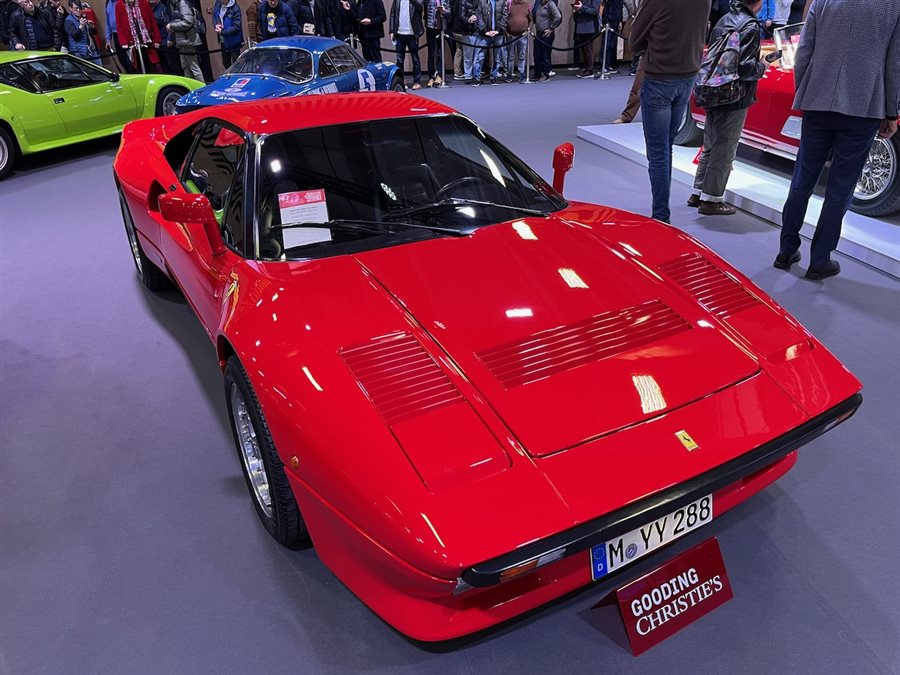
1984 Ferrari 288 GTO coupe, from an auction in Paris on January 29th, 2026
1984: The Ferrari GTO Is Introduced
Ferrari officially unveiled the GTO at the 1984 Geneva Motor Show. The car attracted immediate attention because it represented Ferrari’s return to the GTO name. The original 250 GTO had been created for GT racing in the early 1960s and had already become legendary. Using the designation again signaled that Ferrari considered the new car a serious homologation project rather than simply a faster 308.
The 288 GTO was powered by a 2,855-cc twin-turbocharged V8. Two IHI turbochargers and twin intercoolers helped the engine produce approximately 400 horsepower at 7,000 rpm in European specification. Torque was approximately 366 lb-ft.
Power was sent through a five-speed manual gearbox to the rear wheels.
1984: Why the Engine Was 2.8 Liters
The GTO’s unusual 2.855-liter displacement was determined largely by racing regulations. Under Group B rules, turbocharged engines were subject to a displacement equivalency formula. Ferrari therefore needed to keep actual displacement below a certain threshold so the turbocharged engine would fall within the intended competition class after the multiplication factor was applied. This explains why Ferrari did not simply install a larger-displacement version of its existing V8.
The engine’s relatively modest displacement was compensated for by twin turbochargers. The result was approximately 400 horsepower, an extraordinary figure for a road car in 1984.
1984: A Very Different Car from the 308
Although the GTO shared obvious styling cues with the 308 GTB, the body was substantially reworked. The rear fenders were widened and incorporated distinctive three-slot vents behind each rear wheel. The front bodywork was also revised, while larger wheels and tires filled the widened arches.
Ferrari used lightweight materials extensively. Body panels incorporated fiberglass, Kevlar and other composites, while aluminum was used in additional areas. The goal was to reduce weight while maintaining sufficient structural strength for both road and anticipated competition use. The GTO weighed roughly 2,550 pounds, depending on measurement method and specification.
1984: Performance
The GTO was among the fastest production road cars in the world. Contemporary acceleration figures generally placed 0–60 mph in approximately five seconds or less, while Ferrari claimed a top speed of around 189 mph. More significant than the headline numbers was the character of the power delivery. The twin-turbo V8 produced substantial turbo lag by modern standards. Below boost, the engine could feel relatively manageable. Once the turbochargers came fully on boost, acceleration increased dramatically.
Without traction control, stability control or modern electronic intervention, managing that power required considerable driver involvement.
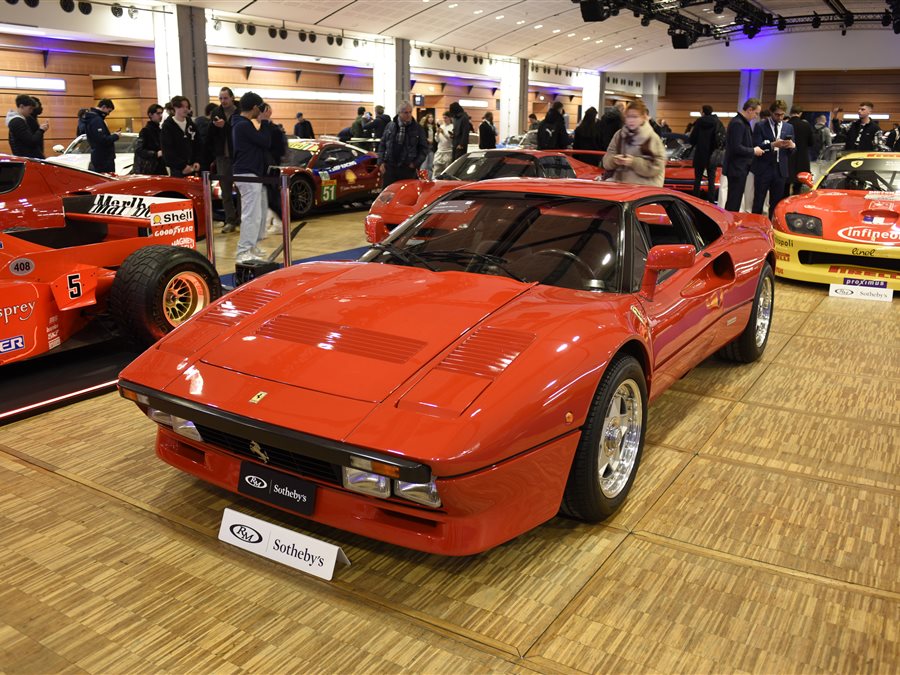
1985 Ferrari 288 GTO coupe, from an auction in Paris on January 28th, 2026
1985: Production Expands
Road-car production continued during 1985 as Ferrari attempted to satisfy homologation requirements and unexpectedly strong customer demand. Ferrari had originally planned to build approximately 200 road cars, the number necessary for Group B homologation. Demand greatly exceeded that figure. Ferrari ultimately produced 272 production examples. All were left-hand drive.
Unlike later limited-production Ferraris that were sold through highly structured allocation systems, the GTO was produced during a period when Ferrari’s approach to special-series cars was still evolving.
The fact that only 272 were made has become one of the car’s defining collector attributes.
1985: Interior and Road Equipment
Despite its racing purpose, the GTO was not completely stripped. The cabin retained much of the general Ferrari sports-car atmosphere of the period. Leather upholstery, carpeting and conventional instrumentation gave the car a more finished interior than later ultra-lightweight machines such as the F40. Air conditioning and power accessories could be fitted, depending on specification.
The dashboard and general layout shared visual similarities with the 308 family, but various GTO-specific details distinguished the car. The combination of comfort and extreme performance made the GTO more of a highly developed road-going GT than a bare-bones competition special.
1985: Suspension and Brakes
The GTO used independent suspension with coil springs and telescopic dampers. Its wider track, longer wheelbase and larger tires provided substantially greater capability than a standard 308. Braking was handled by large ventilated discs. The car had no ABS, power steering, traction control or stability control. This absence of electronic assistance is central to the GTO’s character today.
The driver manages steering, braking and turbocharged power directly, making the car feel much more mechanical than modern supercars.
1985: Wheels and Tires
The GTO used distinctive five-spoke split-rim wheels. They were wider than those of the 308 and accommodated large high-performance tires. The rear tires were especially wide for the period, reinforcing both the car’s appearance and its ability to transmit turbocharged power to the road. Original wheels are important today because replacements or competition-style substitutes can alter the car’s authenticity and value.
1986: Final Road-Car Production
Production of the regular 288 GTO ended in 1986. There was no formal Series II, facelift or major production redesign. Ferrari made small running changes, but the 272 road cars remained fundamentally similar.
That makes specification differences much less significant than on models such as the Porsche 356 or Jaguar E-Type. Instead, collectors focus on individual history, originality, factory documentation, condition and whether major components remain correct.
By the time production ended, Group B itself was already collapsing.
1986: Group B Is Cancelled
The 288 GTO had been conceived for Group B competition, but it never achieved the racing career Ferrari originally envisioned.
A series of fatal accidents in rallying led the FIA to cancel Group B after the 1986 season.
Although Ferrari’s intended GT racing program differed from the rally cars most associated with the regulations, the category’s disappearance effectively removed the competitive environment for which the GTO had been developed.
The road-going 288 GTO therefore became one of the most famous homologation cars that never competed in its intended championship in full works form.
Ironically, that lack of a major racing career did little to diminish its significance.
The GTO Evoluzione
Before Group B disappeared, Ferrari developed an even more extreme version called the GTO Evoluzione. The Evoluzione was conceived as the next stage of competition development. Its bodywork was radically different from the road car, with much more aggressive aerodynamics, larger air intakes, a deeper front spoiler and an enormous rear wing. Weight was reduced dramatically. The engine was also substantially developed.
Depending upon specification, Evoluzione output is generally cited in the range of approximately 650 horsepower. Performance potential was extraordinary.
1986–87: From Evoluzione to F40
When Group B was cancelled, Ferrari was left with a highly developed competition prototype that no longer had a racing category. Rather than abandon the engineering work, Ferrari used the GTO Evoluzione as the technical foundation for a new road car. That project became the Ferrari F40, introduced in 1987.
The relationship between the two cars is significant. Both used twin-turbocharged V8 engines, lightweight composite construction and a philosophy emphasizing performance over luxury. The F40’s body was completely different, but mechanically and conceptually it evolved directly from the 288 GTO program.
This makes the GTO Evoluzione one of the most important developmental Ferraris of the 1980s.
How Many GTO Evoluziones Were Built?
The exact count can be described differently depending on whether prototypes and development cars are included, but approximately five or six GTO Evoluzione examples are generally recognized. That makes them vastly rarer than the 272 production road cars. Authenticity is therefore extremely important.
A road-going GTO converted to Evoluzione appearance is not equivalent to a genuine factory development chassis. Original factory records and continuous provenance are essential when evaluating one of these cars.
The Standard 288 GTO
The regular-production 288 GTO road car represents nearly all of the model’s production. All use the 2.855-liter twin-turbocharged V8 producing approximately 400 horsepower. All have a five-speed manual transmission and rear-wheel drive. There was no factory automatic option.
There was also no regular convertible, targa or right-hand-drive version. Consequently, the collector market does not divide the model into numerous body and mechanical variants. The differences are primarily individual rather than structural.
European Specification
The 288 GTO was essentially conceived as a European-market car. Unlike later Ferraris such as the F40, there was no large, separately engineered factory U.S.-specification production run. Cars that came to the United States often required importation and federal compliance work. These modifications could involve emissions systems, lighting or other equipment depending upon the period and method of importation.
For collectors, identifying whether such changes remain and whether they are reversible can be important. Cars restored to correct original European appearance are generally preferred.
U.S.-Imported Cars
Because the 288 GTO was highly desirable from the beginning, a number reached the United States through private importation. Federalization requirements could alter bumpers, lighting, emissions systems or other components. The extent and quality of those modifications varied. Some were later reversed when regulations or exemptions made that possible.
A U.S.-located GTO should therefore be evaluated on its individual history rather than assumed to be in original specification merely because it looks correct today. Documentation of importation and subsequent restoration work can be valuable.
Color and Interior Specification
Most 288 GTOs were finished in Rosso Corsa, reinforcing the car’s visual association with Ferrari racing history. The interior was generally trimmed in black leather and related materials. Compared with later Ferrari limited-series cars, factory color variation was relatively limited. Because the overwhelming majority were red, an unusual documented factory color or interior configuration can be particularly interesting.
However, originality usually matters more than rarity for rarity’s sake. A repaint into a non-original color can reduce collector appeal even if the new color is attractive.
Understanding the Major 288 GTO Variants
The 288 GTO family is much simpler than many other collectible Ferraris, but several distinctions matter:
- 288 GTO Road Car: The standard production version, with a 2,855-cc twin-turbo V8 producing approximately 400 horsepower, five-speed manual gearbox and rear-wheel drive.
- Early Production Road Car: Initial examples built during the 1984 period. Differences from later cars are minor, and production sequence generally matters less than condition and originality.
- Late Production Road Car: Cars built toward the end of the 1986 production run. Mechanically very similar to early cars.
- European-Specification GTO: Cars retaining their original European configuration, generally preferred by collectors.
- U.S.-Imported or Federalized GTO: Cars modified as necessary for importation into the United States. The significance depends upon what modifications were made and whether they remain.
- GTO Evoluzione: Radical factory competition-development version with lightweight bodywork, aggressive aerodynamics and approximately 650 horsepower. Extremely rare and directly related to the development of the F40.
The 288 GTO Versus the 308 GTB
Visually, the GTO is often mistaken for a heavily modified 308 GTB.
The similarities are understandable, but mechanically the two are dramatically different.
The 308 uses a transverse naturally aspirated V8.
The GTO uses a longitudinally mounted twin-turbo V8 with a separate gearbox behind it.
The GTO also has a longer wheelbase, wider track, composite body components, unique suspension geometry and substantially more power.
Even the body proportions differ when viewed closely.
The GTO’s wider rear body, distinctive side vents and altered front and rear sections identify it as a fundamentally different automobile.
A 308 converted visually to resemble a GTO is therefore not mechanically comparable.
The 288 GTO Versus the F40
The 288 GTO and F40 are closely related historically, but they provide very different experiences.
The GTO is more restrained.
Its styling retains the elegant proportions of Ferrari’s early-1980s road cars, and its interior is relatively civilized.
The F40 is much more aggressive visually and structurally.
It uses more extensive composite materials, produces approximately 478 horsepower in European specification and has a much more stripped-down cabin.
Production rarity is also dramatically different.
Only 272 288 GTOs were built compared with more than 1,300 F40s.
For collectors, that scarcity is one of the strongest arguments for the 288 GTO’s significance.
What Matters to Collectors
Because there are few formal variations among road-going 288 GTOs, condition, originality and provenance dominate the collector discussion.
Matching-numbers mechanical components are extremely important.
The original twin-turbocharged engine and five-speed gearbox form a large part of the car’s identity.
Engine replacement or major non-original modifications can significantly affect value.
The composite body also requires specialist inspection.
Accident repairs can be difficult to identify and expensive to correct.
Panel fit, chassis alignment, suspension mounting points and composite repair quality should all be examined carefully.
Turbochargers, intercoolers, fuel systems and engine-management components require knowledgeable maintenance.
A car that has spent many years sitting unused may need substantial mechanical recommissioning even if its mileage is extremely low.
Original wheels, interior trim, exhaust components and engine-bay details also matter.
Because 288 GTO values have risen dramatically, cars that were modified when they were worth much less are increasingly being returned to factory specification.
The quality and accuracy of those restorations vary.
Mileage can influence value, but extremely low mileage should not automatically be considered superior.
A documented, regularly serviced car with somewhat higher mileage may be mechanically healthier than a museum-condition example that has rarely been operated.
Service history is therefore critical.
The car’s rarity also makes provenance unusually important.
Ownership by a notable collector, participation in significant Ferrari events, or exceptionally complete documentation can enhance desirability.
The GTO Evoluzione occupies a completely different category.
With only a handful built, each car’s identity and developmental history are essential.
A genuine Evoluzione is not merely a rare version of the road car; it is an important piece of Ferrari’s engineering transition from the 288 GTO to the F40.
The 288 GTO’s place in Ferrari history is difficult to overstate.
It revived the GTO name, introduced a twin-turbocharged homologation special for Group B, demonstrated Ferrari’s growing use of composite materials and provided the technical foundation for the F40.
It also helped establish the modern concept of the limited-production Ferrari supercar.
The 288 GTO was followed by the F40, F50, Enzo and LaFerrari, creating an informal lineage of Ferrari flagship performance cars.
Among those cars, the 288 remains one of the rarest and most understated.
Its appearance is less dramatic than the F40’s, yet beneath the familiar Pininfarina-inspired shape is a purpose-built longitudinal twin-turbo drivetrain, lightweight body and chassis engineered around competition homologation requirements.
That combination explains why the Ferrari 288 GTO has moved far beyond its original status as a homologation special.
Today it is recognized as one of the defining Ferraris of the 1980s, a direct link between Ferrari’s traditional GT racing heritage and its modern supercar era, and one of the most important road cars ever to wear the GTO badge..
Important Sales Reviewed by SCM Experts
In each month’s issue for the past 38 years, SCM’s analysts have reviewed 5 to 7 significant cars sold at auction, and discuss what options, history, or details made that particular more or less valuable. They give their expert opinion on the market for these cars, and whether this car was well bought or well sold. If you’re thinking of purchasing a Ferrari 288 GTO, you’ll likely find these profiles critical in helping you make the right decision. Each of the following is an article from our print magazine on a Ferrari 288 GTO sold at auction.
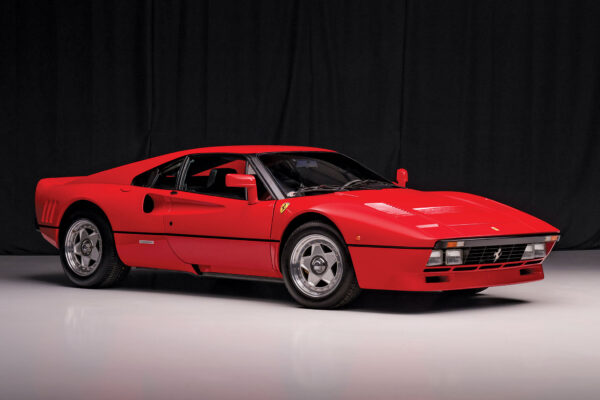 1985 Ferrari 288 GTOPhoto courtesy 1600Veloce The first Ferrari supercar is the rarest when collecting a full set of six This 1985 Ferrari 288 GTO is one of the initial 200 examples constructed en route to achieving the model’s homologation status in FIA Group B competition and is among a total of 272 examples built between 1984 and […]Read more
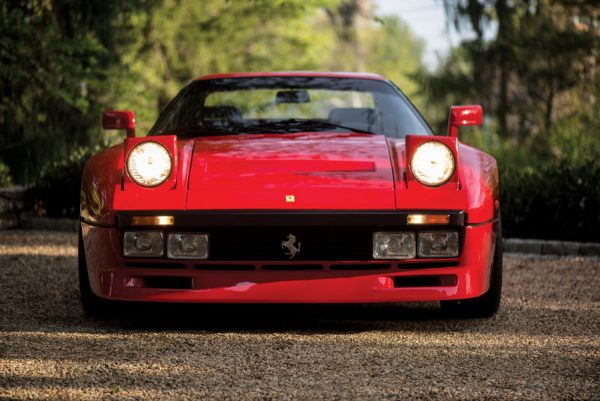 1985 Ferrari 288 GTOOne of only 272 produced Three owners from new; driven 23,555 original kilometers Equipped with factory air conditioning and power windows Includes original owner’s manuals, toolkit, jack and spare key Popular Videos about the Ferrari 288 GTO The Ferrari 288 GTO – Group B Spec!! TaxTheRich100 10,436,169 views Restoration of a very rare Ferrari. Restoration […]Read more
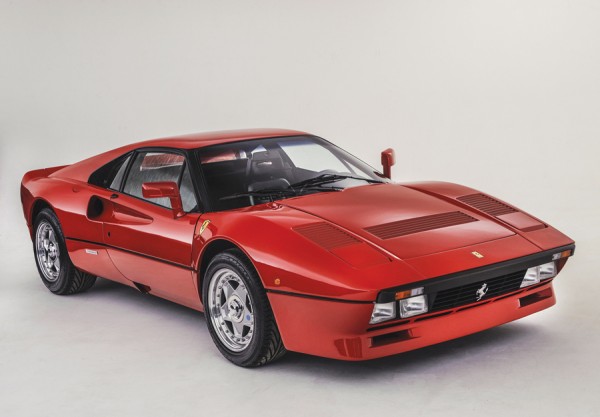 1985 Ferrari 288 GTOThe original, immortal Ferrari 250 GTO had been developed for the FIA GT Championship, duly taking the manufacturer’s title for Ferrari in 1962, 1963 and 1964. So, clearly, any revival of the GTO name could only be permitted for a very special car indeed. Enter the 288 GTO. Like its illustrious forebear, the 288 GTO […]Read more
Cars For Sale
Quick links to listings for this make and model online:
Books on the Ferrari 288 GTO
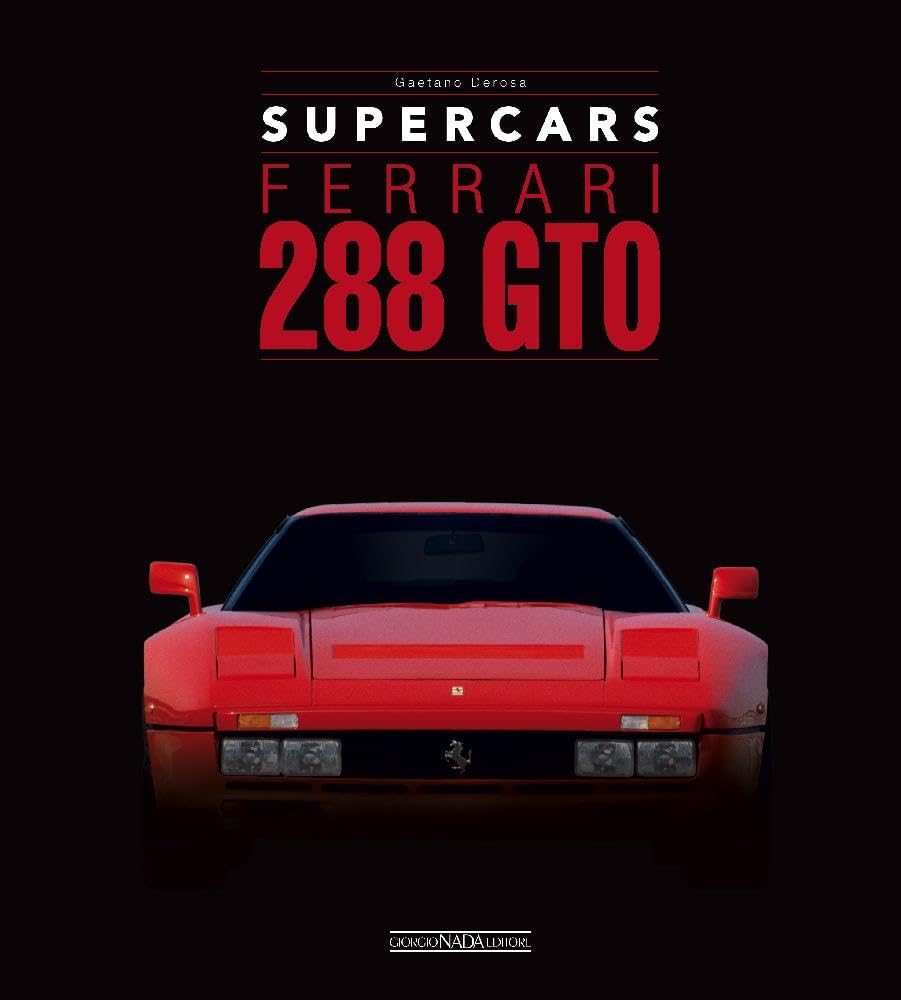
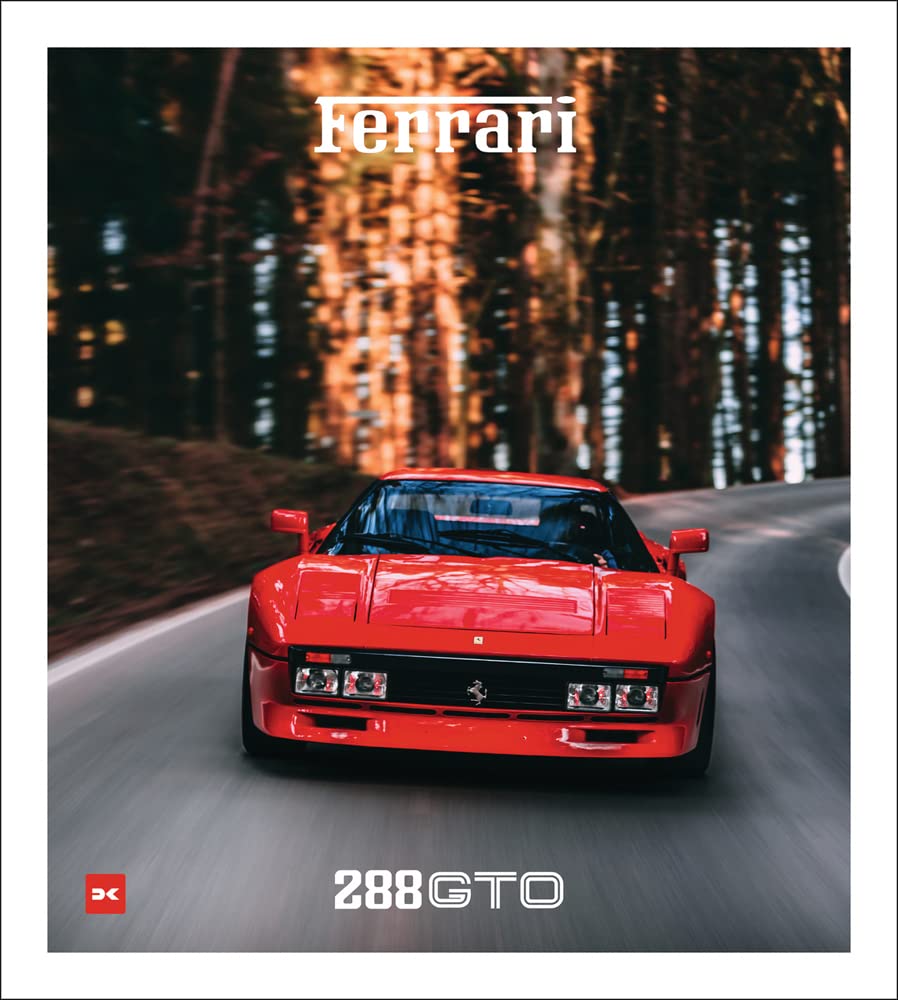
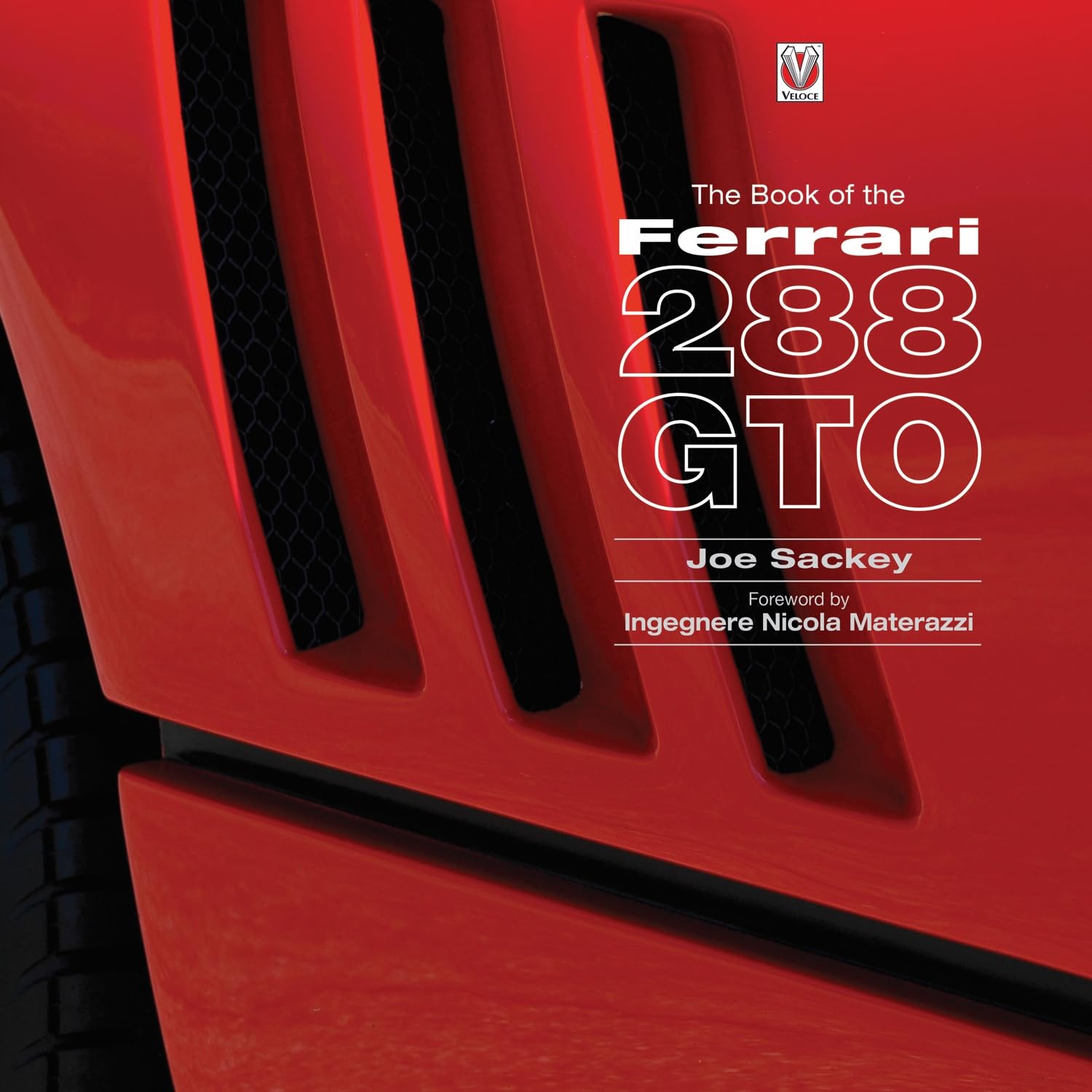
Note that as an Amazon Associate, we earn from qualifying purchases of the above books.
Past Auction Sales – Ferrari 288 GTO
Average Ferrari 288 GTO Sale Price by Year from SCM’s Platinum Auction Database:
Ferrari 288 GTO Sales from SCM’s Platinum Auction Database:

Bring a Trailer
Condition: 2
Jul 10, 2026
$6,832,500

Gooding Christie's
Condition: 2+
Jan 29, 2026
$10,917,295

RM Sotheby's
Condition: 2+
Jan 28, 2026
$7,010,777

Mecum Auctions
Condition:
Jan 17, 2026
$8,525,000

RM Sotheby's
Condition: 2+
May 31, 2024
$3,882,500

Broad Arrow Auctions
Condition: 2+
Aug 17, 2023
$3,910,000

RM Sotheby's
Condition: 2-
Mar 3, 2023
$3,965,000

RM Sotheby's
Condition: 2
Feb 2, 2022
$3,922,712

RM Sotheby's
Condition: 2
May 21, 2020
$2,310,000

Gooding & Co.
Condition: 2-
Jan 18, 2019
$2,507,500

Bonhams
Condition: 2-
Dec 2, 2017
$2,540,251

RM Sotheby's
Condition: 2+
Sep 9, 2017
$3,935,178

Bonhams
Condition: 2
Aug 19, 2016
$2,112,000

Bonhams
Condition: 1-
May 13, 2016
$2,061,932

Bonhams
Condition: 2
Aug 14, 2015
$2,365,000

RM Sotheby's
Condition: 1-
May 23, 2015
$2,132,480

RM Auctions
Condition: 1-
Jan 16, 2015
$2,750,000

Bonhams
Condition: 2
Nov 30, 2014
$2,375,584

Gooding & Co.
Condition: 2
Aug 18, 2013
$1,512,500

RM Auctions
Condition: 2-
May 25, 2013
$1,252,160

Bonhams
Condition: 1-
Apr 11, 2011
$0

RM Auctions
Condition: 2+
May 17, 2009
$529,375

Gooding & Co.
Condition: 3
Jan 17, 2009
$616,000

RM Auctions
Condition: 1-
Oct 31, 2007
$475,549

Bonhams
Condition: 1-
May 21, 2007
$585,900

RM Auctions
Condition: 1-
May 20, 2007
$594,000

RM Auctions
Condition: 1-
May 20, 2007
$683,100

Bonhams
Condition: 1-
Dec 17, 2005
$317,903

Bonhams
Condition: 1-
Dec 17, 2005
$295,983

Bonhams
Condition: 1-
Dec 18, 2004
$322,589

RM Auctions
Condition:
Aug 12, 2004
$302,500

Barrett-Jackson
Condition: 3
Jan 22, 2004
$54,000

Bonhams
Condition: 2-
Dec 19, 2003
$274,748

Bonhams
Condition: 2-
Aug 10, 2002
$231,830

RM Auctions
Condition: 2
Mar 10, 2000
$313,500

Brooks
Condition: 1
Mar 5, 2000
$228,787

Brooks
Condition: 2
Dec 1, 1998
$229,350
Forums & Communities
Popular Videos about the Ferrari 288 GTO