
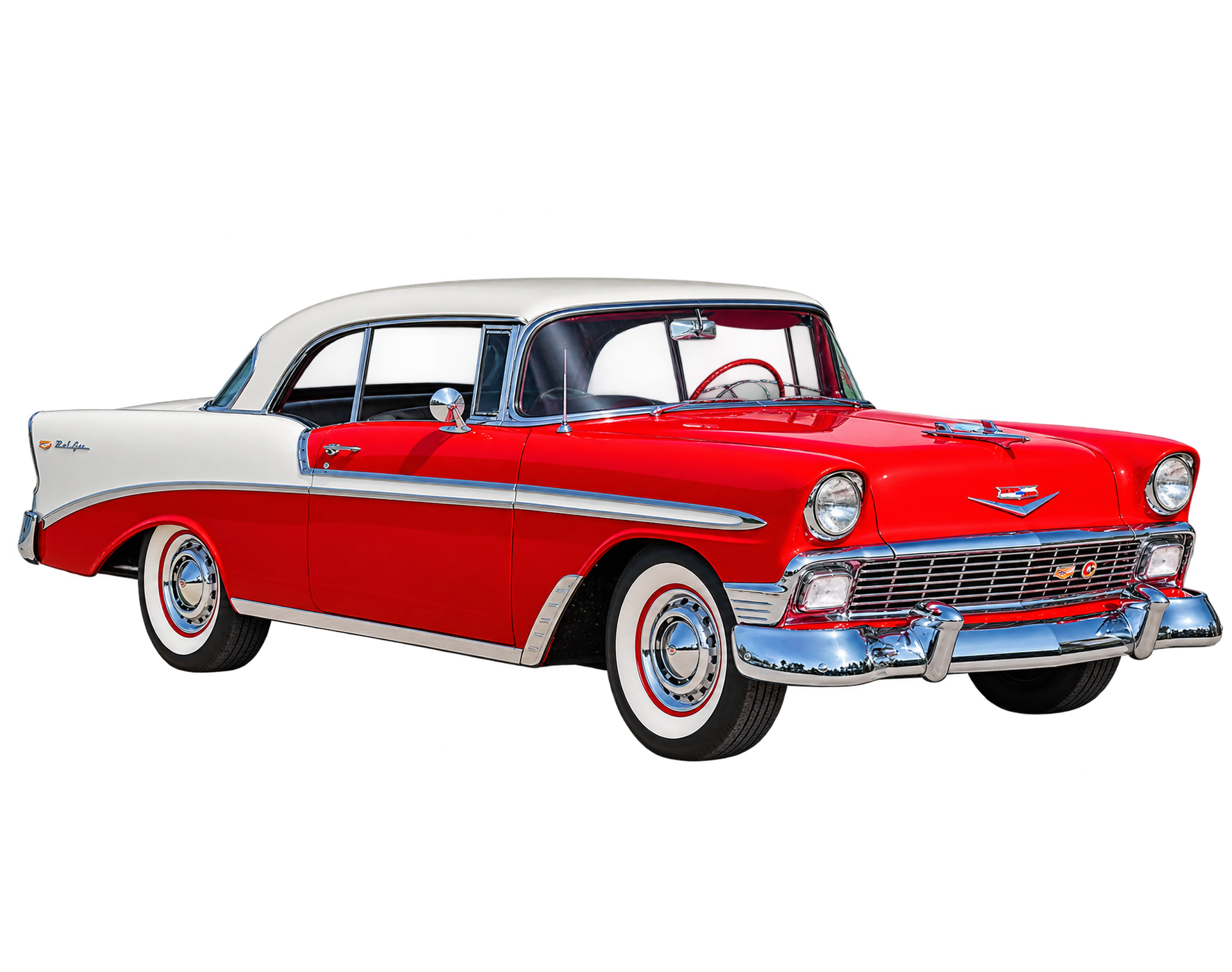
The Chevrolet Bel Air was one of the defining American automobiles of the 1950s and an enduring symbol of the postwar automotive boom. Introduced as a distinctive hardtop body style for 1950, the Bel Air became Chevrolet’s premium model series in 1953 and evolved through successive generations of full-size sedans, coupes, convertibles and station wagons. Its combination of attractive styling, affordable pricing, mechanical simplicity and an increasingly powerful range of engines made it one of the most successful nameplates in Chevrolet history.
Although the Bel Air remained in production in the United States through 1975, its greatest collector significance lies in the 1955–57 Tri-Five Chevrolets, particularly the 1957 Bel Air with its dramatic tailfins and distinctive chrome trim. These cars helped establish Chevrolet’s reputation for combining mainstream affordability with exciting performance, especially after the introduction of the small-block V8 in 1955.
The Bel Air also played an important role in the development of American hot-rodding, drag racing and custom-car culture. Its widespread availability, interchangeable components and enormous aftermarket support made it one of the most popular platforms for performance modifications and restorations. Today, the Bel Air encompasses everything from modest six-cylinder family sedans to highly collectible fuel-injected convertibles and Nomad station wagons.
Origins: Chevrolet’s First Hardtop
The Bel Air name first appeared for the 1950 model year, identifying Chevrolet’s new pillarless two-door hardtop in the Styleline De Luxe range. The car combined the appearance of a convertible with the practicality of a fixed steel roof, an increasingly popular body style among American manufacturers.
The original Bel Air featured distinctive roof styling, generous glass area and upscale trim. Its pillarless construction created an airy passenger compartment and gave the car a more elegant appearance than conventional two-door sedans.
Mechanically, the early Bel Air shared Chevrolet’s established six-cylinder engines and conventional chassis architecture. Performance was modest, but the car offered comfortable transportation and attractive styling at a relatively affordable price.
The success of the hardtop body style encouraged Chevrolet to expand the Bel Air name into a complete premium model series for 1953.
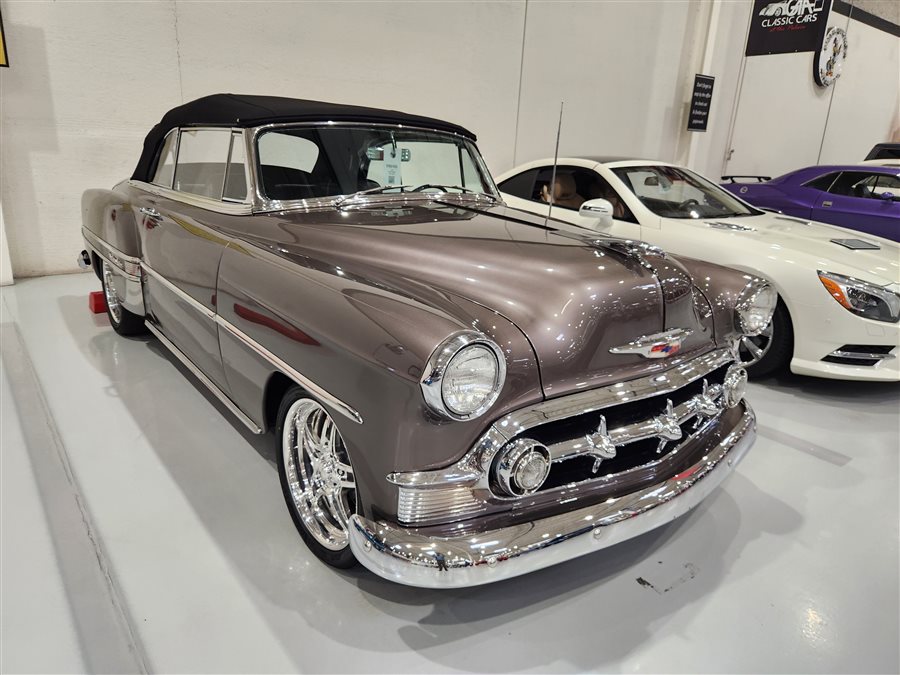
1953 Chevrolet Bel Air Resto-mod convertible, from an auction on November 7th, 2024
The 1953–54 Bel Air
For 1953, Chevrolet reorganized its passenger-car lineup, making the Bel Air the company’s premium full-size model series. The range included two-door and four-door sedans, a two-door hardtop and a convertible.
Styling was updated with a lower, wider appearance, revised grille and more integrated bodywork. The Bel Air featured additional chrome trim and upgraded interior materials compared with Chevrolet’s lower-priced models.
Power came from Chevrolet’s familiar inline-six engines, including the 235-cubic-inch Blue Flame six. Output varied according to transmission and specification, but the engine was known for smooth operation, durability and straightforward maintenance.
The 1954 Bel Air received modest styling and mechanical revisions, including improved suspension and increased engine output.
These early Bel Airs are appreciated for their classic postwar styling, although they generally attract less collector attention than the dramatically redesigned 1955–57 models.
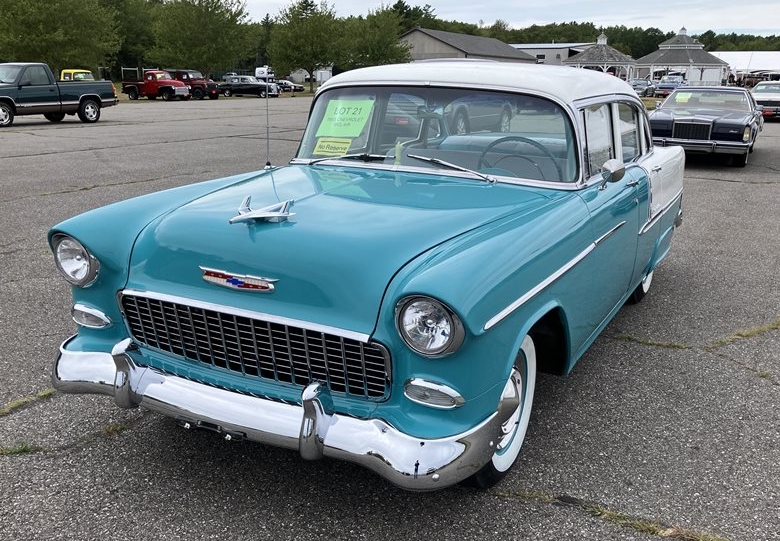
1955 Chevrolet Bel Air sedan, from an auction in New England on August 22nd, 2025
The 1955 Chevrolet Bel Air
The 1955 Bel Air marked one of the most important turning points in Chevrolet history. The completely redesigned body introduced lower, cleaner styling, a wraparound windshield and a more modern chassis. Harrison Ford drove a 1955 Chevy 150 (the base-level model; the Bel Air was the top-of-the-line model) in the classic movie American Graffiti.
The 1955 model was substantially different from its predecessors. Its proportions were lower and wider, with a distinctive egg-crate grille, restrained chrome trim and a more contemporary appearance.
Most importantly, Chevrolet introduced its new 265-cubic-inch small-block V8, designed under the direction of Ed Cole. The engine was compact, relatively lightweight and capable of producing substantially more power than Chevrolet’s traditional inline-six.
The 265 V8 was initially rated at approximately 162 horsepower in standard form, with higher-output versions producing up to 180 horsepower. The engine transformed the Bel Air’s performance and established the foundation for one of the most successful engine families in automotive history.
The 1955 Bel Air was available in a wide range of body styles, including sedans, hardtops, convertibles and station wagons. Its combination of modern styling and V8 performance made it an immediate success.
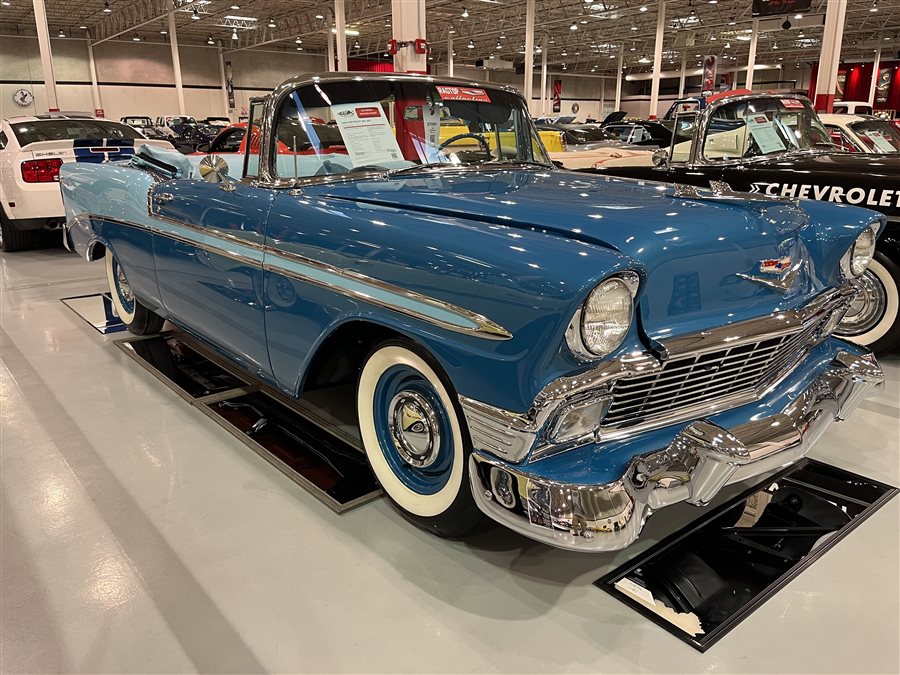
1956 Chevrolet Bel Air convertible, from an auction in Greensboro on November 2nd, 2023
The 1956 Chevrolet Bel Air
The 1956 Bel Air retained the basic 1955 body structure but received substantial styling revisions. The front grille became wider and more integrated, while revised side trim created the distinctive two-tone paint treatments associated with mid-1950s Chevrolets.
The 265-cubic-inch V8 continued, with improved output and additional performance options. Depending upon specification, horsepower ranged from approximately 162 to 225 horsepower.
The 1956 model also benefited from incremental improvements to suspension, brakes and interior equipment.
Although the 1955 and 1957 models often receive greater attention, the 1956 Bel Air is highly regarded for its balanced styling and relative simplicity. Many enthusiasts consider it the most understated and elegant of the Tri-Five Chevrolets.
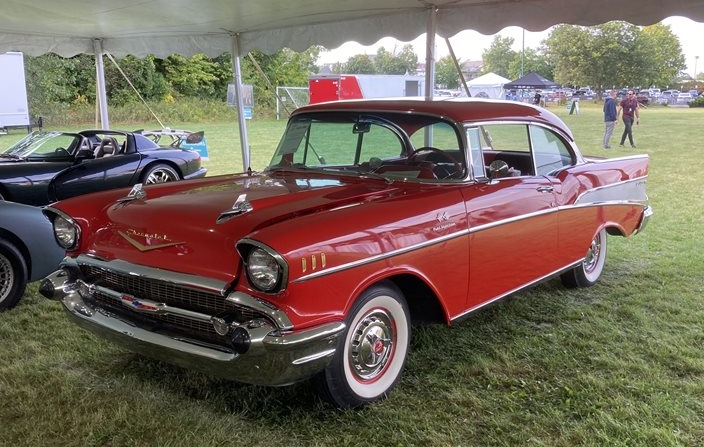
1957 Chevrolet Bel Air Fuel Injected 2-dr hard top, from an auction in Saratoga on September 22nd, 2023
The 1957 Chevrolet Bel Air
The 1957 Bel Air is arguably the most recognizable Chevrolet of the 1950s. Its dramatic tailfins, prominent chrome trim and distinctive front-end styling made it an enduring symbol of American automotive design. The 1957 model retained much of the 1955–56 chassis architecture but incorporated extensive exterior revisions. The front featured a wide grille and prominent bumper, while the rear received sharply pointed tailfins and distinctive vertical trim.
The Bel Air was available in several body styles, including two-door and four-door sedans, hardtops, convertibles and station wagons.
The most significant mechanical development was the introduction of the 283-cubic-inch small-block V8, which replaced the 265 in most V8 applications. The 283 was available in several horsepower configurations, including the celebrated 283-horsepower fuel-injected version.
The combination of dramatic styling and strong performance made the 1957 Bel Air an icon of American car culture.
The 283 Fuel-Injected V8
One of the most important developments in Bel Air history was Chevrolet’s introduction of Rochester mechanical fuel injection for 1957.
The system was offered on the 283-cubic-inch small-block V8, with the highest-output version rated at 283 horsepower. This represented the celebrated achievement of producing one horsepower per cubic inch of displacement. While the 1957 283 hp fuel-injected V8 is famous for achieving 1 hp/cu in, Chrysler’s limited-production 1956 300B with its 354 cu in Hemi (355 hp) technically reached 1 hp/cu in first a few months earlier. However, Chevrolet was the first mass-production high-volume manufacturer to market and popularize the benchmark.
The fuel-injected 283 was among the most sophisticated American production engines of its era. It offered strong performance and demonstrated Chevrolet’s commitment to advanced engine technology. However, the system was expensive and required specialized maintenance. Relatively few Bel Airs were ordered with fuel injection, making genuine factory-equipped examples particularly desirable.
Authentication is critical because fuel-injection systems have been retrofitted to many cars. Original engine identification, factory documentation and correct components are essential when evaluating a purported factory fuel-injected Bel Air.
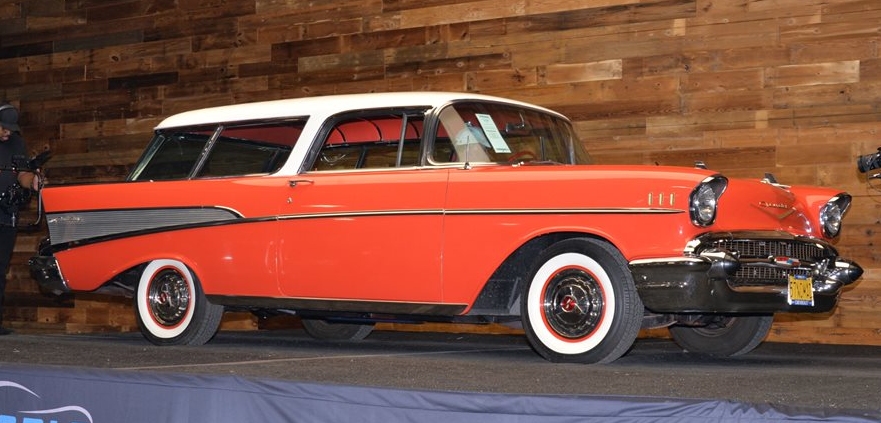
1957 Chevrolet Bel Air Nomad 2-dr wagon, from an auction on August 31st, 2023
The Chevrolet Nomad: 1955–57
The Chevrolet Nomad was one of the most distinctive station wagons of the 1950s. Introduced for 1955, it combined the practicality of a wagon with the styling of a sporty two-door hardtop. The Nomad featured a unique roofline, sloping rear pillars, extensive chrome trim and a distinctive tailgate design. Its styling originated in a Chevrolet Corvette-based concept car displayed in 1954.
Production Nomads were based on the full-size Chevrolet platform and were part of the Bel Air series from 1955 through 1957. The Nomad was considerably more expensive than conventional Chevrolet station wagons, limiting sales. Approximately 22,375 Tri-Five Nomads were produced across the three model years.
Today, original 1955–57 Nomads are among the most collectible Chevrolet station wagons, particularly when equipped with desirable V8 engines and factory-correct trim.
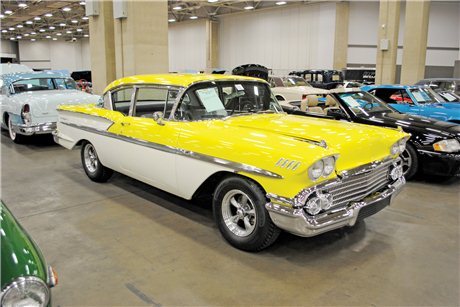
1958 Chevrolet Bel Air 2-dr sedan, from an auction in Dallas on September 8th, 2012
The 1958 Chevrolet Bel Air
For 1958, Chevrolet introduced an entirely new full-size body with longer, lower and wider proportions. The design departed substantially from the compact, upright appearance of the Tri-Five models.
The 1958 Bel Air featured quad headlights, a broad grille and substantial chrome trim. The body was larger and heavier, reflecting the changing tastes of American buyers.
The Bel Air remained an important model series, but Chevrolet introduced the Impala as a premium Bel Air subseries for 1958. The Impala featured distinctive styling and additional luxury equipment, positioning it above the regular Bel Air. Engine choices included the familiar inline-six, the 283 small-block V8 and the new 348-cubic-inch big-block V8. The 348 provided substantially greater torque and became an important foundation for Chevrolet’s growing performance reputation.
The 1958 Bel Air is particularly notable for its one-year-only styling and its role in the transition toward larger, more elaborate American full-size cars.
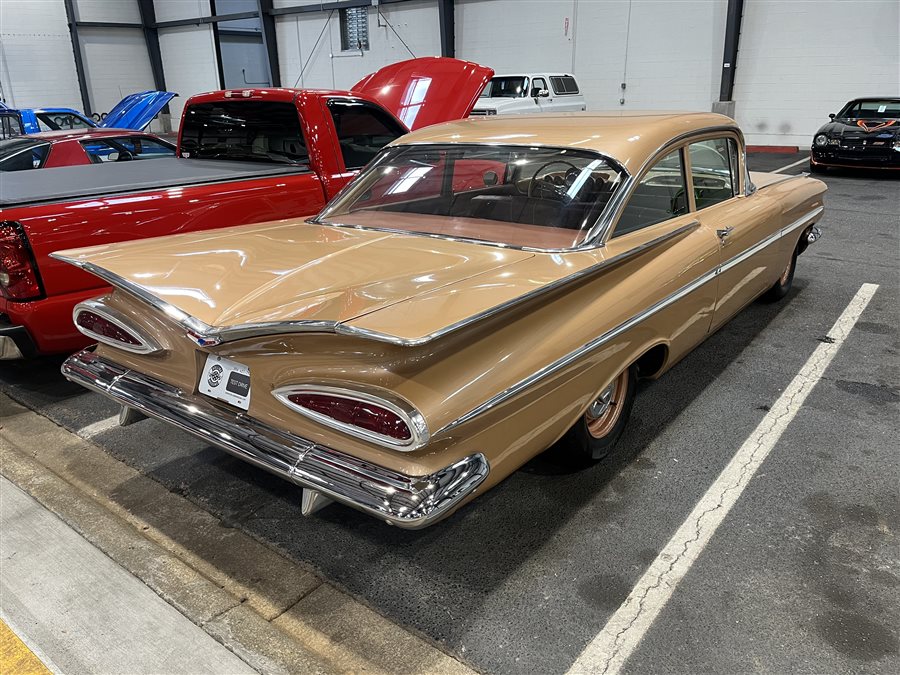
1959 Chevrolet Bel Air Custom 2-dr sedan, from an auction on November 7th, 2024
The 1959–60 Bel Air
The 1959 Chevrolet received another complete redesign, featuring an exceptionally wide body, low roofline and dramatic horizontal tailfins.
The Bel Air continued as a full-size model, now positioned below the Impala in Chevrolet’s lineup. The 1959 styling was among the most flamboyant in the company’s history, with distinctive rear lighting and sweeping body contours.
For 1960, Chevrolet revised the front and rear styling, adopting a more restrained appearance while retaining the basic body structure.
Engine choices included inline-six and V8 options, with the 283 small-block and 348 big-block providing strong performance.
These models are appreciated for their dramatic late-1950s styling, although they generally occupy a different collector niche from the Tri-Five cars.
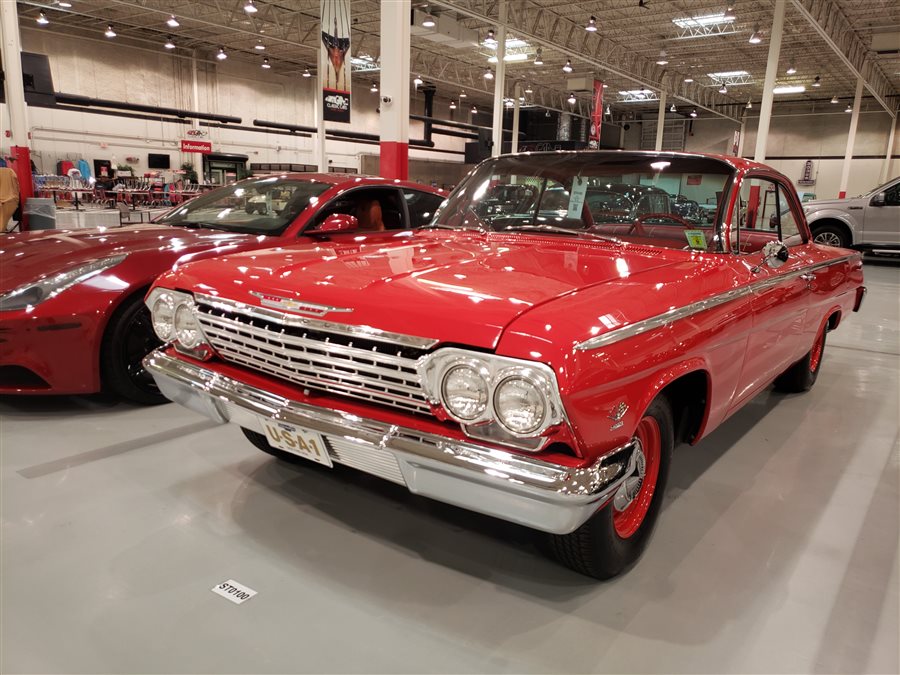
1962 Chevrolet Bel Air coupe, from an auction on July 21st, 2022
The 1961–64 Bel Air
The 1961 Bel Air introduced a cleaner, more restrained design, moving away from the elaborate tailfins of the late 1950s.
The Bel Air remained a midrange full-size Chevrolet, positioned below the Impala but above the entry-level Biscayne. Body styles included sedans and hardtops, with station wagon availability varying by year.
The early 1960s brought important engine developments. Chevrolet introduced the 409-cubic-inch big-block V8 for 1961, creating one of the most famous performance engines of the decade. The 409 became particularly associated with drag racing and Chevrolet’s growing performance image. Although more commonly discussed in connection with the Impala, it was available in certain Bel Air configurations.
The 1962–64 Bel Air models retained relatively understated styling compared with the Impala, making them attractive to enthusiasts seeking high-performance full-size Chevrolets without extensive luxury trim.
The 1962 Bel Air Sport Coupe
One of the most desirable early-1960s Bel Air variants is the 1962 Bel Air Sport Coupe, commonly nicknamed the Bubbletop because of its distinctive roofline and large curved rear window.
The Bubbletop body style had been used on earlier full-size Chevrolets, but its continuation on the 1962 Bel Air created a particularly attractive combination of lightweight appearance and sporting proportions.
The 1962 Bel Air Sport Coupe could be equipped with Chevrolet’s powerful 409 V8, making it popular among drag racers and performance enthusiasts.
Its combination of elegant styling, relatively low weight and big-block power has made the 1962 Bubbletop one of the most collectible non-Tri-Five Bel Airs.
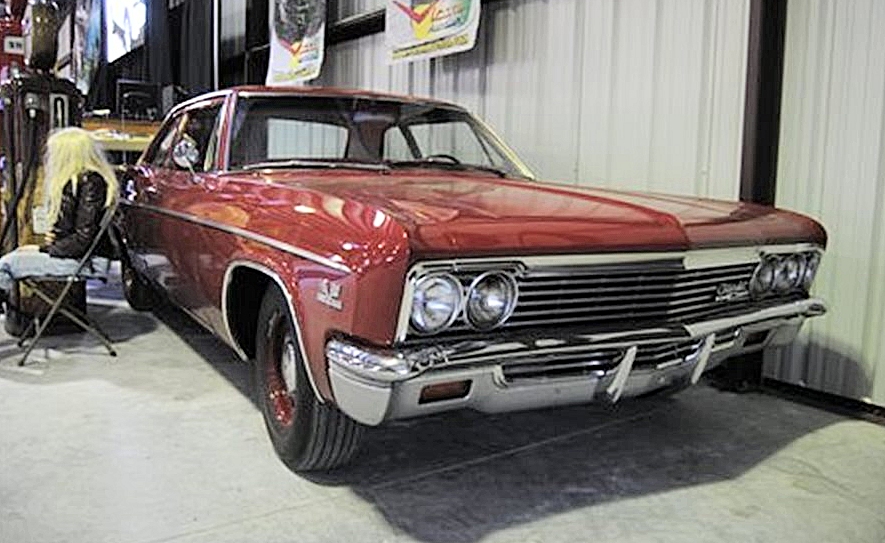
1966 Chevrolet Bel Air 2-dr sedan, from an auction on May 9th, 2015
The 1965–70 Bel Air
For 1965, Chevrolet introduced a substantially redesigned full-size platform with smoother styling, improved suspension and a wider range of engines.
The Bel Air remained positioned below the Impala, offering relatively straightforward trim and equipment. Body styles increasingly emphasized sedans and station wagons rather than sporty hardtops and convertibles. Engine options included the inline-six, small-block V8s and various big-block engines. The 396-cubic-inch V8 appeared during the mid-1960s, followed by the 427 and later the 454 in Chevrolet’s full-size lineup.
Although high-performance engines were more commonly associated with Impalas and SS models, certain Bel Air configurations offered substantial performance with less weight and fewer luxury features.
These cars became popular among drag racers because of their relatively simple equipment and ability to accommodate powerful Chevrolet engines.
The 1971–75 Bel Air
The 1971 Bel Air introduced a larger full-size body reflecting the increasing emphasis on comfort, interior space and smooth highway cruising.
The Bel Air continued as a relatively basic Chevrolet model, positioned below the Impala and Caprice. By this period, the name had lost much of the prestige it enjoyed during the 1950s. Engine choices included inline-six and V8 options, although emissions regulations and lower compression ratios reduced performance compared with earlier models. The Bel Air remained popular with fleet buyers, families and customers seeking straightforward full-size transportation.
Production of the Bel Air for the United States ended after the 1975 model year, although the name continued in Canada for several additional years.
Chassis and Suspension
The early Bel Air used conventional American chassis engineering, with a separate frame, independent front suspension and a live rear axle. 1955–1957 Bel Airs utilized either a traditional open-channel ladder frame (built by A.O. Smith) or a boxed perimeter frame (built by Seamless/Chevrolet). Collectors and restorers inspect frame stamps carefully, as boxed frames offer superior torsional rigidity for high-horsepower builds.
The 1955–57 Tri-Five models introduced a substantially improved chassis with a lower center of gravity and better suspension geometry. Front suspension used coil springs and control arms, while the rear retained a live axle located by leaf springs.
For 1958, Chevrolet adopted a new chassis with coil springs at all four corners, improving ride comfort and handling.
Later generations continued to refine suspension geometry, steering and braking systems, although the Bel Air remained primarily a comfortable full-size automobile rather than a dedicated sports car.
The relatively simple chassis design and extensive aftermarket support make the Bel Air popular for restoration, hot-rodding and modern suspension upgrades.
Transmissions and Drivetrains
Bel Air buyers could choose from several manual and automatic transmissions throughout the model’s production history. Early cars commonly used a three-speed manual transmission or Chevrolet’s Powerglide automatic. The Powerglide was particularly popular because of its smooth operation and straightforward design.
During the late 1950s and early 1960s, Chevrolet introduced additional transmission options, including four-speed manuals and more advanced automatic gearboxes. High-performance Bel Airs equipped with 283, 348, 409 or later big-block engines could be ordered with manual transmissions, making them particularly attractive to performance enthusiasts.
The availability of numerous engine and transmission combinations contributes to the Bel Air’s collector appeal, although factory documentation is important when evaluating rare high-performance configurations.
Interior and Equipment
The Bel Air was positioned as Chevrolet’s premium model during the 1950s, with upgraded upholstery, additional chrome trim and more elaborate interior appointments than lower-priced models.
The 1955–57 interiors are especially distinctive, featuring two-tone upholstery, bright dashboard trim and styling details that reflect the optimism of postwar American design. Buyers could specify equipment such as power steering, power brakes, automatic transmissions, radios, heaters and air conditioning.
As the Impala and later Caprice assumed Chevrolet’s luxury roles, the Bel Air became a more modestly equipped full-size model.
For collectors, original interior materials, correct trim patterns and factory equipment are important because reproduction components vary in quality and certain details are difficult to source.
Common Problems: Rust and Body Structure
Corrosion is one of the most significant concerns when evaluating an older Bel Air, particularly cars that have spent time in regions where road salt was used.
Common problem areas include floor pans, rocker panels, trunk floors, rear quarter panels, wheel arches and lower fenders. Windshield and rear-window surrounds can also trap moisture and develop corrosion.
On Tri-Five models, the frame, body mounts and structural floor sections require careful inspection. Poorly repaired rust can compromise body alignment and structural integrity.
Station wagons and Nomads have additional corrosion-prone areas around the tailgate, rear cargo floor and roof seams.
Because many Bel Airs have undergone restoration or modification, buyers should inspect panel alignment, weld quality and evidence of previous accident damage.
Engine and Mechanical Maintenance
Chevrolet’s inline-six and small-block V8 engines are generally durable and relatively inexpensive to maintain. Their widespread use means that replacement parts and technical expertise remain readily available.
Common concerns include oil leaks, cooling-system deterioration, worn valve components and aging fuel systems. Engines that have been stored for long periods may require substantial recommissioning.
The 283 small-block V8 is particularly well supported by the aftermarket, although correct original components are important for high-value restorations.
The 348 and 409 big-block engines are more specialized, with certain original components becoming increasingly expensive. Factory-correct 409-powered cars require careful authentication because engine swaps are common.
Fuel-injected 1957 Bel Airs present additional challenges because the Rochester mechanical injection system requires specialized knowledge and correct components.
Brakes, Steering and Suspension Wear
Early Bel Airs used drum brakes, which are adequate when properly maintained but provide less stopping performance than modern disc systems.
Brake hydraulics, wheel cylinders, hoses and master cylinders should be inspected carefully, particularly on cars that have been stored for extended periods.
Steering systems can develop excessive play from worn linkage components, steering boxes and suspension bushings.
Many restored or modified Bel Airs have been fitted with disc brakes, power steering or upgraded suspension components. These modifications can improve drivability but may reduce originality and collector value for rare factory-correct examples.
Originality and Authentication
Originality is particularly important for high-value Bel Air variants, including 1955–57 convertibles, Nomads, factory fuel-injected cars and early-1960s big-block performance models.
Body identification tags, VIN information, engine casting numbers, date codes and transmission identification should be examined carefully.
Many Bel Airs have received replacement engines, upgraded transmissions, modern suspension components or extensive cosmetic modifications. Such changes can improve performance and usability but should be distinguished from factory-original specifications.
Documentation is especially important when evaluating rare engine combinations. A car represented as an original fuel-injected 1957 Bel Air or 409-powered 1962 Bubbletop should be supported by credible evidence.
Because the Bel Air is one of the most frequently modified American classics, careful authentication is essential when originality significantly affects value.
Understanding the Major Chevrolet Bel Air Variants
- Bel Air Hardtop (1950–52): Original pillarless two-door hardtop offered within Chevrolet’s Styleline De Luxe range.
- Bel Air Series (1953–54): Premium full-size Chevrolet lineup with six-cylinder engines and expanded body styles.
- Bel Air (1955): First Tri-Five model, introducing Chevrolet’s modern styling and 265 small-block V8.
- Bel Air (1956): Revised Tri-Five model with updated styling and improved V8 performance.
- Bel Air (1957): Iconic tailfin model with available 283 V8 and Rochester mechanical fuel injection.
- Bel Air Nomad (1955–57): Distinctive two-door station wagon with unique roofline and premium trim.
- Bel Air (1958): Completely redesigned full-size model with available 348 big-block V8.
- Bel Air (1959–60): Wide, low full-size models with dramatic late-1950s styling.
- Bel Air (1961–64): Cleaner-styled full-size models with available 409 big-block V8.
- Bel Air Sport Coupe (1962): Highly collectible Bubbletop hardtop, particularly with 409 V8.
- Bel Air (1965–70): Midrange full-size models with a broad selection of small-block and big-block engines.
- Bel Air (1971–75): Final U.S.-market generation, emphasizing affordable full-size transportation.
What Matters to Collectors
The 1955–57 Tri-Five Bel Airs dominate the collector market because of their iconic styling, historical importance and extensive enthusiast support.
Among these cars, convertibles and Nomads are especially desirable because of their distinctive body styles and relatively limited production. Factory-correct V8 cars generally attract greater interest than six-cylinder examples.
The 1957 Bel Air is particularly recognizable, with its dramatic tailfins and available fuel-injected 283. Genuine factory fuel-injected cars command substantial premiums when supported by correct documentation.
The 1955 Bel Air is historically important because it introduced the small-block V8, while the 1956 model appeals to enthusiasts who prefer its more restrained styling.
Outside the Tri-Five years, the 1962 Bel Air Bubbletop, particularly with a factory 409 V8, is one of the most collectible variants.
Condition, originality and documentation remain decisive. A well-preserved standard Bel Air may be more desirable than a poorly restored high-performance example with uncertain provenance.
Important Sales Reviewed by SCM Experts
In each month’s issue for the past 38 years, SCM’s analysts have reviewed 5 to 7 significant cars sold at auction, and discuss what options, history, or details made that particular more or less valuable. They give their expert opinion on the market for these cars, and whether this car was well bought or well sold. If you’re thinking of purchasing a Chevrolet Bel Air, you’ll likely find these profiles critical in helping you make the right decision. Each of the following is an article from our print magazine on a Chevrolet Bel Air sold at auction.
 1956 Chevrolet Bel Air NomadThe Chevrolet Nomad is by far the rarest of Chevrolet’s so-called “Tri-Five” Bel Air models, produced from 1955 through 1957. The nameplate, which would live into the early ’70s, carries a level of cachet unique to the model. Marketed as a halo model of the Tri-Five station-wagon line, the Bel Air Nomad shared its long […]Read more
- 1957 Chevrolet Bel Air 2-door hard topTwo-year frame-off restoration Super Turbo-Fire 283-ci V8 Dual 4-bbl carburetors 2-speed Powerglide automatic transmission Matador Red and India Ivory From the Vault Collection No videos found for "Chevrolet Bel Air 2-door hard top".Read more
- 1956 Chevrolet Bel Air NomadBeautifully finished in its as-delivered Calypso Cream and Grecian Gold paint Winner of numerous First in Class awards Trendsetting 1950s style with much room in the back The car that defined an era Popular Videos about the Chevrolet Bel Air Nomad 1957 Chevrolet Bel Air Nomad. #classiccarauction #chevroletbelairnomad #shorts 713 Classic Cars 468,461 views 1955 […]Read more
 1969 Chevrolet Bel Air 2-door sedanGround-up restoration approximately 10 years ago Featured in Chevy Rumble magazine, August 2008 Original body panels and chassis Date-correct L72 427/425 V8 engine Muncie M22 Rock Crusher 4-speed transmission 12-bolt rear end Power brakes Rare radio delete F70-15 Firestone Redline bias-ply tires No videos found for "Chevrolet Bel Air 2-door sedan".Read more
 1957 Chevrolet Bel Air NomadThe first Chevrolet Nomad was conceived by Harley Earl and based on a Corvette platform. It debuted at the 1954 GM Motorama show. After a warm public reception, the Nomad was placed into production for 1955 and joined the top-echelon Chevrolet Bel Air passenger car line to become the first GM 2-door station wagon. The […]Read more


Cars For Sale
Quick links to listings for this make and model online:
Books on the Chevrolet Bel Air


Note that as an Amazon Associate, we earn from qualifying purchases of the above books.
Past Auction Sales – Chevrolet Bel Air
Average Chevrolet Bel Air Sale Price by Year from SCM’s Platinum Auction Database:
Includes sales listed as Chevrolet BEL-AIR, Chevrolet BelAir.
Chevrolet Bel Air Sales from SCM’s Platinum Auction Database:

Hagerty Marketplace
Condition: 2
Oct 9, 2026
$90,950

Bonhams
Condition: 3-
Aug 13, 2026
$58,240

VanDerBrink Auctions
Condition: 3
Jun 13, 2026
$20,063

Sullivan Auctioneers
Condition: 2-
Mar 2, 2026
$56,650

Bonhams Cars
Condition: 3
Jan 23, 2026
$16,800

Bonhams Cars
Condition: 2+
Oct 3, 2025
$75,040

Owls Head Transportation Museum
Condition: 4+
Aug 22, 2025
$13,800

GAA Classic Cars
Condition: 1-
Nov 7, 2024
$137,700

GAA Classic Cars
Condition: 2-
Nov 7, 2024
$77,760

GAA Classic Cars
Condition: 3+
Nov 7, 2024
$32,940

RM Sotheby's
Condition: 2
Nov 6, 2024
$126,500

RM Sotheby's
Condition: 2+
Nov 6, 2024
$107,800

RM Sotheby's
Condition: 1
Nov 6, 2024
$79,200

Barrett-Jackson
Condition: 2
Oct 10, 2024
$143,000

Worldwide Auctioneers
Condition: 2-
Aug 29, 2024
$41,440

Owls Head Transportation Museum
Condition: 2
Aug 24, 2024
$56,350

GAA Classic Cars
Condition: 1-
Feb 22, 2024
$91,800

GAA Classic Cars
Condition: 1-
Feb 22, 2024
$221,400

GAA Classic Cars
Condition: 1-
Nov 2, 2023
$132,000

GAA Classic Cars
Condition: 2+
Nov 2, 2023
$113,400

Barrett-Jackson
Condition: 1-
Sep 28, 2023
$60,500

Worldwide Auctioneers
Condition: 2+
Aug 31, 2023
$75,040

Worldwide Auctioneers
Condition: 2-
Aug 31, 2023
$76,160

Sullivan Auctioneers
Condition: 3+
Jul 17, 2023
$29,750

Barrett-Jackson
Condition: 1-
Jun 22, 2023
$139,700

Silver Auctions
Condition: 3-
Jun 17, 2023
$38,880

Hemmings
Condition: 3
May 31, 2023
$49,350

Barrett-Jackson
Condition: 1-
Apr 13, 2023
$95,700

McCormick's
Condition: 2+
Feb 24, 2023
$77,380

GAA Classic Cars
Condition: 1-
Feb 23, 2023
$164,160

McCormick's
Condition: 2+
Nov 18, 2022
$65,450

GAA Classic Cars
Condition: 1-
Jul 21, 2022
$99,360

GAA Classic Cars
Condition: 1-
Jul 21, 2022
$63,720

Remlinger Collector Car Auctions
Condition: 3+
Jul 15, 2022
$48,600

Barrett-Jackson
Condition: 1-
Apr 9, 2022
$129,800

GAA Classic Cars
Condition: 1-
Feb 24, 2022
$81,000

Hemmings
Condition: 2-
Feb 3, 2022
$38,850

McCormick's
Condition: 1-
Nov 19, 2021
$96,460

GAA Classic Cars
Condition: 1-
Nov 4, 2021
$91,800

RM Sotheby's
Condition: 2
Oct 13, 2021
$35,000

VanDerBrink Auctions
Condition: 2-
Oct 2, 2021
$112,270

VanDerBrink Auctions
Condition: 2-
Oct 2, 2021
$78,750

VanDerBrink Auctions
Condition: 2
Oct 2, 2021
$96,600

VanDerBrink Auctions
Condition: 2
Oct 2, 2021
$98,100

VanDerBrink Auctions
Condition: 2
Oct 2, 2021
$63,000

VanDerBrink Auctions
Condition: 2-
Oct 2, 2021
$60,900

Carlisle Auctions
Condition: 2
Sep 30, 2021
$87,740

Barrett-Jackson
Condition: 2
Sep 16, 2021
$88,000

VanDerBrink Auctions
Condition: 3+
Jun 26, 2021
$35,700

GAA Classic Cars
Condition: 1-
Feb 25, 2021
$91,800
See all 65 sales in SCM’s Platinum auction database: Chevrolet Bel Air · Chevrolet BEL-AIR · Chevrolet BelAir
Forums & Communities
Popular Videos about the Chevrolet Bel Air


