
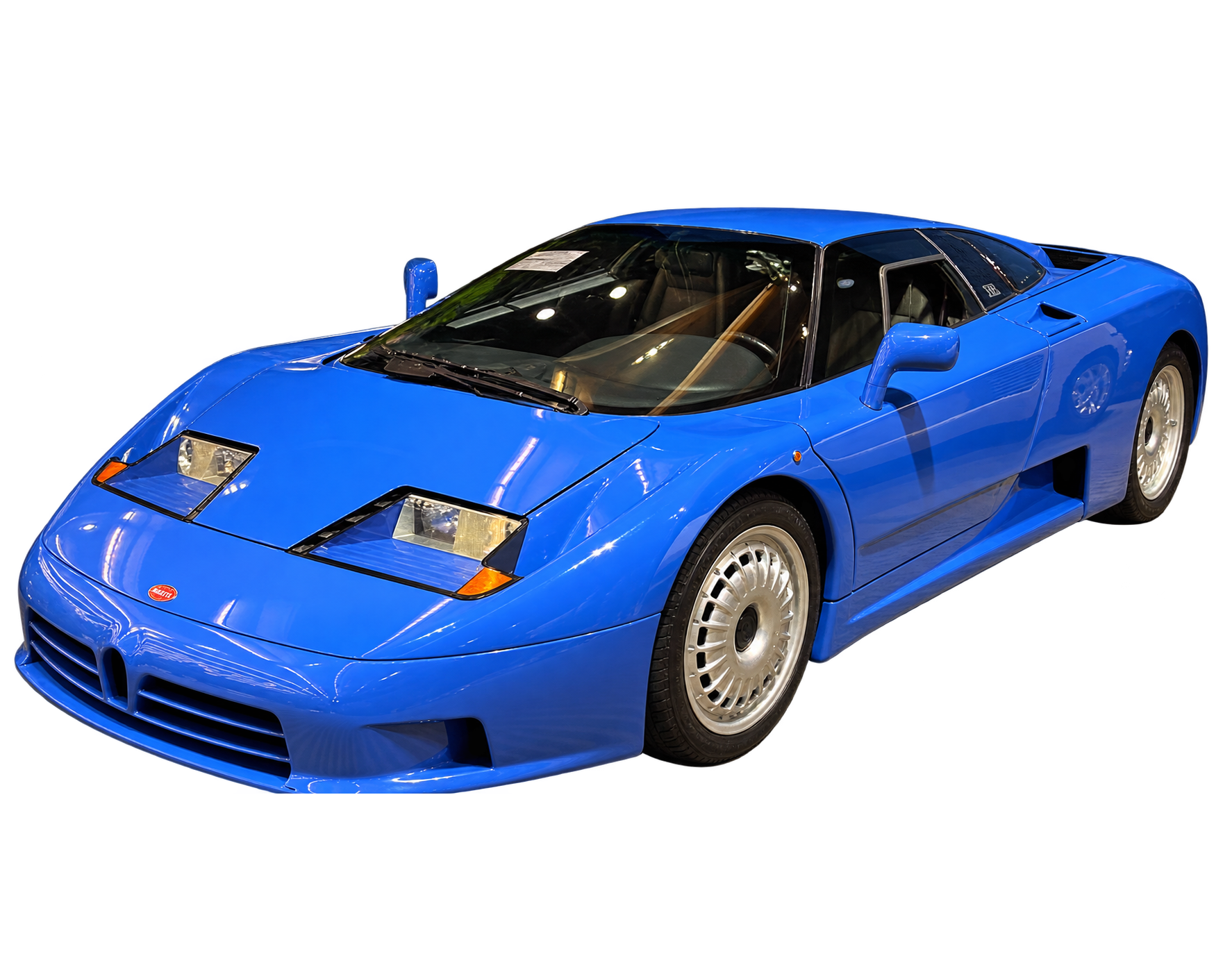
The Revival of Bugatti
The EB110 was the product of Italian entrepreneur Romano Artioli, who acquired the rights to the Bugatti name during the 1980s and established Bugatti Automobili in Campogalliano, near Modena, Italy. Artioli intended to revive one of the most prestigious names in automotive history with a supercar capable of surpassing Ferrari, Lamborghini and Porsche.
The project attracted several distinguished Italian engineers and designers. Paolo Stanzani, previously associated with Lamborghini, played an important role in its early development. Marcello Gandini, whose work included the Lamborghini Miura and Countach, designed the original wedge-shaped prototypes (notably featuring pop-up headlights and angular bodywork). Artioli disliked Gandini’s refusal to alter the design, leading Artioli’s architect/cousin-in-law Giampaolo Benedini to revise the shape, adding fixed recessed headlights and the smooth contours seen on production GT/SS models.
The EB110 was officially unveiled in Paris on September 15, 1991, the 110th anniversary of Ettore Bugatti’s birth. Its name combined the founder’s initials with that anniversary.
Artioli constructed an exceptionally advanced factory to manufacture the car. The facility incorporated modern production equipment, sophisticated quality-control systems and an architectural design intended to reflect Bugatti’s renewed ambitions.
Unfortunately, the EB110 entered the market during a severe downturn in demand for expensive exotic cars. Despite its technical accomplishments, the company struggled financially and ceased production in 1995.
The EB110’s Engineering Architecture
Every original road-going EB110 shared an extraordinarily sophisticated mechanical foundation. The mid-mounted 3,499cc V12 featured a 60-degree cylinder-bank angle, four overhead camshafts and five valves per cylinder, for a total of 60 valves. Four IHI turbochargers supplied boost, with intercoolers helping control intake temperatures.
The engine was mounted longitudinally behind the passenger compartment and paired with a six-speed manual transmission. Permanent all-wheel drive distributed power between the front and rear axles, providing substantially greater traction than the rear-wheel-drive layouts used by many contemporary supercars.
The carbon-fiber monocoque was particularly advanced for the period. Developed with specialist suppliers, it provided exceptional structural rigidity while helping control weight. Aluminum and composite body panels, magnesium wheels and other lightweight components reinforced the car’s technological sophistication.
Independent suspension, powerful ventilated disc brakes and electronically controlled systems allowed the EB110 to combine exceptional performance with a degree of stability and usability uncommon among early-1990s supercars.
These fundamental engineering features remained consistent across the GT and Super Sport, although engine tuning, bodywork, equipment and weight differed significantly.
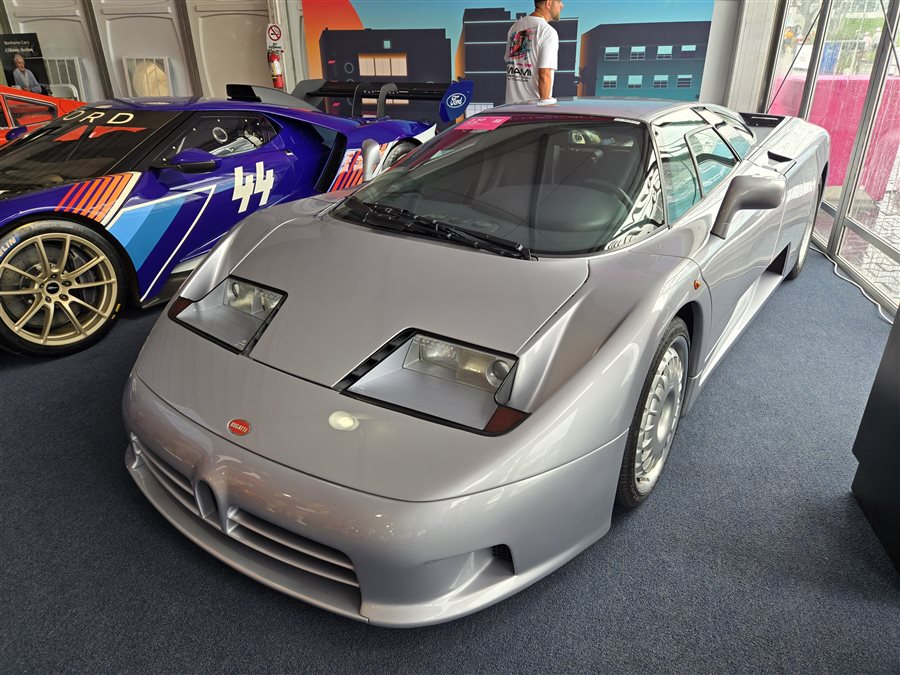
1994 Bugatti EB110 GT coupe, from an auction in Miami on May 3rd, 2025
EB110 GT: 1991–95
The EB110 GT, with GT standing for Gran Turismo, was the original production version and the most numerous member of the family.
Its quad-turbocharged V12 produced approximately 560 metric horsepower (552 bhp) and 611 Nm of torque. Bugatti claimed acceleration from 0–100 km/h in approximately 3.5 seconds and a maximum speed around 342 km/h (213 mph). These figures placed the GT among the fastest production cars in the world when it appeared.
Despite its extraordinary performance, the GT was designed to function as a luxurious grand tourer. Its cabin featured leather upholstery, air conditioning, power-assisted steering and an unusually high level of equipment for a supercar of its period. The exterior was distinguished by its relatively clean bodywork, retractable rear spoiler and distinctive glazed sections behind the doors. Scissor-style doors, a low nose and the small Bugatti horseshoe grille established a recognizable visual identity.
The GT was not merely a less powerful version of the Super Sport. It represented a different interpretation of the EB110 concept, placing greater emphasis on refinement, comfort and long-distance usability.
Approximately 95–96 GTs are commonly cited in factory production histories, although the number varies depending upon the treatment of prototypes and completed chassis.
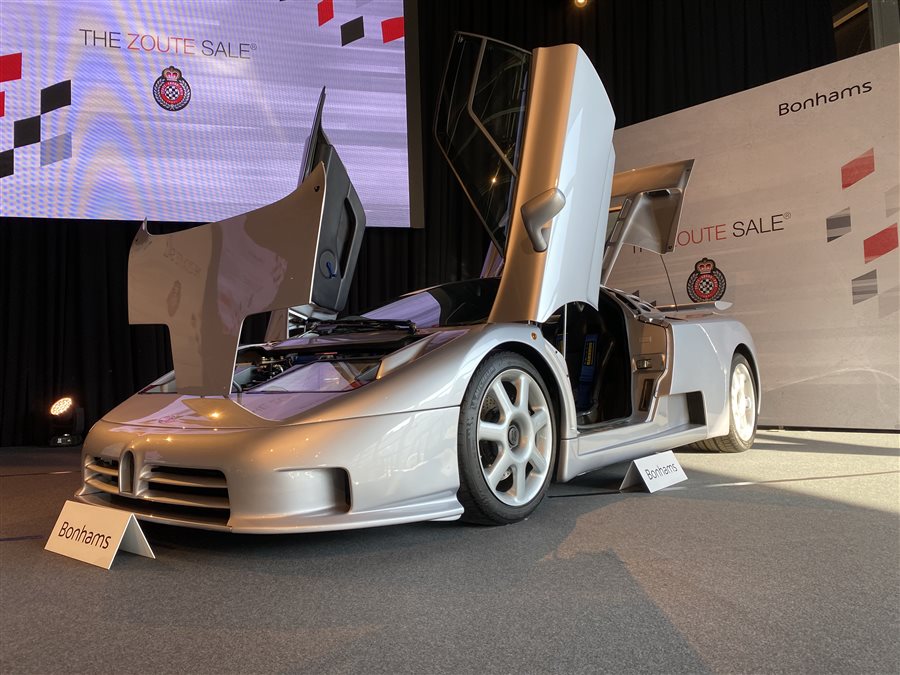
1994 Bugatti EB110 Super Sport coupe, from an auction on October 10th, 2021
EB110 Super Sport: 1992–95
The EB110 Super Sport, commonly abbreviated SS, debuted at the 1992 Geneva Motor Show, only months after the original GT.
The SS was conceived as a lighter, more powerful and more focused version of the EB110, intended to challenge the fastest road cars in the world. Its 3.5-liter quad-turbo V12 was uprated to approximately 610–612 metric horsepower, equivalent to about 603 bhp, with torque increasing to approximately 650 Nm. Revised turbocharger settings and engine management helped achieve the additional output.
Weight reduction was equally important. Greater use of carbon-fiber components, lighter interior equipment and other changes reduced mass by approximately 150 kg (330 pounds) compared with the GT, depending upon specification.
The SS could accelerate from 0–100 km/h in approximately 3.3 seconds and reach a claimed maximum speed of roughly 351–355 km/h (218–221 mph).
This placed it among the fastest production cars of the early 1990s, in direct competition with the Jaguar XJ220 and, subsequently, the McLaren F1.
How to Identify an EB110 Super Sport
The Super Sport incorporated several visible differences from the GT, making the two versions relatively easy to distinguish. Most notably, the GT’s small glazed rear-quarter sections were replaced on the SS by panels incorporating five circular ventilation openings on each side. These openings became one of the model’s most recognizable design features.
The SS also featured a more prominent fixed rear wing, revised aerodynamic details and greater use of lightweight composite materials.
Its interior was generally less luxurious than the GT’s, with weight-saving measures and more performance-oriented trim. Equipment varied among individual cars, reflecting the low-volume, partly hand-built nature of production.
Although the GT and SS shared the same basic carbon monocoque and drivetrain architecture, the SS’s lower weight, increased power and aerodynamic changes created a noticeably different driving experience.
The SS is generally the most desirable regular-production EB110 because of its rarity, performance and more aggressive styling.
EB110 Super Sport Production and Rarity
Production of the Super Sport was extremely limited. Bugatti’s historical accounts commonly cite approximately 32 production examples, although other published figures range into the high 30s when prototypes and certain special vehicles are included.
The distinction between completed customer cars, development prototypes, factory-retained vehicles and post-bankruptcy completions is important. Not every car described as an EB110 SS belongs to precisely the same production category.
The Super Sport was considerably more expensive than the GT when new. Its high price and the collapse of the exotic-car market restricted demand, despite the car’s extraordinary performance.
Today, the SS commands particular collector interest because it represents the most powerful regular-production version of the original Artioli-era Bugatti.
The Michael Schumacher EB110 Super Sport
One of the most famous individual EB110s was the yellow Super Sport purchased by Formula One driver Michael Schumacher in 1994.
Schumacher’s acquisition brought considerable international attention to Bugatti. At the time, he was becoming one of Formula One’s most prominent drivers, and his choice of an EB110 rather than a Ferrari or Lamborghini reinforced the car’s reputation as a serious performance machine. His car featured distinctive yellow paint and a specially configured interior. It later became well known through its association with the multiple Formula One world champion.
Although not a separate factory model, the Schumacher EB110 SS is an important individual example because of its provenance and publicity.
For collectors, its significance illustrates how documented ownership history can distinguish one EB110 from otherwise similar examples.
The EB110 LM: 1994 Le Mans Competition Car
The EB110 LM was one of two official factory-developed competition EB110s.
Prepared for the 1994 24 Hours of Le Mans, the LM was extensively modified from the road-going Super Sport to comply with contemporary GT racing regulations and withstand endurance competition. Changes included revised engine tuning, racing suspension, competition brakes, additional aerodynamic equipment, reduced weight and specialized safety systems. The racing V12 produced substantially more power than the road engine, with period specifications generally placing output in the region of 650–670 horsepower, depending upon configuration.
The car was entered by a French team associated with publisher Michel Hommell and driven by Alain Cudini, Éric Hélary and Jean-Christophe Boullion.
It demonstrated impressive speed, running competitively before an accident late in the race ended its effort. Although it failed to finish, the LM proved that the EB110’s advanced chassis and drivetrain were capable of serious endurance-racing performance.
Only one official EB110 LM was constructed, making it a uniquely significant part of Bugatti’s competition history.
The EB110 Sport Competizione: 1995
The EB110 Sport Competizione, commonly abbreviated SC, was the second official factory-built racing derivative.
It was commissioned by Gildo Pallanca-Pastor, a Monaco-based businessman and racing enthusiast who wanted to compete with the EB110 in international motorsport.
Development began during the final period of Bugatti Automobili’s operations. The SC incorporated further weight reduction, specialized competition equipment and revised aerodynamic components. Its engine was tuned for racing, with output reported at up to approximately 700 metric horsepower in certain configurations.
Bugatti originally contemplated building several Sport Competizione cars, but financial difficulties meant that only one was completed. The SC competed in endurance racing, including events in the United States, and continued to appear after the original factory closed.
Its significance lies in being the last and most specialized factory competition development of the EB110 platform.
EB110 GT, SS, LM and SC Compared
| Version | Engine output, approximately | Principal character |
|---|---|---|
| EB110 GT | 560 PS | Luxurious road-going grand tourer |
| EB110 Super Sport | 610–612 PS | Lightweight, high-performance road car |
| EB110 LM | 650–670 hp | One-off Le Mans competition car |
| EB110 Sport Competizione | Up to 700 PS | One-off factory competition car |
The LM and SC were purpose-built racing derivatives rather than conventional production options. Their mechanical specifications could change with racing configuration, making exact horsepower comparisons less straightforward than those between the GT and SS.
Official Bugatti factory archives generally list 139 total chassis completed during the Artioli era (84 GTs, 32 SSs, 2 official race cars [LM and SC], and various prototypes/development mules). Dauer subsequently completed around 5 or 6 additional cars using original spare chassis.
The EB110 After Bugatti’s Bankruptcy
Bugatti Automobili’s collapse in 1995 did not immediately end the EB110 story. The bankruptcy left unfinished chassis, engines, body components, production equipment and a substantial inventory of replacement parts.
German racing-car manufacturer Dauer Sportwagen, associated with former racing driver Jochen Dauer, acquired important portions of these assets. Dauer subsequently completed several unfinished EB110s and developed its own enhanced versions using original Bugatti components and chassis technology.
These cars are closely related to the EB110 but should be distinguished from vehicles completed by the original Bugatti Automobili factory before its closure. Their existence also helps explain why published EB110 production totals differ.
The Dauer EB110 Super Sport
The Dauer EB110 Super Sport was a post-bankruptcy continuation and development of the original EB110 concept.
Dauer retained the basic carbon-fiber chassis, quad-turbocharged V12 and all-wheel-drive architecture but introduced numerous modifications intended to improve performance, reduce weight and modernize the car.
Some versions used additional carbon-fiber body components and revised mechanical systems. Engine output was increased substantially, with certain Dauer specifications quoted at approximately 705–730 horsepower.
These improvements made the Dauer cars among the most powerful vehicles derived from the original EB110 architecture.
Production was extremely limited, with only a handful of cars completed. Exact totals depend on whether original unfinished Bugatti chassis, Dauer-branded conversions and later developments are counted together. The Dauer cars occupy a specialized collector category. They offer exceptional performance and a direct mechanical connection to the EB110, but they are not identical to original factory-built Bugatti Super Sports.
The B Engineering Edonis
Another important descendant of the EB110 was the B Engineering Edonis, unveiled in 2001.
B Engineering was established by former Bugatti personnel, and the Edonis used technology and components originating from the EB110 program.
Unlike the original EB110, however, the Edonis featured substantially redesigned bodywork and a different mechanical philosophy. Its V12 was enlarged to approximately 3.8 liters, and the four-turbocharger arrangement was replaced by two larger turbochargers. Output was quoted at approximately 680 horsepower. The Edonis also adopted rear-wheel drive, eliminating the EB110’s permanent all-wheel-drive system and reducing mechanical complexity and weight. Its radically different bodywork made it visually distinct from the Bugatti, despite its underlying engineering relationship.
The Edonis is best understood as a separate supercar developed from EB110 technology rather than a factory Bugatti variant. Only a very small number were completed.
The Bugatti Centodieci: A Modern Tribute
The Bugatti Centodieci, unveiled in 2019, was a modern tribute to the EB110 rather than a direct mechanical derivative.
Based on the contemporary Bugatti architecture used by the Chiron, it incorporated design references to the original EB110, including the small horseshoe grille, wedge-shaped proportions and circular side air openings inspired by the Super Sport.
Its 8.0-liter quad-turbocharged W16 produced approximately 1,600 metric horsepower, dramatically exceeding the original car’s performance.
Production was limited to 10 examples, making the Centodieci one of the rarest modern Bugattis.
Although the Centodieci shares no direct chassis or engine lineage with the EB110, its existence demonstrates the historical importance of Artioli’s revival of the marque.
Understanding the Major EB110 Variants and Derivatives
- EB110 GT (1991–95): Original production grand tourer with approximately 560 PS, quad-turbo V12, permanent all-wheel drive and luxurious equipment.
- EB110 Super Sport (1992–95): Lighter, more powerful road version with approximately 610–612 PS, distinctive circular side vents and fixed rear wing.
- EB110 Development Prototypes: Experimental and preproduction vehicles used to develop the chassis, engine, bodywork and production specifications.
- EB110 Super Sport Prototypes: Development vehicles incorporating revised engine tuning, lightweight components and aerodynamic modifications.
- EB110 LM (1994): One-off factory competition car developed for the 24 Hours of Le Mans.
- EB110 Sport Competizione (1995): One-off factory racing derivative commissioned by Gildo Pallanca-Pastor.
- Post-Bankruptcy EB110 Completions: Vehicles assembled from unfinished Bugatti chassis and original components after the Campogalliano factory closed.
- Dauer EB110 Super Sport: Extremely limited post-bankruptcy development with enhanced performance and revised construction.
- B Engineering Edonis (2001 onward): Separate supercar developed using EB110-derived technology, with enlarged twin-turbo V12 and rear-wheel drive.
- Bugatti Centodieci (2019–22): Ten-car modern tribute inspired by the EB110 SS, based on Bugatti’s later W16 architecture.
Important Sales Reviewed by SCM Experts
In each month’s issue for the past 38 years, SCM’s analysts have reviewed 5 to 7 significant cars sold at auction, and discuss what options, history, or details made that particular more or less valuable. They give their expert opinion on the market for these cars, and whether this car was well bought or well sold. If you’re thinking of purchasing a Bugatti EB110, you’ll likely find these profiles critical in helping you make the right decision. Each of the following is an article from our print magazine on a Bugatti EB110 sold at auction.
 1994 Bugatti EB110 Super SportForty years after Ettore Bugatti’s death in 1947, the once-legendary but moribund marque, one of the most renowned in automotive history, was acquired by ambitious Italian businessman Romano Artioli. His aim was nothing less than a resurrection of Bugatti in the form of a state-of-the-art supercar. Artioli chose Modena, home to Ferrari, Lamborghini and Maserati, […]Read more
- 1993 Bugatti EB110 GTItalian Ferrari dealer Romano Artioli dreamed of resurrecting one of the most storied marques in automotive history: Bugatti. Artioli’s Bugatti Automobile SpA was established in October 1987, and construction of a new, state-of-the-art factory in Campogalliano, Italy, began the following year. When it was ready, the EB110 — Ettore Bugatti 110, honoring the great man’s […]Read more


Cars For Sale
Quick links to listings for this make and model online:
Books on the Bugatti EB110


Note that as an Amazon Associate, we earn from qualifying purchases of the above books.
Past Auction Sales – Bugatti EB110
Average Bugatti EB110 Sale Price by Year from SCM’s Platinum Auction Database:
Includes sales listed as Bugatti EB112.
Bugatti EB110 Sales from SCM’s Platinum Auction Database:

RM Sotheby's
Condition: 2-
Aug 13, 2026
$1,847,500

Broad Arrow Auctions
Condition: 2
Oct 10, 2025
$1,829,190

Artcurial
Condition: 2-
Feb 7, 2025
$1,588,096

Bonhams Cars
Condition: 2
Oct 8, 2023
$1,214,745

Bonhams
Condition: 2+
Feb 3, 2022
$2,050,666

RM Sotheby's
Condition: 2
Feb 2, 2022
$2,043,802

Bonhams
Condition: 1-
Oct 10, 2021
$2,594,348

RM Sotheby's
Condition: 2-
Feb 6, 2019
$2,312,982

Bonhams
Condition: 2+
May 11, 2018
$720,515

RM Sotheby's
Condition: 2
Feb 7, 2018
$1,421,955

Artcurial
Condition: 1-
Feb 5, 2016
$1,041,517

RM Auctions
Condition: 2+
Oct 28, 2009
$364,298

Bonhams
Condition: 1-
May 10, 2008
$315,115

Bonhams
Condition: 1
May 21, 2007
$259,200

Gooding & Co.
Condition: 3
Aug 21, 2005
$258,500

Bonhams
Condition: 1
May 16, 2005
$283,500

Christie's
Condition: 2
Apr 19, 2005
$223,250

Bonhams & Brooks
Condition: 1
Dec 4, 2000
$164,980

RM Sotheby's
Condition: 3+
Apr 25, 2026
$1,982,256
Forums & Communities
Popular Videos about the Bugatti EB110


