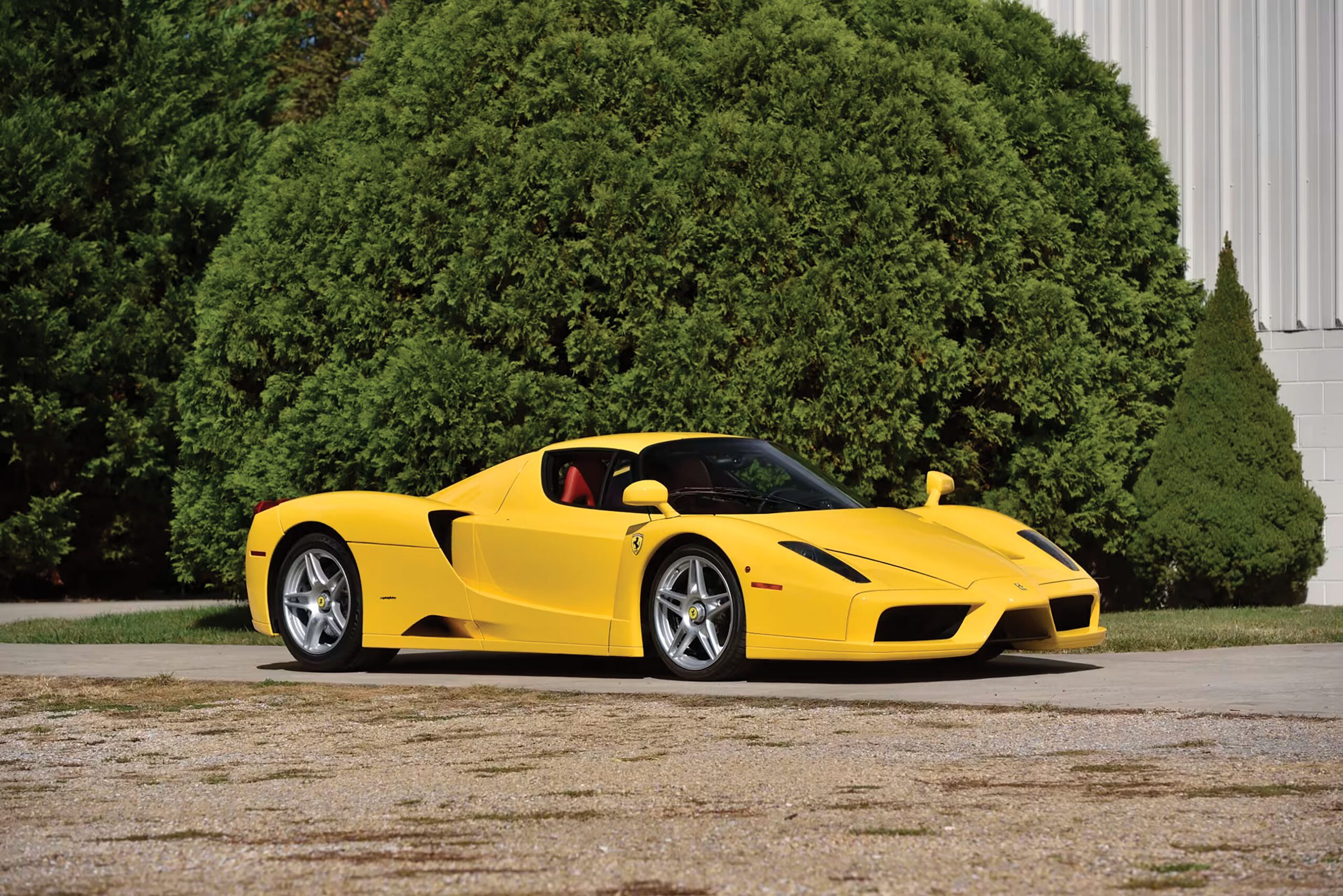
This car, Lot S132, sold for $17,875,000, including buyer’s premium, at Mecum Auctions’ Kissimmee, FL, sale, on January 17, 2026.
The Enzo arrived in 2002 as the fourth entry in Ferrari’s line of halo supercars. This program started in 1984 with the 288 GTO, which was followed by the F40 in 1988, the F50 in 1995. After the Enzo came the LaFerrari in 2013 and the F80 in 2025. These top-tier supercars represent Ferrari’s highest-profile and most desirable models in the previous five decades of production. These cars were built in small quantities and reserved for Ferrari’s best customers. They are the models that grace magazine covers and live in the imaginations of enthusiasts around the world. The one named after the company’s founder, Enzo Ferrari, has recently proved it is more than worthy of that title.
Pre-VIP
Phil and Martha Bachman bought their first Ferrari, a new 308 GTS QV, in 1984 and never looked back. Phil owned several car dealerships and had been accustomed to picking interesting models from his showrooms to add to his informal collection. There were too many to drive, and soon there was a collection of virtually brand-new cars.
Before Ferrari had a VIP client ranking, the Bachmans became VIP clients. Through a friendship with Simone Schedoni of the Schedoni leather company in Modena, Phil was introduced to important people at the Ferrari factory. They worked with Phil to configure the new Ferrari to the family’s imagination.
Record result
Phil had a stroke several years back, limiting his mobility, and he died in late 2025. Martha passed away in 2024, but not before starting the Bachman Family Foundation, to which the cars were pledged. The foundation assists people in Eastern Tennessee who “learn differently.” Many of the Bachman Ferraris were nearly new unicorns with custom configurations, and Mecum Auctions was chosen to sell them.
The Enzo was the battle royale of the sale, and its result was earth-shattering. Hammered at $16.5m, the total with buyer’s premium was $17,875,000. Put in perspective, that was over three times the average Enzo sale price before the Kissimmee auction. It is important to note that this was not a charity auction, so purchases were not tax-deductible.
Enzos are particularly appealing because they represent the last of Ferrari’s pure internal-combustion supercars. The Enzo was followed by the LaFerrari and F80, both of which have hybrid powertrains. LaFerraris have been plagued with long waiting times for expensive replacement hybrid-system batteries, holding down their values. F80s are too new to evaluate their battery performance, but a bias against hybrid supercars will certainly be passed on to them.
Post-auction, the question on Enzo market watchers’ minds changed from, “What it will sell for?” to, “Was the result a one-off or a harbinger of the future?” It did not take long to get an answer. Following the Bachman sale, another Enzo crossed the block at Mecum, selling for $11.1m (SCM# 6971461). This too would have been a world record just a few short hours earlier. Since then, two more Enzos have sold at public auction, each for over $9 million, in Arizona (SCM# 6971205) and Paris (SCM# 6971256).
A 1980s redux?
The secondary market for Ferrari’s halo supercars has always been strong. Collectors who want these top-shelf cars but aren’t qualified by Ferrari to purchase a new example have traditionally been willing to pay a substantial premium to get a second-hand example. Recently, special-edition Ferraris have been on a run too. Ferrari 458 Speciale Apertas have picked up a half-million dollars in value in the past six months, and maybe a million dollars in the last year. Other mid-engine V8 specials — plus 599 GTOs and F12 TdFs — have also seen similar but less-drastic jumps.
The spike can be attributed to the buyers as much as the cars. There’s no shortage of Ferrari collectors trying to have one of each of these rare supercars. In the past they have been patient, waiting for the right cars and the right deal. Now there seems to be a new breed of buyers who are less patient. They are more willing to overpay rather than wait. These buyers don’t seem to be investors as much as collectors. Often they are new to the marque and more interested in building their collection than appreciating the car they are buying.
The run-up of prices is not unprecedented. We saw a similar situation in the 1980s, but this one seems different. Back then, the sentiment was that “You couldn’t pay too much, you could only buy too soon.” The focus was broader and monetary rather than chasing specific cars. This run is targeting special models, and money is the means to the end rather than the major element of the purchase. As long as there’s easy money, the prices will go up. If money gets tight, prices will drop fast.
There is no question the seller was the winner on this one, but what about the buyer? The new owner did not just get an Enzo; they got a piece of history. Few Ferraris are uniquely identified by a name. The “Breadvan,” the “Del Rio 275 GTB,” and the “Shark Nose SWB” are a few that come to mind. Several more can be added to the list as some of these cars will prominently retain their Bachman provenance. The buyer can now claim they bought the “Bachman Enzo.” The name was earned by the owner’s esteem, not the purchaser’s folly.