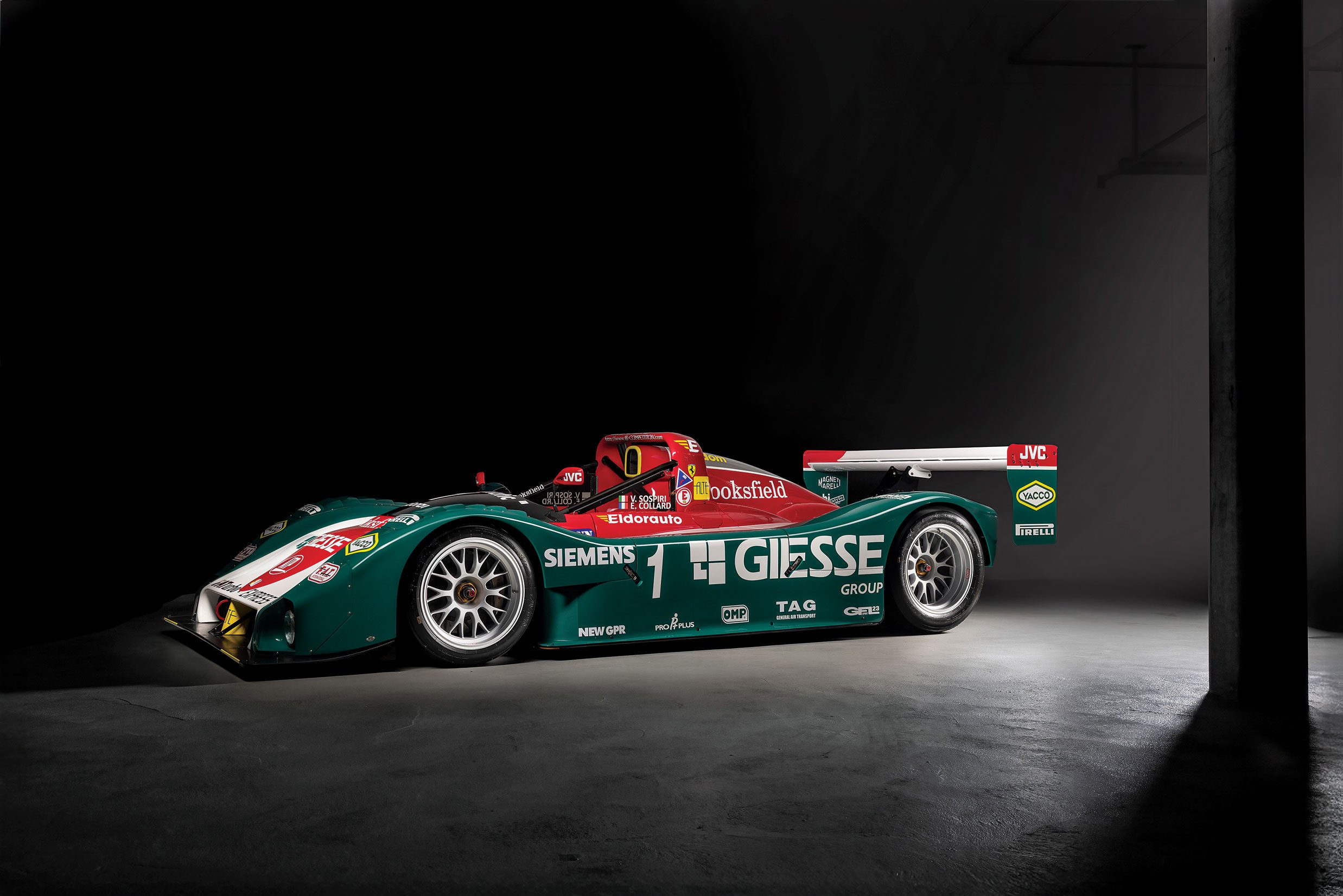
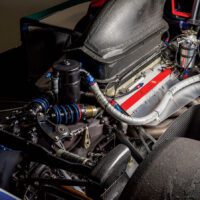
This car, Lot 139, sold for $6,461,560 (CHF 5,208,125), including buyer’s premium, at RM Sotheby’s Zurich, CHE, sale on October 11, 2025.
The Ferrari 333 SP owes its existence to the efforts of several people, not least the genial and charismatic Gianpiero Moretti, founder of the automotive-accessory firm MOMO. Moretti was a longtime Ferrari customer and supplier, a successful international racer and close friend to Piero Ferrari. Along with the support of Ferrari North America, Moretti persuaded Ferrari to build a car for the International Motor Sports Association’s (IMSA) new World Sports Car formula (WSC), launching in 1994 as successor to the just-retired GTP category.
The real deal
Designed around Ferrari’s 1990 641 Formula 1 chassis, suspension and engine architecture, most of the 333 SP’s major componentry was already well tested. WSC regulations required engines to be production-based, but because the racer’s stroked, detuned F1 powerplant was going to be used in the upcoming 1995–97 Ferrari F50 road car, it met the letter of the rule, if not the spirit. There were four 333 SP prototypes built by Ferrari, nine serial examples from Dallara, with the balance of the 40-unit run constructed by Michelotto.
According to Kevin Doran, whose team ran multiple 333 SPs (and before that, Al Holbert’s Löwenbräu Porsche 962s), the car was fast and reliable from the beginning. He noted that its weak spot was the transaxle, at least until the Hewland internals were strengthened.
Didier Theys, the all-time-winningest 333 SP driver, with 10 victories, echoed Doran’s observations and added, “The 333’s greatest strength was that it was a complete package: good chassis, good suspension and good engine.”
Away from the track, the 333 SP program was also a successful business venture for Ferrari. After it built the prototypes, everything was farmed out to Dallara and Michelotto and did not detract from the Scuderia’s F1 racing efforts. Further, no other major automaker built dedicated cars for the WSC category, so development costs were relatively low. Finally, the 333 SP was victorious on its 1994 debut at Road Atlanta and remained competitive until the end of the WSC formula, generating a steady and substantial revenue stream for the better part of a decade.
Outside North America, Le Mans was one of the few major events where you could race a 333 SP. As early as 1995, a small number of 333 SPs began competing there but had only modest success. However, in 1997, the European-based International Sports Racing Series (ISRS) was formed. It was an entirely new market for the 333 SP and no doubt contributed to what Mark Raffauf et al., stated in their book, IMSA — 1990–1999, “Ferrari later confided it was one of the most profitable cars in (its) history.”
A winning legacy
Chassis 023 was sold, unraced, by its first owner to JB Racing in 1999. It competed in all nine races of the Sports Racing World Cup (formerly ISRS) that year with drivers Emmanuel Collard and Vincenzo Sospiri, winning twice, with four other podium finishes. Together with the squad’s other 333 SP, Team JB Giesse finished 1st in that year’s Teams Championship (the second consecutive championship with a 333 SP for JB Racing, Collard and Sospiri). Afterwards, chassis 023 was retired and sold the following year at auction in Monaco for $510k (SCM# 9868) — less than the $650k price tag on a new 333 SP.
As for the conventional benchmarks that make a race car collectible, this Ferrari 333 SP ticks virtually all of the boxes, including a championship-winning racing career and a recent restoration to its former glory by the people who originally built it. The latter is a half-million-dollar value add, at least. All this certainly justifies a top-of-the-market valuation.
Record-setter
Sale prices for 333s broke through the million-dollar barrier more than a dozen years ago, as the market was roaring back from the 2008 recession. Prices rose to $2.5m by 2015, between $3m to $3.5m over the pandemic years, to the $5.1m sale of the 12 Hours of Sebring winner in 2024 (SCM# 6968041).
The 333 SP is hardly common, but they come to market with surprising frequency. Given the regularity with which these 1-of-40 cars change hands, my sense is that they are currently seen as short-term investments as much as artifacts — or treasured possessions.
Conversely, Ferrari’s exceedingly expensive sports racers from the 1960s and ’70s, forebears to the 333 SP, were produced in single-digit runs, are highly prized, rarely seen in the open market and trade in the tens of millions. We can forget price comparisons to those distant cousins.
A more contemporary and relatable equivalent would be the 2005–08 Porsche RS Spyder, which raced in the U.S. and Europe a few years after the 333 SP. Two examples have come to auction recently — one a no-sale in 2023 at $4.7m (SCM# 6958207), the other selling for $5.6m in 2022 (SCM# 6955464). For perspective, the latter helped Penske Racing win the U.S. championship two years on the trot.
So, is Ferrari 333 SP 023 worth $6.5m? Somebody thought so, but this result is almost 30% higher than a market-defining sale for the model just 14 months prior, and 16% beyond a factory-backed, ex-Roger Penske car that won two championships in a far-more-competitive series. Ferrari 333 prices are rising quickly, but not that quickly. The good news for the buyer is they did not overpay; they just bought too soon.