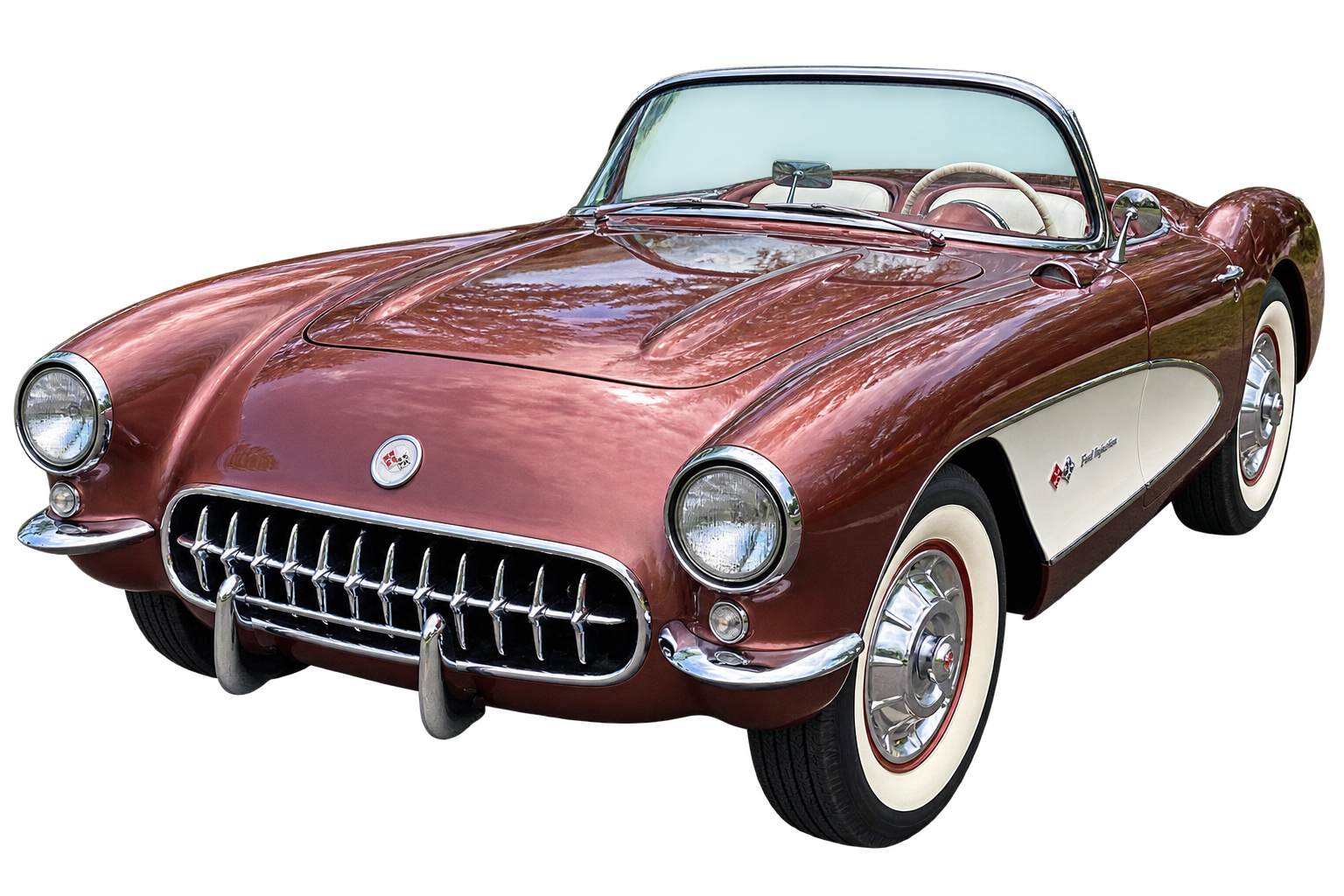
- Original, unrestored cars can be worth more than equally nice restored cars. A genuinely preserved, low-mileage survivor occupies a much rarer category than one of the many restored 1954 Corvettes. Restoring a good original can actually eliminate some of what makes the car special.
- Documentation can materially increase value. Original dealer paperwork, ownership records, manuals, correspondence and other period documentation help establish provenance and support mileage and ownership claims.
- Do not accept claims of low mileage or few owners without evidence. A car advertised as having few owners and low mileage is much more compelling when original records establish those claims. We regarded the lack of supporting documentation as a weakness.
- A known, favorable ownership history adds confidence and value. Low mileage, few owners and evidence of careful long-term use give a car what we would describe as “good bones.”
- Investigate where and how the car spent its life. Knowing the state where a Corvette lived isn’t sufficient. Climate, storage conditions and whether it spent long periods outside or improperly stored can significantly affect condition.
- Check the car’s current condition even if it previously won awards or was highly judged. NCRS judging or an older high-quality restoration doesn’t guarantee that the Corvette remains in the same condition today. Cars deteriorate after restoration and judging.
- The identity and reputation of the restorer matter. We consider it a positive when respected restorers and early-Corvette specialists are specifically identified. An anonymous restoration deserves more scrutiny.
- Correctness is one of the biggest determinants of 1954 Corvette value. Accurate details combined with an exacting restoration can justify a substantial premium.
- Factory-correct details need to correspond to the car’s position in the 1954 production run. Chevrolet made numerous running changes during 1954, including changes involving the camshaft, valve covers, hood release, exhaust extensions, ignition shielding, brake and fuel lines, dimmer-switch position and tires. Components should be appropriate to the individual car’s production period.
- Be cautious about judging unusual early-production details as incorrect. Very early cars can legitimately have features different from later 1954 production, such as different brake/fuel-line routing and hood-release arrangements.
- Paint and interior color combinations affect desirability. Pennant Blue is particularly desirable because relatively few cars were produced in the color and it was paired with a distinctive beige interior. Sportsman Red was also uncommon, while Polo White dominated production.
- Rare factory colors can command a premium. We consider Pennant Blue one of the most attractive and desirable 1954 colors and view it as an advantage over more-common examples.
- Be wary of extremely specific color-production claims unless the provenance supports them. There’s some uncertainty surrounding some commonly quoted 1954 production totals by color, so rarity claims deserve verification.
- Original parts have value even when they show normal age. Minor pits, dings, imperfect fit and other signs of age can support the conclusion that trim and components are actually original. Perfect reproduction pieces aren’t necessarily preferable.
- Don’t expect perfect body-panel fit on an authentic 1954 Corvette. Somewhat irregular door and hood fit is characteristic of factory production. Modern-perfect panel fit isn’t necessarily an indication of greater authenticity.
- Interior materials can reveal the quality and correctness of a restoration. Upholstery and vinyl that look too modern can detract from an otherwise correct restoration. Materials should have an appropriate period appearance.
- Original nitrocellulose lacquer was prone to deterioration and fading. Genuine survivors may therefore exhibit paint aging that is historically normal and shouldn’t necessarily be judged the same way as poor restoration work or neglect.
- Original accessories and difficult-to-find components add desirability. Correct items such as the soft top, side curtains and their storage bag strengthen a car because these pieces frequently disappeared over the decades.
- A factory hardtop is not correct for a 1954 Corvette. Chevrolet did not offer a factory or Chevrolet-sponsored hardtop for 1954, although aftermarket versions were sold through dealers. A hardtop shouldn’t automatically be represented as an original factory option.
- 1954 Corvettes generally trade below 1953 cars. Chevrolet built 3,640 Corvettes for 1954 versus just 300 in 1953. The first-year status and extreme scarcity of the 1953 make it substantially more collectible.
- The six-cylinder drivetrain limits the model’s value relative to some other early Corvettes. The Blue Flame Six didn’t provide the performance buyers increasingly expected, while the small-block V8 arrived for 1955.
- Exceptional provenance can overcome an otherwise ordinary specification. Extremely low mileage, unusual history, extensive publicity and comprehensive documentation helped the car discussed by the SCM reporter achieve a particularly strong result.
- Auction exposure and promotion can materially affect a sale price. Prominent marketing contributed to a particularly strong auction result in this example, meaning one exceptional sale shouldn’t automatically reset the value of every comparable 1954 Corvette.
- Awards are meaningful evidence of quality, but investigate exactly what was awarded and when. NCRS, Bloomington Gold, AACA and similar recognition can support a car’s quality and correctness, but there’s an important distinction between merely participating in judging and receiving a significant award.
- A car assembled from unrelated original parts carries a value penalty. An attempted authentic reconstruction made from a surviving body plus sourced OE components we’d call a “bitsa.” Even if accurately completed, such a car remains stigmatized compared with an intact original.
- Restoring an incomplete original body to factory specification may not make financial sense. Sourcing the hundreds of correct components required to reconstruct a largely missing car can cost enormous sums while leaving the finished car worth only about as much as an ordinary restored example.
- A well-executed resto-mod can sometimes be worth considerably more than a compromised attempt at an “original” restoration. The custom Corvette SCM analyzed sold for $159,500. We concluded that turning its orphaned original body into a high-quality resto-mod probably produced a better financial result than attempting to reconstruct a stock car from assorted sourced components.
- Resto-mod values depend heavily on execution quality. High-quality paint and panel preparation, a detailed engine compartment, premium undercarriage finishing, upgraded suspension and brakes and high overall workmanship contributed substantially to the custom car’s appeal.
- Check the actual usability of a highly modified Corvette. In this particular car, we flagged the absence of windshield wipers and other compromises as evidence that the custom Corvette was more of a show car than a vehicle intended for substantial road use.
- A visually spectacular custom isn’t necessarily a historically valuable Corvette. Modified and factory-correct cars occupy different markets. Expensive workmanship and dramatic presentation can generate strong bidding, but they aren’t substitutes for originality, provenance or historical authenticity.
Valuation Tips: Chevrolet Corvette
Our valuation tips all come from articles written by SCM experts about significant cars sold at auction over the past 38 years. We’ve used AI to extract just the tips about this make and model. Each tip is linked to the original article in which the SCM analyst’s tip was found.