
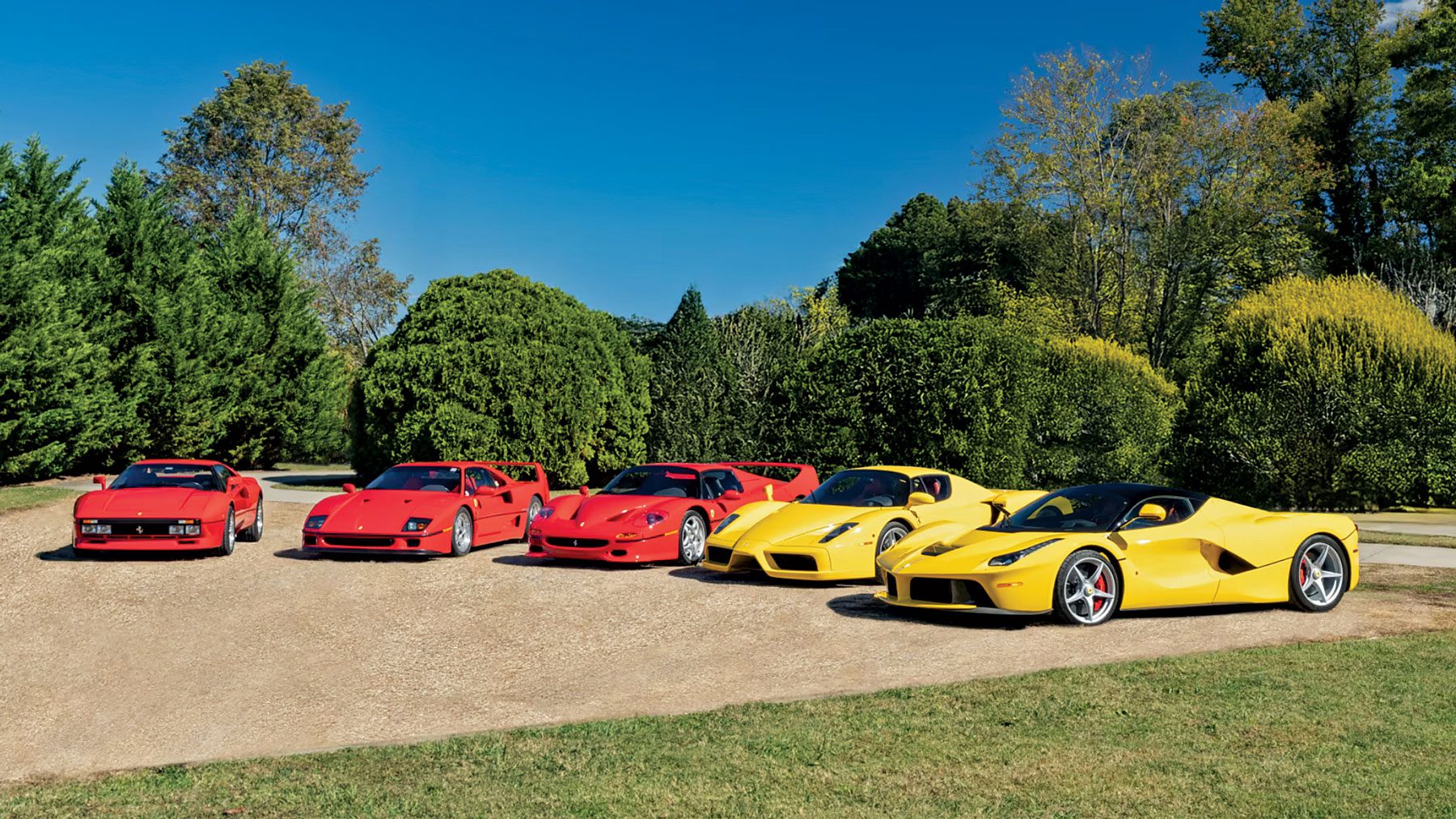

My friend Phil Bachman was a Ferrari collector. His son Philip wrote a book on the collection, Full-Scale Passion: The Bachman Collection, which opens with a quote from his father: “Some people collect model cars, like 1:18- or 1:43-scale models. I collect the full-scale ones.” The quote is uncharacteristically boastful for the rather modest man. Phil was a collector’s collector, one who settled for nothing less than the best. When he was surprisingly passed over for a new F50, he spent a couple of years waiting for the right one to pop up. Sometimes if a better car than his could […]
My friend Phil Bachman was a Ferrari collector. His son Philip wrote a book on the collection, Full-Scale Passion: The Bachman Collection, which opens with a quote from his father: “Some people collect model cars, like 1:18- or 1:43-scale models. I collect the full-scale ones.”
The quote is uncharacteristically boastful for the rather modest man. Phil was a collector’s collector, one who settled for nothing less than the best. When he was surprisingly passed over for a new F50, he spent a couple of years waiting for the right one to pop up. Sometimes if a better car than his could be found, he would buy it and have two.
Phil showed his Ferraris and he was laser-focused on winning. He knew the game and seldom lost, bringing the right cars to make a splash at shows. When Boxers were the king of the hill, he showed Boxers. Later, it was supercars, especially limited-production models that he had specced at the factory, where Ferrari accommodated his sometimes-extravagant requests.
Starting with a yellow body, he mixed interior colors and exterior trim to build uniquely “Bachman” cars. Then he would make the trip across Modena to the Schedoni workshop, where his friend Simone would craft a unique set of luggage to match his car. The cars were always immaculately prepared for show, with the family dressed in matching red pants with yellow shirts logoed to complement them.
The sell-off
When Phil had a stroke several years back, his passion for collecting did not diminish, but his ability to act on it did. His wife, Martha, understood their son had a life and career in another city and would not be able to look after the collection. She admirably started the Phil and Martha Bachman Foundation to turn the collection into a source of funding for education in Northeast Tennessee. Martha died in 2024; Phil followed her in 2025. The foundation then started the process of liquidating the cars.
The collection was estimated to be worth between $45m to $75m, and every auction company wanted it. Mecum Auctions is rumored to have guaranteed $60m to win the prize. This may have been a leap of faith, but not so big of a risk for an auction company that grossed $441m at the two-week-long Kissimmee auction featuring the cars. Mecum reported a $259m tally just for the Saturday that the Bachman Collection crossed the block.
When the cars were assembled for the auction, a casual observer must have been awed that one person could have that many Ferraris and wowed by how much they were worth. Serious collectors recognized many of the cars were unicorns, unrepeatable examples of the best Ferraris of their era. A good portion were speciales and halo supercars that were only allocated to Ferrari’s best VIP clients. It was not unusual for the cars to have little more than delivery mileage. Except for the unfinished projects, the cars were in impeccable condition. Many were one-owner cars, purchased new by the Bachmans. Most came with custom luggage, and some even had extra seats.Often the cars were show winners.
Once-in-a-lifetime opportunity
The first Bachman cars to cross the block were an Alfa Romeo 8C Spider and an 8C coupe. At $424k, the opening Spider pulled $100k above market and the coupe sold for just over expectations. The following Ferrari 512 TR brought $550k, not bad for a 7,000-mile example.
It would be the next car, a 288 GTO, which started the fireworks. Only 272 were built, making it one of the most difficult Ferrari supercars to acquire. The Bachmans were the first and only owners and had only driven it 2,008 km. It was as desirable and high profile as 288 GTOs come. Hammering at $8.5m, it nearly doubled the highest known public sale at the time.
The crowd had come for the supercars, and they were not disappointed. Phil owned two F40s. The first sold for $5.8m — a record price, until the second upped that to $6.6m. The F50 which Phil scoured the world for sold at $12.2m, an astonishing number considering that the ex-Ralph Lauren F50 sold at $9.2m several months ago was considered an outlier at millions over the market.
Watching the action, it was hard not to notice the buyers were not one-and-done. A South Florida dealer bought several cars, spending over $60m in a couple hours. A Miami bidder with one of the best supercar collections anywhere bought three cars. Another Florida collector paid up for a couple of cars because “it might take years to accumulate them otherwise.”
Going down the list, record sales were the norm, but it was the Enzo that was the surprise of the day. It was a perfect metaphor for the collection, Bachman-liveried in yellow with a red-and-yellow interior that was a bit on the loud side, and factory-ordered with some unique features that would always differentiate it from other cars. A plaque on the steering wheel confirmed it was the final one built, making it the last non-hybrid Ferrari supercar. It was driven just 649 miles, and a bevy of hopeful buyers wanted it. Few would-be buyers got to raise their paddles, though, before the bidding was in record territory. Two determined bidders went millions over the wildest expectations to $17,875,000, nearly three times the previous highest public sale.
The collection sold for well over $130m, an excellent day for the foundation, which can now meet its mission for years to come. More important, however, was Kissimmee’s effect of shredding Ferrari price guides. Within days of the sale, other Enzos, F40s, F50s and 288 GTOs had sold for prices far exceeding pre-auction estimates, producing windfalls for consignors and auction companies.