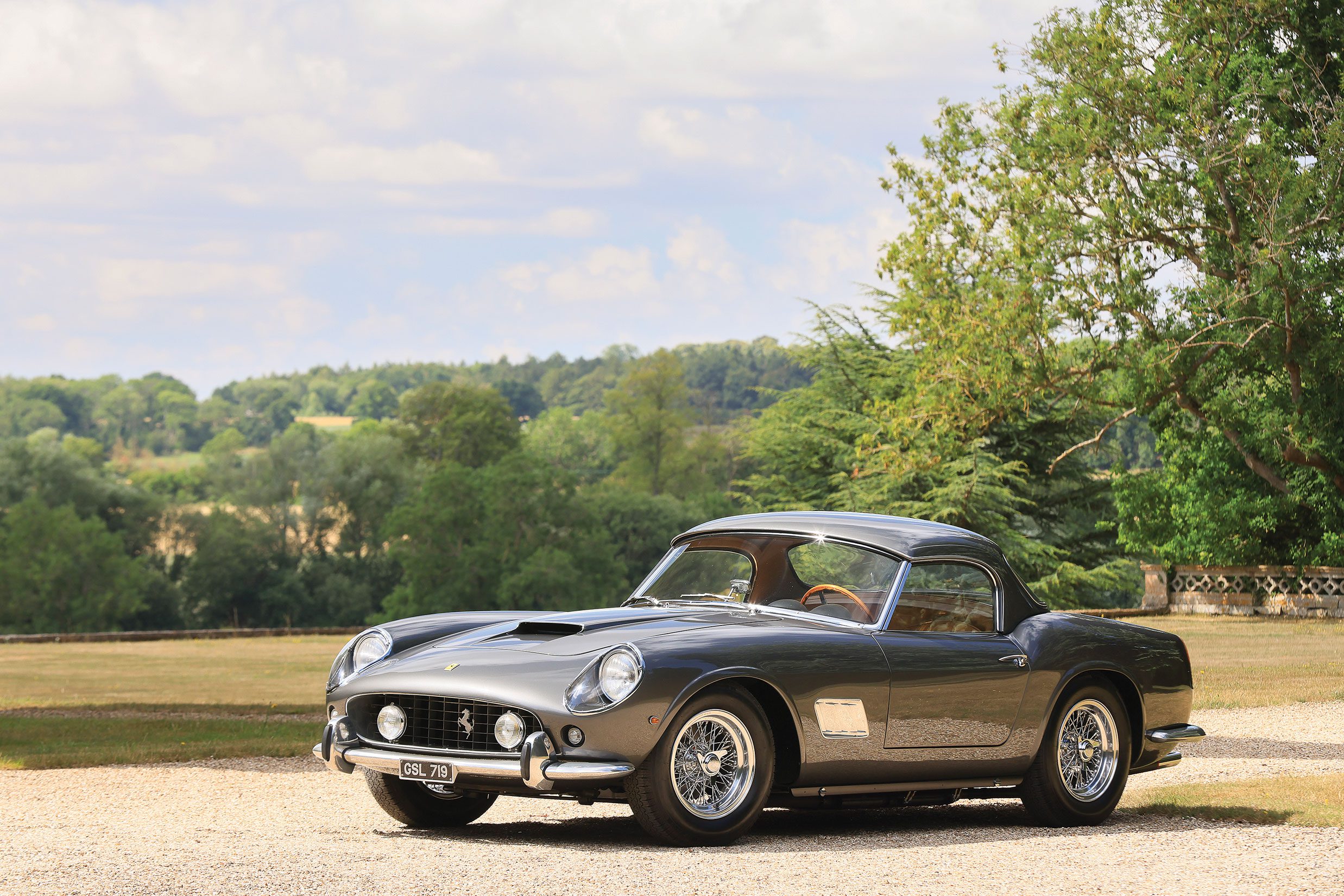
This car, Lot 26, sold for $25,305,000, including buyer’s premium, at Gooding Christie’s Pebble Beach, CA, auction, on August 15, 2025.
Ferrari’s dual-purpose 250 berlinettas — closed coupes — were produced for clients who seriously wanted to go racing. Its other GT models were designed for road use; however, clients found they could also be competitively raced in many events. The 3-liter 250 Ferraris dominated GT racing in the 1950s and ’60s. Then they became the darlings of collectors and are now among the most valuable cars on earth.
California dreamin’
California Ferrari dealer John von Neumann took note of the response Porsche got to its 356 Speedster and lobbied Luigi Chinetti, Ferrari’s U.S. distributor at the time, to get Ferrari to build a similar open-top car. Enzo Ferrari recognized the potential in the idea and agreed to develop the model. At the time, none of the three men could have had any inkling of the impact their idea would have on Ferrari’s legacy.
The new car would be called a 250 California. The name and the car were inspired by the state’s perfect weather, breathtaking scenery and beautiful people, as seen in movies. While not designed to be raced, the California was built on the 250 GT LWB Tour de France’s 2,600-mm underpinnings, making it an open-top version of the dual-purpose berlinetta. Clients quickly recognized that the berlinetta’s DNA was passed down to the California and that it could be raced, too. Ferrari responded by producing a dedicated competition model. These Competizione Californias featured a lightweight aluminum-alloy body, oversize fuel tank, hotter engine, velocity stacks, a cold-air intake box and an outside fuel filler.
The Californias evolved in parallel with the berlinettas. When Ferrari decided to produce a 2,400-mm short-wheelbase berlinetta, the California saw the same updates. While the new SWB berlinetta received a new body to go with the shorter chassis, the SWB California only received new door handles and three louvered front fender vents. Both the LWB and SWB models came in open- and covered-headlight versions, due to an Italian law banning headlight fairings. Non-Italian clients could order either style, so an open-headlight car is not necessarily an Italian-market model.
Track time
Competition versions of both the long- and short-wheelbase California were built: eight LWB versions and three SWB examples. All competition Californias have lightweight, all-alloy bodies, but not every alloy California was raced. Several non-alloy Californias also had competition success. Competition Californias could have a type 128D, 128F, 168 or 168B engine, each type having slight differences. Most competition models had outside fuel fillers, and some had ribbed gearboxes and differentials. The ribs make the cases stronger and help them cool more efficiently than standard cases.
Our subject car, 2383, was the second of three 250 GT SWB alloy Californias. It features covered headlights, a fuel filler mounted through the driver’s side of the trunk lid, a 120-liter oversize fuel tank, and a very cool aluminum removable hard top. Mechanically, it features a type 168 competition motor derived from the 250 Testa Rossa. The engine has velocity stacks, a cold-air intake box and high-lift cams. The brakes are discs, and the differential is a limited-slip unit in a ribbed case. The car was delivered new to Germany, where the owner ran it in some German hillclimbs and at least one road race. Its originality has been confirmed by a Ferrari Classiche certification.
Only two of the three 250 GT SWB Competizione California Spiders were raced. The third car, 2977, has only seen road use. Chassis 2383 competed in regional events in Germany but did not participate in any international events. Chassis 2015’s competition career only spanned one year, but it gloriously went to Le Mans, Sebring and the Bahamas Speed Week.
Cost no object
Gooding Christie’s estimated 2383 would sell for over $20,000,000. Set the dial back 10 years and that would not have seemed audacious, but in 2025, it either had chutzpah or blinders on predicting a record-breaking California Spider sale. The market for vintage Ferraris, even great ones, has been soft. The last California to sell at auction was a 250 GT Competizione example that had a spectacular fall from grace. The open-headlight LWB example, chassis 1451, had finished 5th overall at Le Mans in 1959, followed by a stellar career in SCCA events and a trip to the Bahamas Speed Week. It was purchased for $17,999,000 in late 2017 to the delight of a cheering crowd. Early this year it was resold for $9,945,000, again to a cheering crowd — most of them oblivious to the fact that they witnessed one of the biggest financial disasters in collector car history.
Amazingly, three Californias were sold by Gooding Christie’s at Pebble Beach. A non-competition SWB brought $7,550,000 post-auction, and a non-competition prototype LWB made $7,265,000. Both came in at the low end of conservative estimates. Our subject competition car, however, sold for $25,305,000, which was an all-time record sale for the auction house. It was also a record for any California Spider by almost $7,000,000, totally validating the pre-auction estimate and astonishing most everyone following the sale.
Gooding Christie’s had two things working in its favor. First, it had a unicorn. This car is one of only three examples of one of the most desirable cars on the planet. The chances of the other two cars being available in the next few years are slim. If someone wanted a competition SWB California, they won’t find another anytime soon. Secondly, the purchaser is rumored to have been a European billionaire who had recently bought a 250 GT SWB berlinetta “SEFAC Hot Rod.” This California was the open-top complement to their berlinetta, and a must-have car for a purchaser with virtually unlimited resources. Viewed in that context, the number comes into focus.