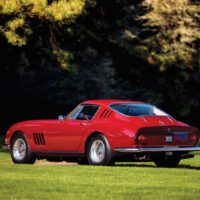
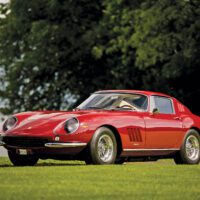
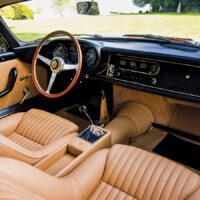
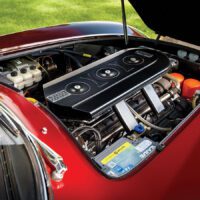
This car, Lot 135, sold for $3,595,363 (CHF 2,875,000), including buyer’s premium, at Bonhams Cars’ Chéserex, CHE, auction on June 29, 2025.
Automobile manufacturers typically rely on outside suppliers for many of the parts needed to build their cars. Ferrari sourced parts from outside suppliers such as Gilco for chassis, Weber for fueling components, Borrani for wheels and Marelli for electronics. Pininfarina and Scaglietti have been responsible for body design and manufacture. Together they have all contributed to Ferrari’s success.
Rolex, too, has historically been dependent on outside suppliers to produce its watches. The first Rolex-branded watches were produced in the early 1900s by Hans Wilsdorf in the U.K. Wilsdorf sourced movements made by the Swiss Aegler family to put in his proprietary Rolex-branded cases.
Rolex used Aegler movements through 2004, when Rolex bought out the owning family. Watch-case maker C.R. Spillmann similarly was a long-term supplier, until being bought out by Rolex in 1988. Dial manufacturer Beyeler and bracelet manufacturer Gay Frères had similar fates.
Other suppliers were brought into the Rolex family, including Boninchi SA, manufacturer of Rolex’s famous crowns and complication pushers. Boninchi was controlled by Jean-Pierre Slavic. His take from the sale reportedly made him a billionaire, supercharging his burgeoning world-class car-collecting hobby.
Slavic’s collection contains at least 60 important cars, with 24 of them being Ferraris. A bevy of Ferrari 250s includes the crown jewel, a 250 GTO. Modern Ferraris include the obligatory supercars. He also owns Ferrari-based replicas of a 250 GT California Spider, a 250 LM and a 250 GTO. Our subject 275 GTB/4, s/n 09603, was configured as a 275 GTB/4 NART Spyder replica when it joined Slavic’s collection.
Out with the old
The 275 series was Ferrari’s replacement for its legendary 250 series. Where the 250 series was based on a 12-cylinder, 3-liter engine, the 275 was based on a 275-cc-per-cylinder (3.3-liter) engine of similar “Colombo” architecture. Depending on the intended model, the 275 engine could have two camshafts per bank or four. It also could have three 2-barrel Weber carburetors or six. Depending on the configuration, output could range from a low of 260 horsepower to a high of 320. The 250-series output ranged from 200 hp in the earliest variation to 300 hp in the 250 GTO, making the 275 a considerable improvement.
The production 250 series evolved from drum brakes to discs and had a 4-speed — sometimes with overdrive — and a live rear axle. The 275 arrived with a rear-mounted transaxle and independent rear suspension, firsts for a Ferrari production car. The driving experience was as different as the specs. The 250 models feel vintage where the 275s seem nearly modern.
Variations galore
The 275 was introduced in 1964 in two distinctively different configurations. The open-top 275 GTS was somewhat demure and conservative, where the closed 275 GTB featured an extended nose and fastback rear that was tastefully stylish. Both models featured a two-cam, three-carb version of the 275 engine, with an optional six-carb setup available.
The original GTB became known as a “short nose” when aerodynamic issues necessitated the model to be modified with a new “long nose” snout. The new long- nose model saw modifications including updating the open driveshaft first to a center-bearing style, then to an enclosed torque-tube style. Again, power came from a two-cam engine with available six-carb setup.
Next came the 275 GTB/4. As the name indicates, this model had a four-camshaft engine. All 275 GTB/4s featured a six-carb engine producing 300 hp. The four-cam got some minor cosmetic upgrades and lost the wood dash in favor of a vinyl-covered one.
The GTBs were available in steel or alloy bodies. The were also a few competition specials. As a favor to American Ferrari importer Luigi Chinetti, Ferrari produced special open-top versions of the 275 GTB/4. These specials are called 275 GTB/4 NART Spiders after Chinetti’s North American Racing Team.
The NART Spiders were slow sellers, and only 10 were built. A combination of rarity and coolness has elevated the model to mega-star status, having sold for as much as $27 million. The model is so desirable that some owners had the roofs cut off their 275 GTBs to mimic the NART model. Our subject 275 GTB/4, chassis 09603, was one of the cars that was beheaded. As Slavic is not a stickler for pur sang examples, it is not surprising that 09603 found a home in his collection. He had it converted back to a coupe by Ferrari later in his ownership.
Old dog, big bucks
Today, 275 GTBs are blue-chip Ferraris. Even though Ferrari collectors are migrating from the classics to modern supercars, 275 GTBs are still in demand. Few hit the market and there is always a ready buyer when they do. Multimillion-dollar buyers are fussy, though, and any hint that a car is not investment grade usually results in a reduction in value. You would think 09603’s conversion to an open car, and then back to a coupe, would be a pretty big deterrent. Yet that did not seem to dampen bidders’ enthusiasm for the car at Bonhams Cars’ Bonmont sale.
Just a day before, Artcurial auctioned a 275 GTB at a sale in Saint Tropez, France. Artcurial’s car was a short-nose that had been converted to a long-nose and back to short-nose. The car was estimated at an optimistic $2.6m–$3m and found no takers. Perhaps the difference was the bodywork was not completed by Ferrari. Artcurial’s car also did not have Ferrari Classiche “Red Book” certification, which is becoming de rigueur for high-value Ferraris.
Bonhams did not provide a catalog estimate for 09603, but if it had, the sale result would have been on the high end of it. Ferrari 275 GTB/4s have been selling for around $3.4m for years. While $3.6m might have been a bit high, as it is said, “find another one.” It may have a wart in its provenance, but Ferrari Classiche gave it a thumbs-up, so it is hard to hold that history against it.
Slavic was fortunate to get almost all the money for his 275 GTB/4. The buyer got a known quantity, restored to turn-key, as-new condition by Ferrari, with a Red Book. If he paid a bit too much, it just does not matter.