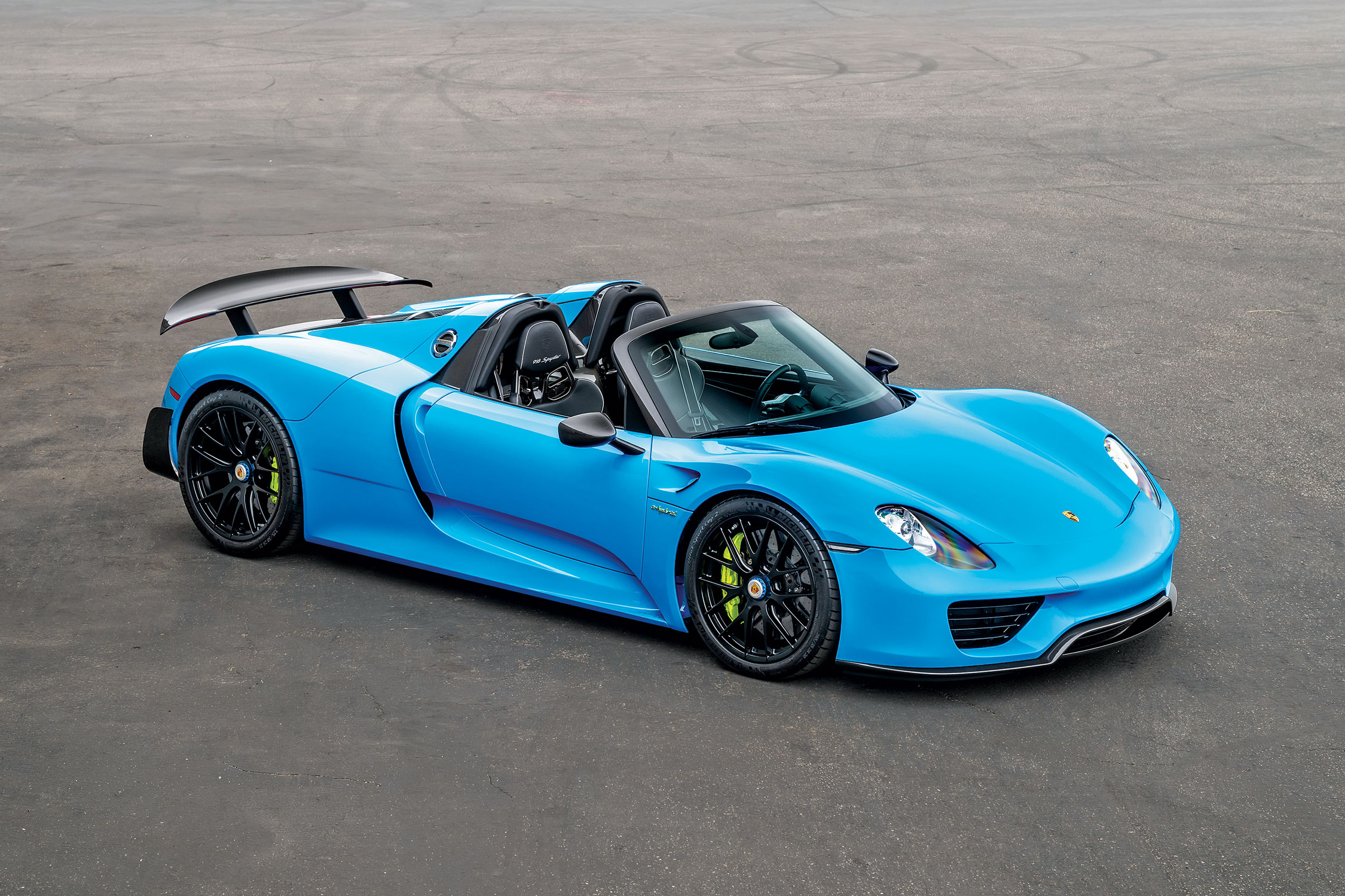
This car, Lot 256, sold for $4,680,000, including buyer’s premium, at Broad Arrow Auctions’ Costa Mesa, CA, sale on May 25, 2026.
When Millennials became players in the automobile market, prices of modern supercars took off. The old cliché that “generations collect the cars that were on their walls” still holds. Ferrari F40s, F50s, Enzos, LaFerraris, McLaren F1s and P1s, Bugatti Veyrons and Chirons have all prospered. Hybrid supercars, aka “hypercars,” are a special subset of this group that includes the Porsche 918 Spyder, the LaFerrari and the McLaren P1.
A hybrid innovator
As we Porschephiles love to point out, Professor Ferdinand Porsche (1871–1950) designed and built the first production hybrid, the Lohner-Porsche System Mixte Chaise, circa 1901. It had an under-seat gasoline engine powering either two or four hub-mounted electric motors. The car set two land-speed records. Inexpensive mass-produced internal-combustion engines (ICE) and plentiful gasoline pushed aside the hybrid concept. For a century, hybrids survived primarily in large equipment such as locomotives and tanks, more recently in trucks and buses.
Renewed interest in electric drive came with the oil embargo in 1974 and with governmental dicta on emissions. In 1997, Toyota introduced its hybrid Prius in Japan, followed by the Honda Insight. In the following decades, virtually every car manufacturer introduced hybrid models, and their popularity is undeniable.
The Ferrari
After several years exploring different concepts, Ferrari introduced its LaFerrari at the Geneva Auto Show in 2013. It was intended to be the ultimate Ferrari, thus the name. Between 2013–17, Ferrari manufactured around 710 units, including 210 Apertas (open versions) and 500 coupes. Although the numbers varied, the 6.3-liter V12 produced about 789 hp and 516 lb-ft of torque, while the electric unit added 161 hp and 148 lb-ft. That was good for 0–60 mph in 2.6 seconds and a top speed of 217 mph.
In the past five years, LaFerraris recorded 30 public sales. The highest sale before August 2025 was $5.6m, with most hovering around $4m. Since then, there have been six sales between $6.6m and $8.6m million, all coupes. The single Aperta sold this year pulled $11m at Mecum Kissimmee this past January (SCM# 6971480).
The McLaren
The 2013–15 McLaren P1 used a twin-turbo V8 of 3.8 liters that delivered 727 hp and 531 lb-ft of torque, plus an electric unit worth 177 hp and 192 lb-ft. McLaren initially made 375 units, about a third of which came to the U.S. Later small runs of special models upped that number. The P1s were good for 0–60 mph in 2.7 seconds, the quarter-mile in 9.8 seconds at 152 mph, with a top speed electronically limited to 217 mph. Special models were programmed a little more aggressively.
McLaren P1s recorded 20 public sales over the past five years, none so far in 2026. Prices were clustered between $1m–$2.1m. The six cars on the market in 2026 have had asking prices of $2.2 million to $2.8 million, with none sold.
The Porsche
Porsche introduced the 918 Spyder at the Frankfurt Auto Show in September 2013. After receiving a reported 2,000 letters of interest, the car went into production in December, with 918 units delivered throughout 2014, some as 2015 models. The cars were not as easy to sell as anticipated, so the VIP list was invented. Buy a 918 and get purchasing access to subsequent limited-production models. Porsche buyers still complain about that list.
Porsche 918s like our subject car use a V8 of 4.6 liters developed off the hugely successful RS Spyder racing engine, stroked for more displacement. It produced 599 hp and 398 lb-ft of torque. The car employed two electric motors, one on the rear axle with 154 hp and one on the front axle with 127 hp. The complete system was rated at 875 hp and 944 lb-ft. The 918 delivered a 0–60 mph time of 2.2 seconds and the quarter-mile in 9.8 seconds at 145 mph. Top speed was 215 mph.
Paint to Sell
Our subject was painted in Paint to Sample (PTS) Riviera Blue, reportedly one of three or four U.S. cars ordered in this color. That hue regularly produces sale results roughly one-third greater than standard colors across many models. The car had the desirable Weissach weight-savings package that trimmed 90 pounds off the standard car’s 3,700-pound curb weight, at a cost of $84k. This 918 had 1,267 miles and was fully up to date on all service needs. Against a pre-auction estimate of $4.5m–$5.5m, the car hammered at $4,250,000 for a final price of $4,680,000 after buyer’s premium.
Over the past five years, 918 Spyders had 42 public sales. Prior to 2023, most sold between $1.2m and $2m. Prices ticked up in 2023 and showed a wide dispersion, about $1.6m to $3.9m. In 2026, only two cars bettered that high-water mark — our blue subject car and the $6.1m PTS Pure Orange example at Mecum Kissimmee in January.
Perhaps ICE wins the day
We’ve all seen some big numbers out of auctions this year, but they were primarily ICE supercars. Please consider:
Ferrari F40s registered 60 public sales in the past five years. At the beginning, prices were in the $1.9m range — with just two over $3m, at $3.9m each. In 2026, there have been six sales between $5.1 million and $6.6 million.
Ferrari F50s saw 18 public sales over the period. Until 2026, all except one were between $3.3m and $5.6m. In 2026, there have been four sales between $8.8m and $12.2m.
Ferrari Enzos recorded 21 sales over the past five years. Before 2026, all except one were $4.4m or less. In 2026, all seven sales have been between $7.7m and $17.9m.
Writers hate to generalize, but please allow me. The internal-combustion-engined supercars are more collectible at higher rates of appreciation than the hybrid hypercars. Why? I’m not that smart, but I’d offer up fear of long-term maintenance on the complex electronic and battery systems. Plus, collectors tend to have more enthusiasm for the fire-emitting, raucous-sounding, pulsating power of ICE supercars. They are simply intoxicating.