

On September 15 of this year, I’m going to watch the taillights of a fully laden vehicle leave our condo garage, head west on SW Market Street and eventually merge onto Interstate 5 south. I know what taillights they won’t be. They won’t be the iconic rear of our Land Rover Disco II, as that rig has moved on to a new home. So has the “Happy 16th Birthday” 1982 Corvette C3 Collector Edition. I won’t be hearing the raucous, almost-playful exhaust note of the 1975 Porsche 911S Sportomatic, either. It’s currently under refurbishment in preparation for leaving the collection. Nor […]
On September 15 of this year, I’m going to watch the taillights of a fully laden vehicle leave our condo garage, head west on SW Market Street and eventually merge onto Interstate 5 south.
I know what taillights they won’t be.
They won’t be the iconic rear of our Land Rover Disco II, as that rig has moved on to a new home. So has the “Happy 16th Birthday” 1982 Corvette C3 Collector Edition. I won’t be hearing the raucous, almost-playful exhaust note of the 1975 Porsche 911S Sportomatic, either. It’s currently under refurbishment in preparation for leaving the collection.
Nor will I be looking at the “three-body trunk” of the 1971 Mercedes-Benz 250C. That was my son Bradley’s favorite car, as he could pile four friends in it, head to the beach and park it anywhere. No worries about somebody backing into its nose, as might happen with our Jag E-type or Alfa Spider. Nonetheless, once we had learned all the Mercedes had to teach us, it was time for it to move on as well.
This fall it will be Bradley that’s moving on, headed off to Lane Community College in Eugene, OR. He is enrolled in the “DuckLane” program that will allow him to transfer to the University of Oregon.
From Alfas to Volvos
It’s only been 16 months since he got his license, and what a cornucopia of vehicles he’s had to choose from. When I was his age, I had barely left behind my $30 Bugeye Sprite and was touching up the rattle-can silver paint job of my $250 MGA with another rattle can of almost the same shade.
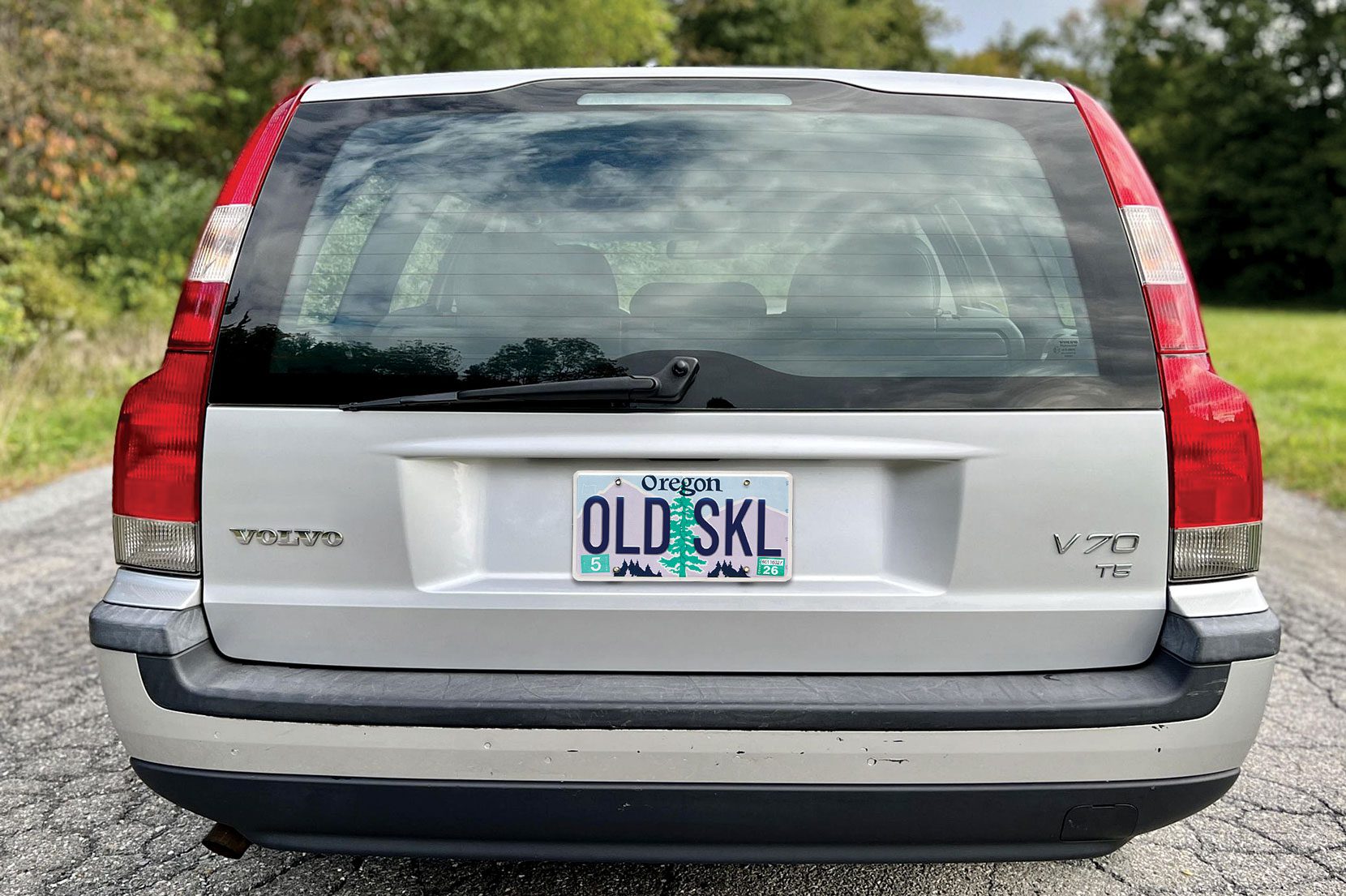
Through a variety of fortunate circumstances, Bradley has now ended up owning the Volvo V70 T5 that formerly belonged to SCM Editor-In-Chief Jeff Sabatini. My fluency in Volvos extends only through 544s, 1800s and 122s, so Bradley is totally on his own here. In bright red paint with its 16-inch Perfo wheels, the P80-platform Volvo has served Jeff well for the past 3,000 miles. It’s an automatic wagon, and at just over 230k miles, it’s barely broken in. It’s not perfect, but it’s the perfect college car for a college kid.
It’s right for RADwood, Wagonfest and whatever other Gen-Z car events Bradley discovers. The price — in the low four-figure range — was within his budget as well. The only other of our SCM cars he was interested in was the Lotus Elise, which seemed a bit impractical.
While I am proud that he has launched into this next phase of his life, nonetheless this marks the first time I have ever been an empty-nester.
What happens next?
Now I will have one less driver to help me exercise our cars. Admittedly, the fleet has been growing thinner, with just the 1971 Jaguar E-type Series III V12 coupe, the 2006 Lotus Elise and a pair of Alfas — the 1965 Giulia Spider Veloce and 1991 S4 Spider — left to keep trickle-charged and happy.
It will be years before Bradley is ready to be owned by a collector car. As his responsibilities pile up, his time will become more precious as well.
Golden era
We may look back at this as the Golden Era for classic cars. Our children in the next 20 years will be living in a vastly different world. Even setting aside the impact of the EV revolution, another looming question is where they will manage to park their cars.
In an attempt to push people toward using mass transit, most apartment buildings here in Portland no longer have on-site parking. If we didn’t have the underground garage here at my condo, that would be another 100 cars that would be looking for spaces on the street every night. Further, building codes across Oregon are being revised to eliminate any requirement of space set-asides for parking in front of houses.
Leaving a 50-year-old Jaguar parked at the curb is not a very appealing thought, even in a nice residential neighborhood. Parking is one of the reasons there are so many commercial collector car garages being built, but they are often neither inexpensive nor close to home.
Collector cars and our desire to have and use them are not going to disappear. Just as horse shows and rodeos still exist, classic-car clubs and tours will continue to provide opportunities to use and enjoy our vintage rides.
The fueling infrastructure, highways and low-cost of gas compared with Europe and most other countries makes it easy for us to own and use our internal-combustion-powered classic cars.
I can’t predict what our lives with collector cars will be over the next decades. But it will be different.
I am sure we will become even more creative in finding ways to get behind the wheel and get back on the road. And appreciate even more the times we use our old cars as way to bring our family and friends together to join us.