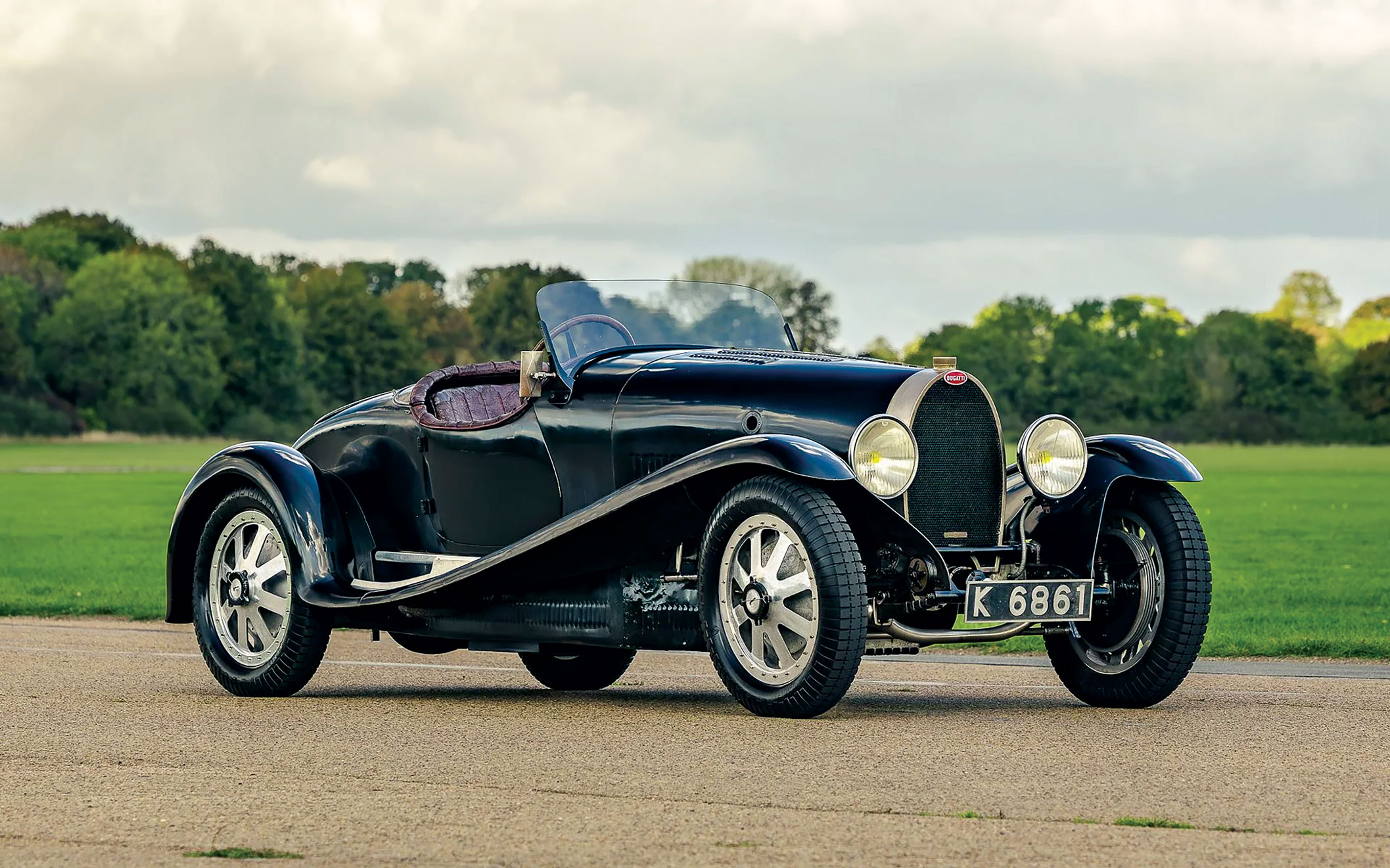
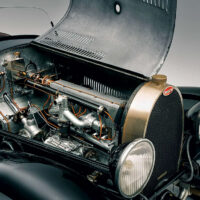
This car, Lot 243, sold for $1,171,521 (€1,007,500), including buyer’s premium, at Broad Arrow Auctions’ Cernobbio, ITA, sale, on May 17, 2026.
To understand the Bugatti Type 43, we need to go back in time a few years. In 1924, Bugatti released the Type 35 grand prix car with a 2-liter 8-cylinder inline engine, with a single overhead cam. Nothing particularly unusual at the time, but it quickly morphed into a supercharged 2.3-liter that dominated grand-prix racing for five years. And in the racing world, then as now, that is a long time. The T35 was small, efficient and beautiful. But it offered no creature comforts, and could only seat two people if they were good friends. There was a road version sans supercharger and with cycle fenders, but still without doors and no more comfort.
For road and race
So, a couple of years later, Bugatti started building the T43 with two different types of client in mind. Firstly, the gentleman driver who wanted a modicum of comfort, and secondly a car to use in sports-car races, where regulations stipulated four seats and a soft top. And, of course, this appealed to weekend racers who wanted to drive to the race in the morning and back home in the evening.
The T43 was substantially longer than the T35, with a wheelbase of 117 inches, as opposed to the T35 at 94 inches. The track remained about the same. The factory-bodied car sported a pointed tail and was described as a 3.5-seater — space for rear passengers was limited. The body was wider, allowing more interior space, but there was only one door, on the passenger’s side. Once again, interior comfort was basic.
But the car used the 2.3-liter supercharged T35B engine, with a slightly lower compression ratio to allow it to run on pump fuel, and the addition of a starter motor. Bugatti claimed that it was the “fastest sports car in world,” and despite its relatively small displacement, it conceivably was.
But that wasn’t the end of the story. The T43 was efficient but very simple. Toward the end of the production run, Bugatti produced a few cars with the T43A appellation. And these were different beasts, having the same chassis and engine, but with a different clientele in mind. Strictly two seats with more luxury, a new elegant body, a trunk that could take a decent weekend bag, and even a transversal slot for golf clubs. These rare “roadsters” are now on nearly every serious Bugatti collector’s shortlist and are highly desirable. Which leads us to our subject car.
New body, new engine
Bugatti T43 number 43248 was delivered new as a rolling chassis to Belgium in early 1929. It is not known who made its first body, but in 1931 or 1932, the car was rebodied by an obscure coachbuilder in Brussels named Eugene Matthys. The result, loosely based on the factory roadster, was a true delight. The lines are perfect, and the ruby red leather interior, which still survives today, is simply lovely.
The first owner kept the car until the mid-’30s, and then no news until it turned up in 1948, fairly close to its original owner. It had lost its wonderful Bugatti engine and was running a Chevrolet 6-cylinder. The T43 engine was effectively a race-car engine, with a roller-bearing crank. Rebuilding one needs specialist knowledge and parts, so at a time when repairing such an engine would probably cost more than the car was worth, the swap was logical.
Chassis 43248 then passed through various owners until 1981, when it ended up with Fuad Mazub in England. Mazub sourced an original T43 engine from the renowned Bugatti collector and historian Hugh Conway. Mazub had a number of important classic cars, and the family kept them after his death in 1992.
A diminished market
Broad Arrow sold this car for just under $1.2m, against a $1.7m–$2.9m pre-sale estimate, at its annual auction connected to the Villa d’Este Concorso d’Eleganza on Lake Como, north of Milan. The main concours event is held on the Saturday, but it is extremely difficult to get tickets, as this has effectively become a BMW corporate event. On the Sunday, the show moves down the road to the Villa d’Erba, which is open to the public. And this is where Broad Arrow holds its sale.
The event featured a fine array of post-war and contemporary cars, and a just handful of pre-war examples. The generational shift away from pre-war cars in the past few years has seen a dramatic decline in values. Traditional owners are generally too old to be purchasing another car, and their children are not interested. Buyers of classic Bugattis generally want to inspect the car themselves, but the pool of potential buyers is smaller and they’re not going to go out of their way. This often translates into values being half of what they were as little as five years ago.
This car is simply gorgeous by any standard, and had the body been made by the Bugatti factory or a well-known coachbuilder such as Figoni, it would be worth considerably more. The mismatched engine will have had some negative effect on the value, but probably not considerable to a Bugatti enthusiast. The car will be more than welcome at all the best events. In today’s market this sale price was about on the money, even if the buyer, an established dealer, will likely remarket the car seeking a fair profit.