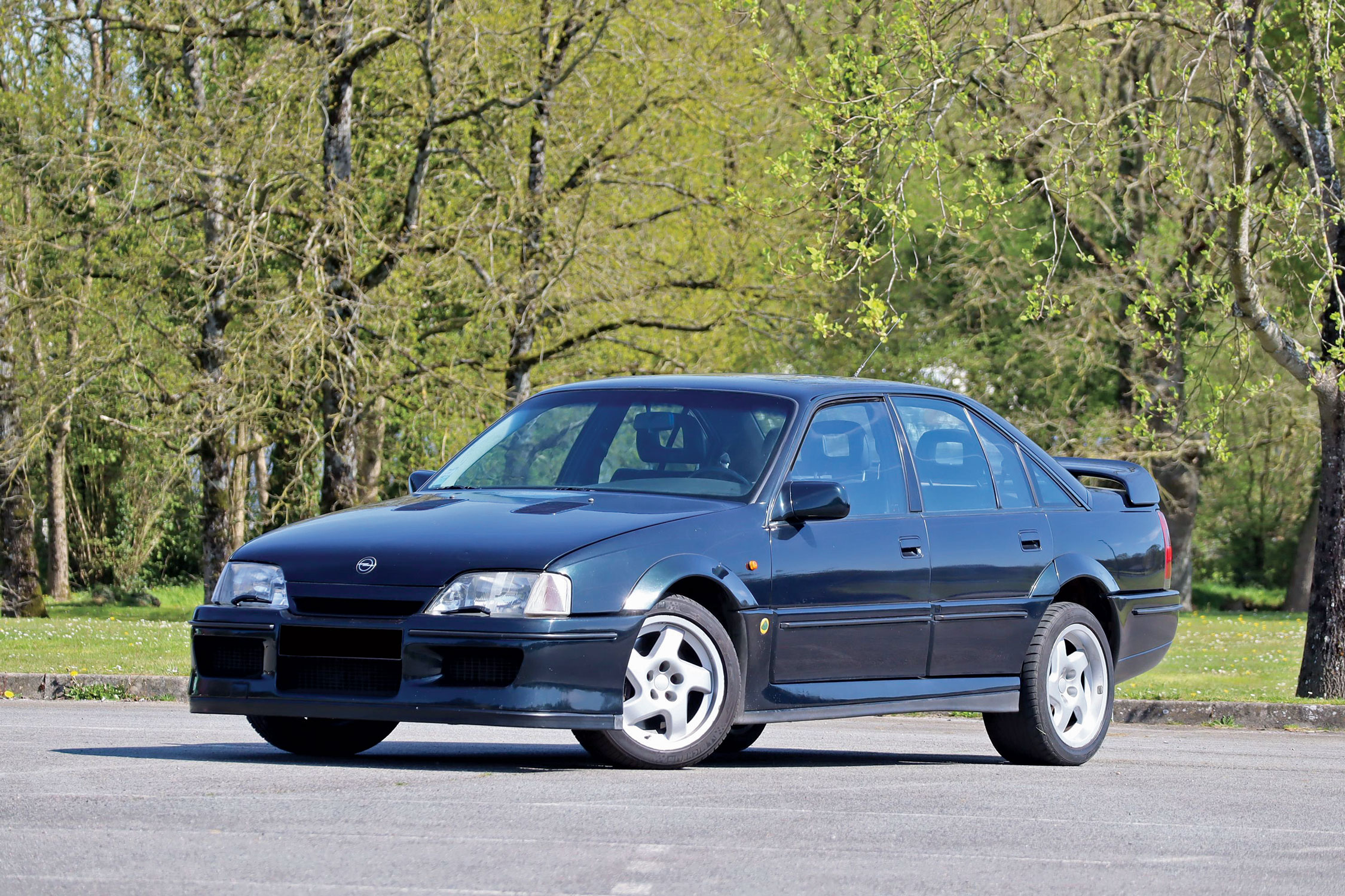
This car, Lot 130, sold for $67,968 (€59,600), including buyer’s premium, in Artcurial’s online sale on July 8, 2026.
What made the brand-shared Lotus Omega (or, as we knew it in the U.K., Lotus Carlton) notorious back in the day was the absence of a speed limiter. This caused a tabloidesque storm of controversy when it was realized that this 4-door sedan could touch 175 mph, putting it in exotic-supercar territory. The other German manufacturers — BMW, Mercedes and Porsche — by and large followed a “gentlemen’s agreement” to limit their super-saloons’ top speeds to 250 km/h, or 155 mph.
But this was British! Or British engineered by Lotus, at least, which gave it the designation Type 104. Even if most of them had Opel badging. Today, 376 hp doesn’t sound a right lot, but it was back then, especially in a 4-door sedan, So was 419 lb-ft at a rather high 4,200 rpm (and it did help that top speed). If you could find a stretch of road long enough, it was good for an officially timed 176 mph, with 60 mph coming up in 5.1 seconds. By comparison, the Mercedes-Benz E500/500E offered 322 hp (and was speed-limited by gearing rather than electronics), and the AMG Hammer yielded 355 horses from 5.6 liters.
Unfortunately, that desirability, along with Vauxhall door locks, made it one of the most-stolen cars, after the Sierra Cosworth, which attracts a similar type of following. My boss at the time had one nicked from under his window in a hotel car park. “As I had arrived with zero fuel in the tank, the burglars were caught whilst filling up. The damage was only to the door lock, ignition and one set of completely rooted tires. But I did get a full tank of petrol.”
“It was a monster,” he fondly remembers. “[An indicated] 180 mph came up surprisingly quickly in fifth. Sixth was more long-legged.”
GM flaunts its muscle
Opel and Vauxhall were both part of General Motors and already had a merely “quick” version of the shared Omega/Carlton sedan, the 3000 GSi 24v, which produced a bit over 200 hp and was good for 145 mph. With its Type 104, Lotus, also under GM control at this time, essentially did what it had done in 1965 with the Ford-derived Lotus Cortina to make a hot sedan, though the Omega was never designed to win races.
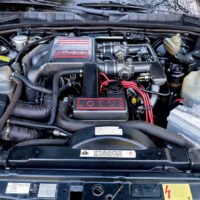
Taking the 3-liter inline-6 from the GSi, Lotus enlarged it to 3,615 cc using a long-throw crank, the block reinforced with extra webbing, then added two Garrett T25 turbochargers, which provide up to 10 psi of boost from about 2,500 rpm. The original distributor ignition was replaced with a three-coil system, and the distributor drive was repurposed to run the pump for the water-air intercooler circuit.
Borrowing from elsewhere within GM, the 6-speed ZF S6-40 manual transmission was the same as the one fitted to the C4 Corvette ZR-1, and the Servotronic power steering, in which assistance decreases with speed, was borrowed from the Opel Senator. Lotus’ engineers would have liked rack-and-pinion, but cost and space constraints limited them to the worm-and-roller arrangement.
Badged either as Opel Lotus Omega (most of them) or Vauxhall Lotus Carlton depending on market, 950 were built, of which 666 were left-hand drive, like this one. Only one color was available: Imperial Green.
Of those, only 59 were officially imported into France. This, number 658, has had just one owner and has done 133,316 km, or 82,655 miles, from new. The catalog alluded to a decent service history but didn’t picture any of it.
Not without needs
As this was an online sale, I didn’t personally see our subject car, but from photographs it looks in original order, though presented dusty and scratched, and the catalog admitting to wear and tear commensurate with its age and mileage. Rather tellingly, a spare front bumper is included — I might have kept quiet about that, as even the replacement is scratched on the lower lip, as are the side skirts. There are a few rust spots in the front door shuts. Rust in the rear wheelarch area can be fatal for these, but they looked fine here. All four wheels are lightly curb-rashed, wearing ancient and mismatched tires — Michelin Pilot Sport front dated 2013, Falkens rear dated 2007 with lumpy sidewalls. At least they are ZR+Y rated, indicating they are safe above 300 km/h — when they were new, anyway.
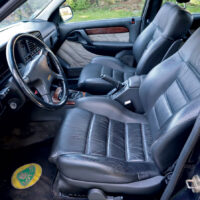
The seats feature obvious creasing as the dark-gray leather was ruched from new, in that early ’90s style, and display the usual wear to the driver-side outer bolsters. Lotus-badged mats have saved the original carpets, and the steering wheel is rather shiny, but all dash plastics are good.
In short, this looked like a car that had been used as a regular driver at moderate speeds, with no special treatment, confirming the catalog description, and it still had its books, tools and jack, as well as unused space-saver spare. There was no specific information about the service history: These typically need timing chains at 65,000 miles (100,000 km), with no indication this had been done.
A strong sale
Overlapping with Artcurial’s less-than-stellar live Le Mans sale, this Omega was offered at no reserve. The winning bid equaled the high estimate of €50k, leading to a price roughly equal to a decent Mercedes E500/500E. That’s rather more than its ’60s equivalent, a really nice Jaguar Mk 2 3.8 with overdrive (Artcurial’s published prices include VAT on the premium, where most auction houses’ don’t).
Single ownership and largely unmolested condition is helping here, along perhaps with the realization that, with speed unrestricted, this rather forgotten model is a rare and unrepeatable unicorn. Compared with previous prices and given that it needs, at the very least, a new set of tires (and likely timing chains too), this was well sold.