
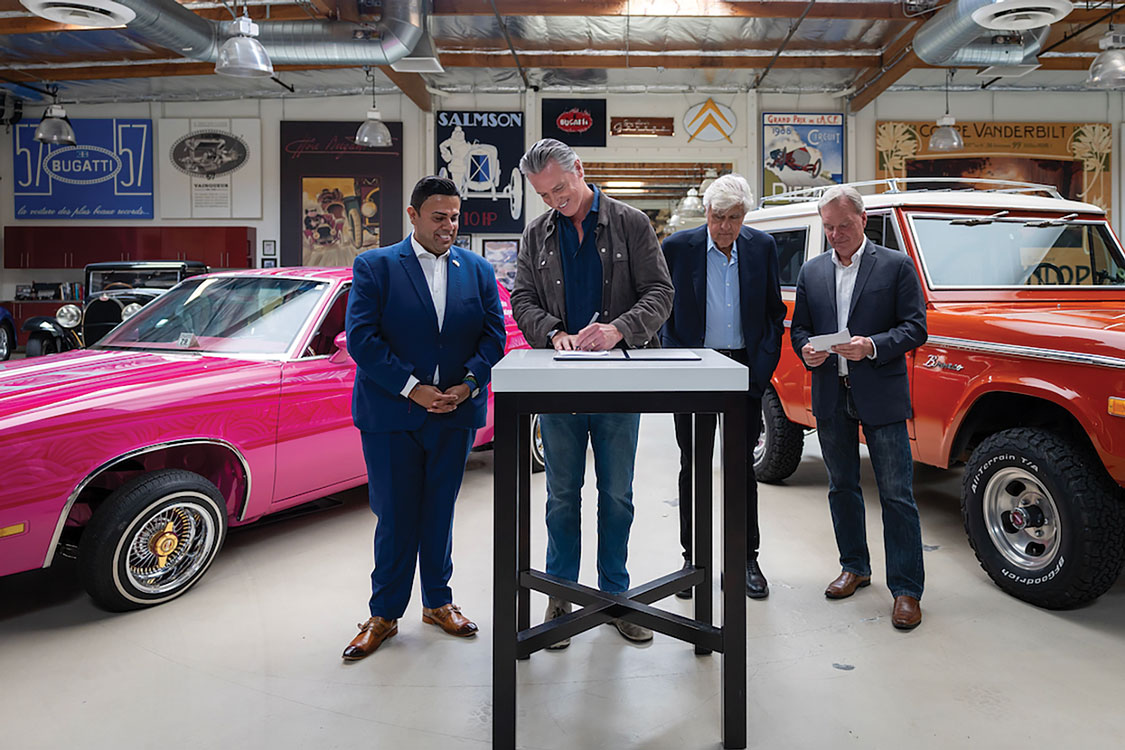

California Governor Gavin Newsom signs Leno’s Law at Jay Leno’s garage in Burbank Leno’s Law brings emissions-rules relief to California collectors “Jay Leno’s Law” passed the California state legislature and was signed into law by Governor Gavin Newsom in September, providing some measure of regulatory relief for collector car owners in California. After failing in committee last year, the bill succeeded in this year’s session after fierce advocacy from the celebrity entertainer and car collector, along with the Specialty Equipment Market Association (SEMA). CA SB1392 will loosen emissions regulations on 1977–86 model-year collector cars. While there will be requirements and restrictions, […]
California Governor Gavin Newsom signs Leno’s Law at Jay Leno’s garage in Burbank
Leno’s Law brings emissions-rules relief to California collectors
“Jay Leno’s Law” passed the California state legislature and was signed into law by Governor Gavin Newsom in September, providing some measure of regulatory relief for collector car owners in California. After failing in committee last year, the bill succeeded in this year’s session after fierce advocacy from the celebrity entertainer and car collector, along with the Specialty Equipment Market Association (SEMA). CA SB1392 will loosen emissions regulations on 1977–86 model-year collector cars. While there will be requirements and restrictions, and a gradual roll-out for the changes, this is a major step forward for enthusiasts in the Golden State.
California culture
California has long been at the front of post-war car culture in America, shaping trends that have influenced the automotive scene throughout America and beyond. The state is an incubator for car customizers such as Gene Winfield and George Barris, designers like SCM Contributor Robert Cumberford, and hot-rodders and racers, such as Vic Edelbrock and America’s first Formula 1 World Champion, Phil Hill.
The first NHRA-sanctioned drag race was held at a newly paved parking lot in Pomona in 1953, a location now better known as the In-N-Out Burger Pomona Dragstrip, the longest continuously operating dragstrip in the country. While SCCA racing got its start on the East Coast, Californians were quick to pile on, racing at various Air Force bases and stadium parking lots, as well as along the twisty roads of Pebble Beach. Historic tracks such as Willow Springs and what is known today as WeatherTech Raceway Laguna Seca were constructed. Texan racer Carroll Shelby built his eponymous Cobras adjacent to Los Angeles International Airport, and popular automotive magazines Motor Trend, Hot Rod and Road & Track were all founded in California.
So, it has been troubling that over the past 20 years some cars have been difficult to own and enjoy in this automotive mecca. A little background: Until 2005, California exempted motor vehicles, collector cars or not, from emissions testing when they reached 30 years old by model year. This “rolling” exemption meant that by 2005, vehicles from model years 1975 and older were no longer subject to biennial emissions tests as a requirement for registration. However, in September of that year, then-Governor Arnold Schwarzenegger signed a slew of environmental bills into law, including one that repealed this rolling emissions exemption. In doing so, exemptions were then frozen at the 1975 model year. Any newer vehicles would still have to pass emissions tests, in perpetuity.
Years of malaise
While the goal of reducing emissions pollution is admirable, many automotive enthusiasts felt they were scapegoated. After all, how many 30-year-old cars were on the road at any given time, especially in a daily-driver capacity? How much pollution were they really responsible for? Everyone wants clean air, but many felt the legislation was clumsily aimed at the wrong target.
Especially frustrating was the timing of the repeal. The EPA began to crack down hard on vehicle emissions in the mid-1970s, resulting in slapdash engineering solutions that were archaic and backwards. Catalytic converters were required in some states but not others, and most automakers took the easiest solutions available to reduce tailpipe emissions. That meant strangling engines with low-compression pistons, mild-lift cams and smaller carburetors. As we all know, the result was less power — so much so that, for example, in 1978, the standard Chevrolet Corvette produced just 175 horsepower from its 5.7-L V8. European cars sold in the U.S. weren’t exempt, meaning their home-market counterparts were nearly always more powerful. Ever wonder why some collectors prefer Euro-spec cars from this period? That’s a major reason.
Additionally, components such as injection pumps crammed fresh air into exhaust manifolds to burn more hydrocarbons, charcoal canisters were added to contain vapors, and a maze of valves, vacuum lines and solenoids attempted to make engines burn fuel more efficiently. These often led to poor running characteristics, decreased reliability from hastily construed engineering, and more complex and expensive repair processes. The “Malaise Era,” as it has come to be known, was truly upon us. Requring these cars, mostly used as weekend toys, to continue to pass smog tests at 30-plus years old put a damper on ownership.
A path forward
Leno’s Law starts to give California collector car owners some relief. Essentially, Section 44011 of California’s Health and Safety code, which specifically relates to vehicle emissions testing, has been amended to immediately exempt “collector motor vehicles” manufactured before the 1981 model year from biennial emissions inspection and testing, provided that they comply with emissions standards for their class and model year. (This means cars like a Euro-spec Ferrari 308 or Porsche 911 SC, produced without federal emission controls, are ineligible.) They still must pass a functional-fuel-cap inspection and a visual inspection for fuel leaks. These conditions should be fairly easy to meet for any well-maintained collector car.
The bill defines a “collector motor vehicle” as one which is not just 35 years old, but also “is used primarily in shows, parades, charitable functions and historical exhibitions for display, maintenance and preservation, and is not used as the owner’s primary mode of transportation.” The vehicle must also either be specifically insured with a collector car policy, or “determined, through a process developed by the department, to be driven fewer than 1,000 miles per calendar year.”
Additionally, starting on January 1, 2028, collector vehicles at least 35 years old are exempted in a rolling fashion, annually, until the year 2032, when 1986 model-year vehicles qualify. No ongoing exemptions beyond 2032 are currently included in the bill, though proponents are optimistic that this can be regarded as a trial period of sorts, with further amendments to follow.
This is an excellent start toward making collector car ownership more practical, especially as Next Gen cars from the 1980s are rising in popularity. It provides a path forward for the most needy of these vehicles, those from the mid-1970s through early 1980s with antiquated emissions systems. And it shows that lawmakers are recognizing the importance of California’s significant contribution to car culture.
Leave a Reply